Key takeaways
- •Mindfulness is attention on purpose — any everyday activity can become practice.
- •Micro-moments of ten to sixty seconds build the skill faster than rare long sessions.
- •Anchor practice to existing routines: meals, walks, queues, and transitions.
- •Befriend wandering attention; noticing distraction is the practice, not the failure.
What Mindfulness Actually Means for a Beginner
Mindfulness is paying attention to the present moment on purpose, without judging what you find. That is the entire definition, and it is smaller than it sounds. You are mindful every time you fully taste a sip of coffee instead of drinking it on autopilot, every time you notice irritation rising before you speak, every time you feel rain on your skin instead of merely hurrying through it. The skill is not achieving some special state — it is noticing the state you are already in.
Beginners often believe mindfulness requires emptying the mind or sitting perfectly still, and both myths stop people before they start. In truth, the wandering mind is the training ground. Each time you notice you have drifted into planning or replaying and return to what is happening now, you complete one repetition of the core exercise. A day with fifty small notices is a day of serious training, even if you never sat on a cushion once.
Start with Your Senses: Tips 1 to 5
The senses are the beginner's best doorway because they only ever operate in the present. You cannot smell yesterday or taste tomorrow. These first five tips require zero extra time in your day.
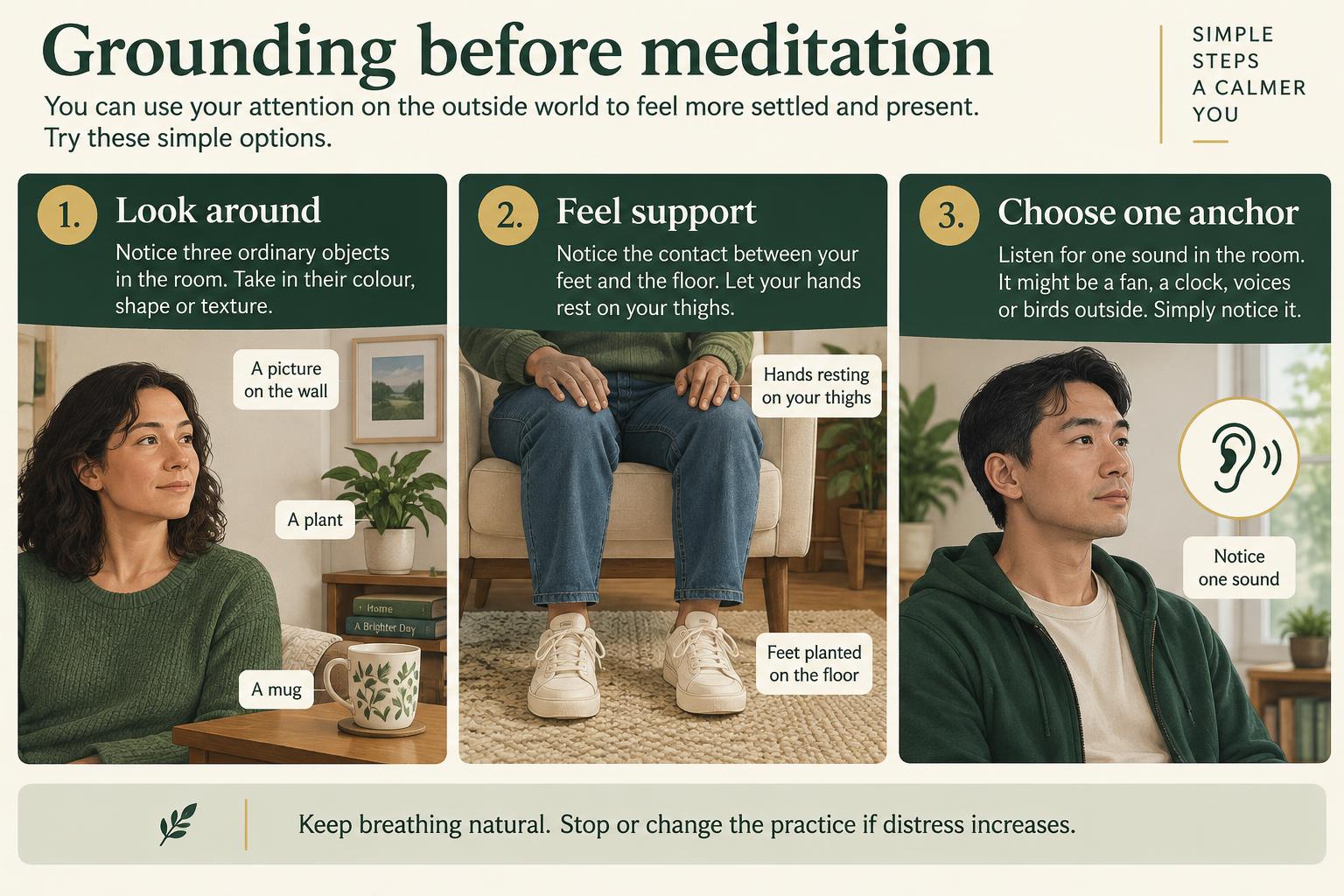
Tip one: mindful first bites. Give the first three bites of each meal your complete attention — texture, temperature, flavor — before returning to conversation or your screen. Tip two: the doorway pause. Each time you walk through a doorway, feel one full breath. Dozens of doorways a day become dozens of practice reps. Tip three: hands in water. Whenever you wash your hands or dishes, feel the temperature and slipperiness of the water for five seconds. Tip four: sound showers. Once a day, close your eyes for thirty seconds and simply receive every sound around you without labeling or judging. Tip five: the feet check-in. Several times a day, drop attention into the soles of your feet and feel the contact with the ground. It is discreet, instant, and remarkably stabilizing.
Recommended listening
The 5 Minute Meditation Paradise
by Stephens Hyang · narrated by Robert Gazy · 6 hrs and 1 min
The Ultimate "How to Meditate Guide" to Help You Increase Mindfulness and Reduce Anxiety Through Meditation, Guided Meditation, Chakra, and Zen Music
Weave Mindfulness into Routines: Tips 6 to 10
Once sensory pauses feel natural, graduate to mindful versions of daily routines. Tip six: the mindful morning minute. Before touching your phone, sit on the edge of the bed and take ten unhurried breaths. Starting the day on your own terms changes its entire flavor. Tip seven: mindful walking. On any walk — to the car, the shop, the mailbox — synchronize attention with your steps for one block. Feel lifting, moving, placing. Tip eight: one mindful chore. Pick a daily chore, folding laundry or sweeping, and do it in silence with full attention on the movements.
Tip nine: the queue conversion. Every queue, delay, or red light is free practice time; instead of reaching for the phone, feel three breaths and look around with curiosity. Tip ten: transition breaths. Before starting a new activity — opening email, entering a meeting, walking into your home — take three deliberate breaths to arrive fully. These transitions are where autopilot is strongest, which makes them the highest-value places to insert awareness. Within two weeks, most beginners report these micro-habits running themselves.
Mindful Listening and Speaking: Tips 11 and 12
Conversations are advanced mindfulness training disguised as ordinary life. Tip eleven: listen to understand, not to reply. In one conversation each day, give the other person total attention. Notice the urge to plan your response while they are still speaking, and let it go, returning again and again to their words, tone, and face. People can feel the difference, and so can you — genuine listening is one of the most immediately rewarding mindfulness practices available.
Tip twelve: the pause before speaking. When emotions rise — irritation, defensiveness, excitement — insert one breath before you respond. That single breath creates a gap between stimulus and response, and in that gap lives every wiser choice you have ever wanted to make. Do not aim for perfect equanimity; aim for one breath. Over months, this tiny habit quietly rewires relationships, because most regretted words are spoken in the half-second this practice reclaims.
Add Tiny Formal Practice: Tips 13 and 14
Informal moments build the skill, but a small formal practice accelerates everything. Tip thirteen: the three-minute sit. Once a day, sit anywhere, set a timer for three minutes, and rest attention on your breathing. When the mind wanders, notice and return. Three minutes is short enough that resistance never bothers arguing, yet long enough to practice the full loop of settling, wandering, and returning.
Tip fourteen: guided audio on busy days. When your mind is too loud for silence, let a narrator carry the structure. Short guided sessions — such as the five-minute mindfulness and zen music practices in The 5 Minute Meditation Paradise by Stephens Hyang — fit into a lunch break or the gap before bed, and beginners consistently find a calm voice easier to follow than a silent timer. Many people use guided audio for the first month, then mix in silent sits as confidence grows. There is no purity test here; five guided minutes count just as much as five silent ones.
Make It Stick: Tip 15 and the Beginner's Mindset
Tip fifteen: track moments, not minutes. Keep a simple daily note — a check mark, a line in a journal — for each day you practiced any of these tips, even once. The visible record exploits the brain's love of streaks and quietly builds the identity that sustains long-term practice: I am someone who pays attention. Research on habit formation confirms that small tracked behaviors compound into automatic routines within about two months.
Above all, adopt the beginner's mindset as a permanent feature, not a phase. Mindfulness teachers with forty years of practice still describe themselves as beginners, because every moment is genuinely new when you actually attend to it. Judge your practice by one question only: did I notice, at least once today, that I was somewhere else — and did I come back kindly? If yes, you practiced mindfulness correctly. Everything else, from cushions to apps to retreats, is decoration on that simple, radical act of returning.
| Tip | When | Time needed | Skill it builds |
|---|---|---|---|
| Mindful first bites | Every meal | 30 seconds | Sensory attention |
| Doorway pause | Any doorway | One breath | Transition awareness |
| Hands in water | Washing up | 5 seconds | Body awareness |
| Sound shower | Once daily | 30 seconds | Open listening |
| Feet check-in | Anytime | 10 seconds | Grounding |
| Morning minute | On waking | 1 minute | Intention setting |
| Mindful walking | Daily walks | 1-5 minutes | Movement awareness |
| Queue conversion | Any wait | 1-3 minutes | Patience |
| Deep listening | One conversation | One conversation | Presence with others |
| Three-minute sit | Daily | 3 minutes | Formal meditation |
Begin with One Everyday Activity, Not Your Entire Day
For a beginner, the instruction to be mindful all day can feel impossibly vague. Choose one activity with a clear beginning and end instead. Washing a mug is a good example: feel the temperature of the water, notice the shape of the handle, and watch the movement of your hands. When your mind moves to the next task, recognize that shift and return to the activity already happening. You do not need to wash unusually slowly or turn the kitchen into a retreat. One ordinary action becomes a practice because you attend to it intentionally. Begin with a minute or two, then let the rest of the day proceed normally.
Eating offers another simple experiment, provided it does not encourage uncomfortable monitoring or conflict with existing care around food. Notice the appearance and aroma of the first bite, then its texture as you chew. Put down the phone for that brief interval. You are not evaluating calories, judging your appetite, or trying to eat perfectly. You are becoming aware of an experience that often happens automatically. After a few bites, return to whatever arrangement is comfortable and appropriate for you. Mindfulness is an option for bringing attention to a meal, not a rule that every meal must be slow, silent, or free from conversation.
For someone whose day is dominated by screens, try a transition practice. Before opening a new tab, notice your hand on the mouse and ask what you intended to do. That question can expose the difference between searching for information and clicking reflexively to avoid a difficult task. Then make a choice: continue, close the tab, or take a short break. The exercise does not require you to eliminate distraction forever. Its value lies in recognizing one moment of automatic behavior. A beginner who notices that moment once has already practiced awareness in a setting where it may be genuinely useful.
Use Simple Language When You Notice a Thought
A common beginner mistake is turning mindfulness into an argument with the mind. A worried thought appears, and you respond with a lecture about why you should not worry. That creates more thinking rather than more awareness. Try a shorter description: planning, remembering, comparing, or worrying. Say it silently once, then return to the chosen sensation or activity. The label is not a diagnosis and does not need to capture the thought perfectly. Its purpose is to help you recognize that a mental event has appeared. You can notice an urgent thought without immediately treating it as an instruction that must be followed.
Some thoughts do require action. Mindfulness does not mean ignoring a real deadline, a safety issue, or a conversation that needs attention. If an important task appears during practice, write a brief reminder and return when appropriate. Later, address it deliberately. This distinction keeps awareness from becoming avoidance. You are learning when to engage with a thought, not pretending that responsibilities disappear. For beginners, it can help to keep a small notepad nearby so that the mind does not feel it must rehearse an item repeatedly in order to remember it. Once recorded, the item has a place outside the session.
Apply the same simple approach to emotion. Instead of I am terrible at this, try frustration is here. Then notice what is directly observable: tightness in the forehead, pressure in the hands, or an urge to stand up. You do not have to investigate every feeling. Sometimes the most helpful response is to open your eyes, move, or end the practice. Awareness creates options; it does not require endless inward inspection. If labeling feels artificial, omit it and simply return to hearing or touch. Beginner mindfulness tips should reduce unnecessary effort, not introduce a new vocabulary that you must use correctly to qualify.
A Seven-Day Beginner Experiment with Mindfulness
On the first day, practice noticing your feet while seated for one minute. On the second, listen to the room without naming every sound. On the third, attend to washing a mug. On the fourth, notice the first few steps of a safe walk. On the fifth, pause before opening a familiar app. On the sixth, try a short guided passage, perhaps a sample from The 5 Minute Meditation Paradise if the narration suits you. On the seventh, repeat whichever activity was easiest to approach. This is a sampler, not a requirement to master seven skills. Each experiment introduces attention in a different ordinary setting.
After each attempt, record one sentence about the process. I remembered while washing the cup is more informative than good session. I noticed that listening was easier than watching my breath is a useful preference. Keep the note factual and brief so that reflection does not become another opportunity for self-criticism. You may discover that formal sitting is helpful, or that everyday activities provide the most comfortable entry point. Either is a reasonable beginning. There is no need to extend every exercise as soon as it becomes familiar. A small practice can remain small while you learn to recognize the same skill elsewhere.
At the end of the week, choose one cue to keep. Attach it to something that already occurs, such as waiting for the kettle or putting on your shoes. If you forget, resume at the next opportunity rather than compensating with a long session. Keep breathing natural and choose an eyes-open external anchor if inward attention feels uncomfortable. If mindfulness brings up persistent distress, pause and seek suitable guidance. The best beginner tip is not to become endlessly aware of everything. It is to practice one approachable moment of noticing, recognize the mind's wandering, and return without making ordinary human distraction into a personal failure.
What Mindfulness Is Not Asking You to Accept
Nonjudgmental awareness is sometimes mistaken for approval. You can recognize anger without endorsing harmful behavior, notice exhaustion without agreeing to more work, and observe a stressful situation while deciding to change it. Mindfulness concerns the clarity with which you meet an experience; it does not remove your right to set boundaries or solve problems. If a workplace, relationship, or environment is causing ongoing harm, a breathing exercise is not the whole response. Use the moment of awareness to identify a practical next step, such as asking for help, taking a break, or planning a necessary conversation.
Likewise, being present does not mean never thinking about the past or future. Remembering, learning, imagining, and planning are useful human abilities. The issue is whether you know you are doing them and can redirect attention when needed. Set aside a deliberate planning period if tomorrow's tasks keep intruding. Give the plan a place and a purpose, then return to the current activity. For beginners, this is often more realistic than trying to remain in a continuous state of sensory awareness. Mindfulness can coexist with thoughtful preparation and reflection; it becomes useful when those activities are chosen rather than endlessly automatic.
Start listening today
The 5 Minute Meditation Paradise
by Stephens Hyang · narrated by Robert Gazy · 6 hrs and 1 min
The Ultimate "How to Meditate Guide" to Help You Increase Mindfulness and Reduce Anxiety Through Meditation, Guided Meditation, Chakra, and Zen Music
Frequently asked questions
What is the easiest mindfulness exercise for a complete beginner?
The feet check-in is the easiest: stop wherever you are and feel the contact between the soles of your feet and the ground for about ten seconds. It is invisible to others, works anywhere, and instantly anchors attention in the present moment through the body.
Do I need to meditate to be mindful?
No. Formal meditation accelerates the skill, but mindfulness itself is simply deliberate, non-judgmental attention, and it can be practiced during any activity — eating, walking, listening, or washing dishes. Many beginners start with informal moments and add short sits later.
How much time does mindfulness take each day?
The tips in this guide require almost no extra time, since they attach to activities you already do — meals, walks, queues, and conversations. Adding a three-minute daily sit brings the total dedicated time under five minutes, which is enough to see benefits within a few weeks.
How do I know if I am doing mindfulness right?
You are doing it right every time you notice your attention has wandered and gently bring it back. That noticing-and-returning is the entire exercise. There is no special feeling to achieve, and a busy mind is not a problem — it is the material the practice works with.
How long before mindfulness makes a difference?
Many people notice small shifts — slightly calmer reactions, better awareness of stress — within one to two weeks of daily micro-practice. Research on more formal mindfulness programs typically measures significant changes in stress and focus after about eight weeks of regular practice.
Pick one tip from this list — just one — and do it today: three mindful bites at lunch, or ten breaths before your phone in the morning. Small moments, repeated, quietly transform how a whole life feels. And when you are ready for a gentle next step, a five-minute guided session from The 5 Minute Meditation Paradise is the easiest sit you will ever do.


