Key takeaways
- •Mindfulness meditation is non-judgmental observation of the present moment.
- •Thoughts are treated as passing mental events, not facts or commands.
- •It is the most researched meditation style, with proven mental-health benefits.
- •Five to ten daily minutes over eight weeks produces measurable change.
A Clear Definition
Mindfulness meditation is the practice of paying attention, on purpose, to whatever is happening in the present moment, with an attitude of openness and without judgment. Every word in that sentence does work. Paying attention means deliberate focus rather than autopilot. On purpose distinguishes practice from accidental presence. Present moment restricts attention to what is actually occurring now — sensations, sounds, thoughts — rather than memories or plans. And without judgment means observing experience without the running commentary of good, bad, should, and shouldn't that normally colors every perception.
The most useful metaphor is the sky and the weather. In mindfulness, awareness itself is like the sky: vast, stable, always present. Thoughts, emotions, and sensations are weather moving through it — sometimes stormy, sometimes clear, always temporary. Ordinary attention gets lost inside the weather; mindful attention learns to rest as the sky, noticing each storm and sunshine without becoming them. The practice does not change your weather. It changes where you stand in relation to it.
Where Mindfulness Meditation Comes From
Mindfulness meditation descends directly from vipassana, or insight meditation, taught by the Buddha roughly 2,500 years ago and preserved in the Theravada traditions of Southeast Asia. The foundational text, the Satipatthana Sutta, instructs practitioners in four foundations of mindfulness: awareness of body, of feeling tones, of mind states, and of mental patterns. For over two millennia this was trained intensively in monasteries, often over months-long retreats.
The secular translation happened in 1979, when Jon Kabat-Zinn — a scientist and longtime meditator — founded mindfulness-based stress reduction at the University of Massachusetts Medical School. MBSR kept the training methods while removing religious framing, offering eight weeks of structured mindfulness to hospital patients with chronic pain and stress. The program's measurable success launched the modern research field and carried mindfulness into medicine, psychology, education, and eventually the mainstream, where it now stands as the most widely practiced and studied meditation in the world.
Recommended listening
The 5 Minute Meditation Paradise
by Stephens Hyang · narrated by Robert Gazy · 6 hrs and 1 min
The Ultimate "How to Meditate Guide" to Help You Increase Mindfulness and Reduce Anxiety Through Meditation, Guided Meditation, Chakra, and Zen Music
How Mindfulness Differs from Other Meditation
The meditation world divides roughly into two great families. Concentration practices — mantra repetition, breath counting, visualization — narrow attention onto a single chosen object and hold it there, returning whenever it strays. Mindfulness, after an initial period of stabilizing on the breath, does the opposite: it opens attention to include whatever arises, moment by moment, without preference. Concentration builds the power of the spotlight; mindfulness widens it into a floodlight that illuminates the whole stage of experience.
The practical difference shows up in how each handles difficulty. In concentration practice, a distracting emotion is something to set aside on the way back to the anchor. In mindfulness, that same emotion becomes an object of practice — something to observe with curiosity: where does it live in the body, how does it change, what is it made of? This is why clinical programs chose mindfulness for working with anxiety, depression, and pain: it trains a new relationship with difficult experience rather than a temporary escape from it. The two families complement each other beautifully, and most good practice includes both.
What Actually Happens in a Session
A typical mindfulness session follows a simple arc. You sit upright and comfortable, and begin with a few minutes of breath awareness to steady the mind — this is the concentration warm-up. Then you widen the field: instead of holding only the breath, you let awareness receive whatever is most prominent in each moment. A sound arises — hearing. Tension in the shoulder — tightness. A worry about tomorrow — thinking. Each experience is noted softly, allowed to be exactly as it is, and released as the next moment arrives.
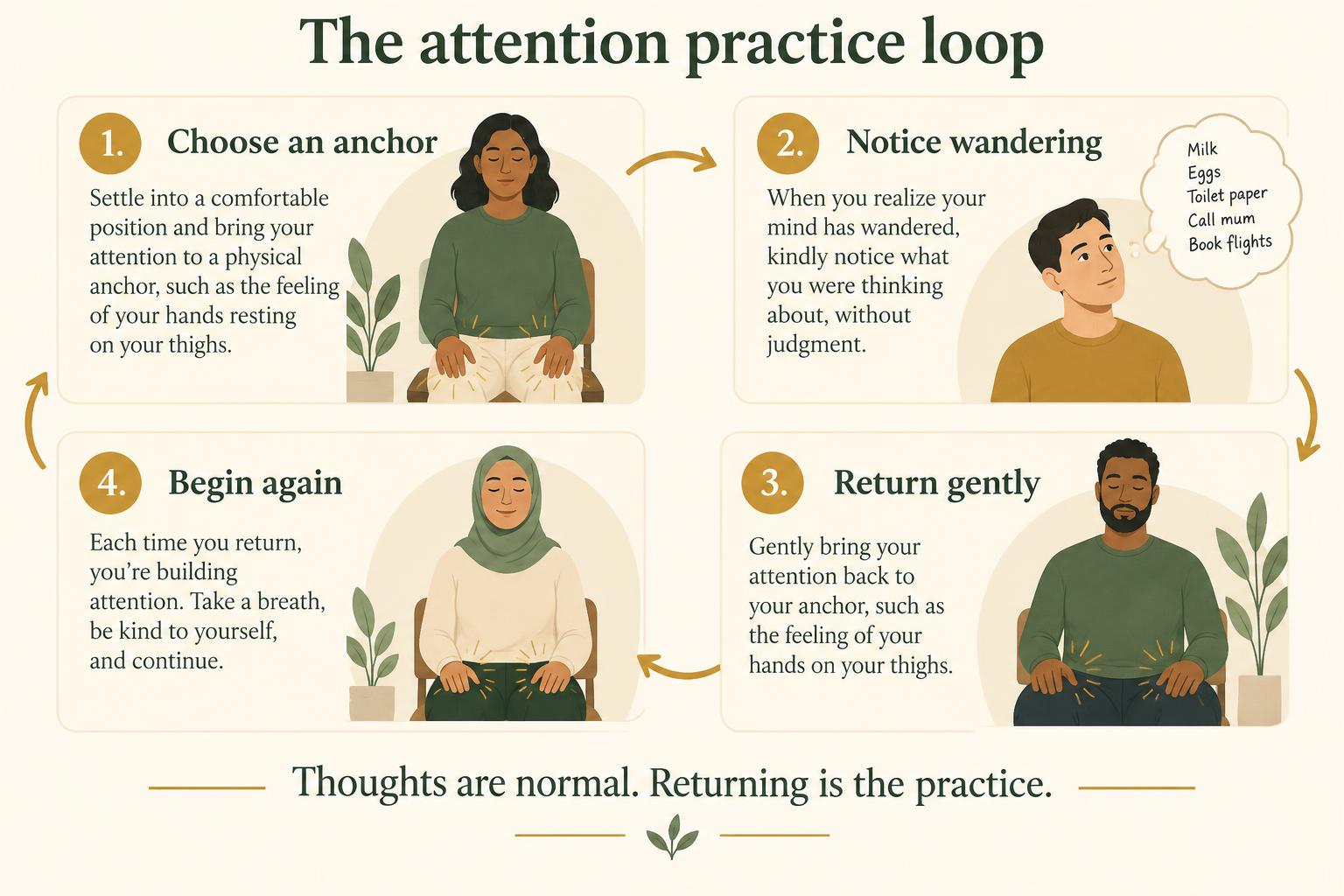
The engine of the practice is the noticing-and-returning loop. Inevitably, attention gets kidnapped — you wake up three minutes into a fantasy or a rehashed argument. The tradition is unanimous that this moment of waking up is not failure but the very heart of the practice: you noticed. You label it gently — thinking — and return to open awareness. A ten-minute session might contain thirty such returns, and each one strengthens the capacity that makes mindfulness valuable in daily life: the ability to see what your mind is doing while it is doing it.
The Proven Benefits
Mindfulness meditation carries the deepest evidence base of any mental training practice. Meta-analyses of randomized controlled trials show moderate, reliable reductions in anxiety and depression symptoms from eight-week programs. For depression specifically, mindfulness-based cognitive therapy reduces relapse risk by roughly a third in people with recurrent depression — enough that national health guidelines recommend it. Studies also document benefits for chronic pain, insomnia, blood pressure, and attention, including measurable improvements on objective focus tasks.
Brain imaging explains the how. Eight weeks of practice is associated with reduced gray-matter density in the amygdala — the brain's threat alarm — and increased density in the hippocampus, which supports memory and emotional regulation. Connectivity strengthens between the prefrontal cortex and emotional centers, giving the observing mind more leverage over reactive circuits. Practitioners also show quieter default mode network activity: less rumination, less anxious self-talk, less mental time travel. The ancient claim that training attention changes the mind turns out to be literally, visibly true.
Try It Now: A Five-Minute Mindfulness Session
Set a timer for five minutes and sit in a chair with your spine tall and feet flat. Close your eyes or lower your gaze. For the first minute, simply feel your breathing — air at the nostrils, movement in the chest — without changing it. For the next three minutes, open the lens: let whatever arises into awareness be there. Sounds, sensations, emotions, thoughts — note each softly and let it pass. Hearing. Warmth. Impatience. Thinking. Nothing needs to be fixed, pursued, or pushed away.
For the final minute, return to the breath alone, then open your eyes slowly. Notice how you feel compared to five minutes ago — not to grade the session, but simply to know. You have just practiced mindfulness meditation in its complete, essential form. If the session felt busy or frustrating, that is normal and changes nothing about its value. And if you would like a calm voice to lead your early sessions, guided programs such as The 5 Minute Meditation Paradise offer five-minute mindfulness practices paced exactly for beginners — the same arc you just did, with company.
Common Misconceptions, Corrected
The most persistent misconception is that mindfulness means emptying the mind. It does not and cannot — the mind generates thought as continuously as the heart beats. Mindfulness changes your relationship to thoughts, not their quantity. Second misconception: mindfulness is relaxation. Relaxation often accompanies practice, but the goal is clear seeing, not calm feeling — some mindful sessions are restless, and they count fully. Third: mindfulness means accepting everything passively. In fact, clear awareness of problems usually leads to more effective action, taken earlier and with less reactivity.
Fourth: mindfulness is Buddhist, so it conflicts with other beliefs. The practice as taught in modern programs is fully secular — attention training with no doctrine attached — though its historical roots deserve respect. Fifth: you need special conditions. Silence helps, but mindfulness is specifically designed to work with whatever is present, including noise, discomfort, and a busy mind. The practice that only works in perfect conditions is not mindfulness; mindfulness is precisely what works in imperfect ones.
| Misconception | The reality |
|---|---|
| It empties the mind | It changes your relationship with thoughts, not their number |
| It is just relaxation | Calm is a side effect; clear seeing is the goal |
| It means passive acceptance | Clear awareness enables earlier, wiser action |
| It requires Buddhist belief | Modern mindfulness is fully secular attention training |
| It needs silence and stillness | It works with whatever conditions are present |
An Example That Makes the Definition Concrete
Imagine sitting with your hands resting on your thighs. You notice warmth, pressure, and the texture of clothing. A thought about tomorrow appears, and attention follows it into a plan. A moment later, you realize that you are planning. You acknowledge the thought and return to contact with your hands. That sequence illustrates mindfulness meditation without requiring unusual sensations or a silent mind. There is an intention to attend, awareness that attention has moved, and a deliberate return. The anchor could have been breathing, sound, or another ordinary experience. The particular object helps organize attention; it is not the definition of mindfulness itself.
The word nonjudgmental is often misunderstood. It does not mean that you lose the ability to evaluate a situation or distinguish helpful behavior from harmful behavior. It means that you try not to add an immediate layer of condemnation to every experience that appears. A thought is recognized as a thought before it becomes proof that you are bad at meditating. A sensation is noticed before it becomes a demand that you must relax. You may still decide to adjust posture, end the session, or address a real problem afterward. Awareness and sensible judgment can coexist.
Mindfulness also differs from continuous self-monitoring. You are not required to track every breath, emotion, and movement throughout the day. Formal practice creates a bounded opportunity to develop a skill. Informal practice uses that skill in selected moments, such as listening during a conversation or noticing an impulse to check the phone. The rest of life includes planning, memory, imagination, and ordinary distraction. A useful definition leaves room for those activities. Mindfulness meditation is not a state in which thinking has been abolished; it is a practice of recognizing experience and relating to it with more deliberate attention.
How Mindfulness Relates to Concentration and Acceptance
Concentration helps stabilize attention on a chosen object. Mindfulness includes awareness of what is occurring, including the fact that concentration has been lost. In many practical sessions, the two work together: you attend to breathing, notice a thought, and return. Other methods use a wider field of awareness rather than one narrow anchor. These distinctions are useful, but traditions and teachers use terms differently. A general article should not imply that one definition resolves every philosophical debate. For a beginner, it is enough to understand what the current instruction asks you to do and how to return when the mind moves elsewhere.
Acceptance means acknowledging what is present, not approving everything or resigning yourself to circumstances. If you feel tired, noticing tiredness can support a decision to rest. If you feel anger after a harmful remark, awareness can help you set a boundary deliberately. You are not required to make the feeling disappear before taking action. This is why mindfulness can be compatible with problem-solving. It offers a clearer starting point rather than replacing the need to act. A practice that is used to tolerate ongoing harm without response has drifted away from the ordinary purpose of increasing awareness and choice.
At the same time, acceptance should not become an instruction to endure escalating distress during meditation. If inward attention triggers panic, upsetting memories, or disconnection, open your eyes, orient to the room, and stop or change the exercise. Seek suitable guidance if this repeats. A comfortable external anchor can be a valid alternative. The practice is not a contest in remaining still. Keeping agency and safety visible makes the definition more useful: mindfulness meditation involves deliberate awareness, but the way you practice it should remain responsive to your body, history, and current circumstances.
What a Mindfulness Resource Can and Cannot Offer
A book, app, or recording can explain a technique and provide a sequence to follow. It can remind you to return gently and help you build a routine. It cannot know your symptoms, decide which adaptation is safe for you, or guarantee a particular benefit. Structured clinical mindfulness programs may include trained instructors, substantial practice, and a specific treatment context. Research about those programs should not be automatically applied to every short audio session. This distinction matters when a resource makes confident claims about anxiety, depression, sleep, or brain change. Useful instruction does not require a promise that exceeds the evidence.
The 5 Minute Meditation Paradise is one audiobook option to explore if you want guided listening alongside this definition. Review the current description and sample to understand the style and available content. During a suitable passage, notice what action you are actually practicing. Are you following a breath sensation, listening to sound, or working with imagery? That question turns listening into learning. You can adapt instructions and pause when necessary. The recording is a companion for practice, not a substitute for professional care or a complete representation of every tradition named in meditation media.
To decide whether a routine is useful, look for concrete observations. You may recognize distraction sooner, return to a task more deliberately, or notice tension before responding in a conversation. These are possibilities to observe, not outcomes owed to every practitioner. Keep other supports in view and avoid interpreting one peaceful session as proof of a permanent change. A good understanding of mindfulness meditation remains modest and practical: it is an intentional way of attending to experience, recognizing when attention moves, and returning with enough flexibility that the practice supports rather than constrains your daily life.
A Practical Detail to Keep in Mind
A useful distinction is between remembering the intention and controlling the experience. You can remember that you are practicing without deciding what thoughts or feelings are allowed to appear. The intention gives attention a direction; it does not dictate the content of the mind. When something unexpected arises, recognize it and choose whether to return, adapt, or stop. This makes mindfulness a responsive practice rather than a rigid attempt to maintain one state. The distinction can also help outside formal sessions. You may intend to listen carefully while still noticing impatience or distraction. Recognizing those events gives you a choice about what to do next without requiring them to disappear first.
Start listening today
The 5 Minute Meditation Paradise
by Stephens Hyang · narrated by Robert Gazy · 6 hrs and 1 min
The Ultimate "How to Meditate Guide" to Help You Increase Mindfulness and Reduce Anxiety Through Meditation, Guided Meditation, Chakra, and Zen Music
Frequently asked questions
What is mindfulness meditation in simple terms?
It is the practice of noticing what is happening right now — your breath, body, sounds, and thoughts — without judging or reacting to it. You observe experiences as they come and go, building calm, clarity, and a healthier relationship with your own mind.
How is mindfulness meditation different from regular meditation?
Meditation is the broad category; mindfulness is one style within it. Unlike concentration practices that hold attention on a single object, mindfulness opens attention to observe whatever arises in the present moment, treating all experiences — pleasant and unpleasant — with equal, non-judgmental awareness.
How long does it take to learn mindfulness meditation?
The basic technique can be learned in a single five-minute session. Developing reliable skill takes consistent practice — most research programs run eight weeks of daily sessions, after which measurable improvements in stress, attention, and emotional regulation typically appear.
Can mindfulness meditation help with anxiety and depression?
Yes. Mindfulness-based programs show moderate, well-replicated reductions in anxiety, and mindfulness-based cognitive therapy reduces depression relapse risk by about a third in recurrent cases. It works by interrupting rumination and changing reactivity, and it complements professional treatment.
Do I need to sit still to practice mindfulness meditation?
Sitting is the classic form, but mindfulness can be practiced walking, eating, listening, or doing routine chores — any activity done with deliberate, non-judgmental attention to present experience. Formal sitting builds the skill; informal practice applies it throughout the day.
Mindfulness meditation is the simple, radical act of being where you already are — noticing each moment as it is, rather than as your worries paint it. Five minutes today is a complete beginning. If you would like guidance for those first sessions, The 5 Minute Meditation Paradise leads the same practice you just learned, one gentle five-minute sit at a time.


