Key takeaways
- •Mindfulness means observing present experience without judgment — including discomfort.
- •It is the most researched meditation style, with strong evidence for stress and anxiety relief.
- •The core skill is noticing thoughts as events, not facts or commands.
- •Five to ten daily minutes produce measurable benefits within about eight weeks.
What Mindfulness Meditation Is — and Is Not
Mindfulness meditation trains a specific way of paying attention: on purpose, in the present moment, and without judgment. In practice, that means sitting quietly and observing whatever your experience contains right now — the breath moving, a sound outside, an itch, a worry, a flicker of impatience — without chasing pleasant experiences or fighting unpleasant ones. Thoughts are treated as mental events passing through awareness, like clouds crossing a sky, rather than as truths you must believe or problems you must solve immediately.
Equally important is what mindfulness is not. It is not relaxation, though relaxation often follows. It is not emptying the mind; a mindful session can be full of thought, as long as the thoughts are observed rather than inhabited. And it is not passive acceptance of a bad life — by seeing your reactions clearly, mindfulness actually increases your capacity to change what needs changing. The practice is best understood as strength training for attention and emotional balance, disguised as sitting still.
How Mindfulness Differs from Other Meditation Styles
Most meditation styles are concentration practices: you choose one object — a mantra, a candle flame, the breath — and hold attention there, returning whenever it strays. Mindfulness adds a second move. After some stability develops, attention opens to include whatever arises: sounds, sensations, emotions, thoughts. Instead of returning to a single anchor every time, you learn to let experiences come and go in awareness without grasping or resisting. Concentration builds the spotlight; mindfulness teaches the spotlight to widen into a floodlight.
This difference explains their different strengths. Concentration styles like mantra meditation are often faster at producing calm and are easier for busy minds to grip. Mindfulness excels at changing your relationship with difficult experiences, which is why clinical programs chose it for treating anxiety, depression relapse, and chronic pain. In practice the two blend: nearly every mindfulness session begins with breath concentration to steady the mind, then opens into broader awareness. Learning both moves gives you a complete toolkit.
Recommended listening
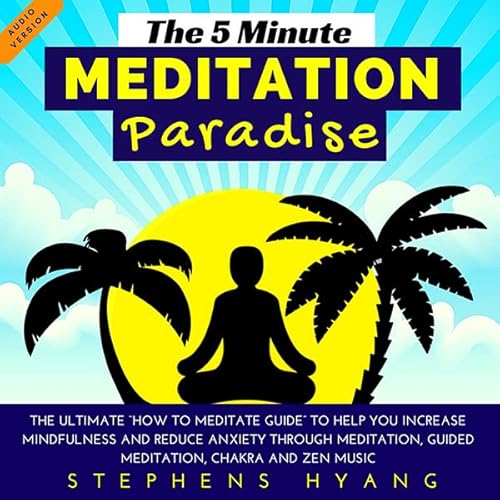
The 5 Minute Meditation Paradise
by Stephens Hyang · narrated by Robert Gazy · 6 hrs and 1 min
The Ultimate "How to Meditate Guide" to Help You Increase Mindfulness and Reduce Anxiety Through Meditation, Guided Meditation, Chakra, and Zen Music
The Science: Proven Benefits of Mindfulness Meditation
Mindfulness is the most studied meditation in history, largely because Jon Kabat-Zinn's mindfulness-based stress reduction program gave researchers a standardized, secular eight-week protocol to test. Across hundreds of randomized trials, MBSR and similar programs show moderate, reliable reductions in anxiety and depression symptoms, with one landmark trial finding mindfulness training performed comparably to a leading antidepressant for preventing depressive relapse. Studies also document lower cortisol, reduced blood pressure, improved sleep, and reduced emotional reactivity under stress.
Brain imaging reveals the mechanism. Eight weeks of practice is associated with increased gray-matter density in the hippocampus, which governs learning and memory, and decreased gray matter in the amygdala, the brain's threat alarm. Connectivity between the prefrontal cortex and amygdala strengthens, meaning the rational brain gains leverage over the alarm system. Perhaps most practically, experienced practitioners show less activity in the default mode network — the circuitry of rumination and anxious self-talk. The changes are dose-dependent: more total practice minutes, more measurable difference.
How to Practice Mindfulness Meditation, Step by Step
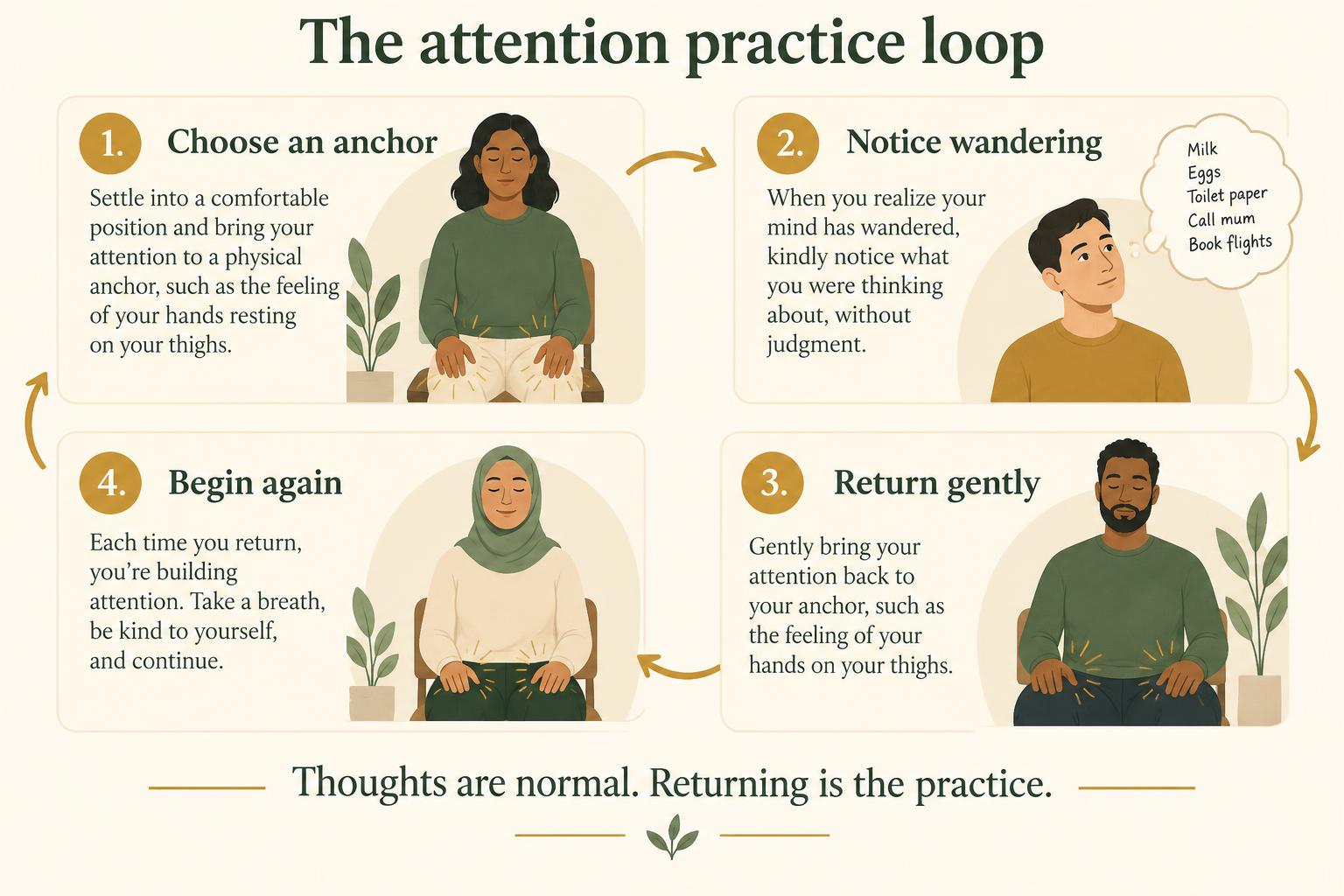
Sit upright and comfortable, set a timer for five to ten minutes, and close your eyes. Begin with two minutes of breath awareness to steady attention: feel each inhale and exhale at the nostrils, chest, or belly. Then widen the lens. Let your awareness include whatever is most vivid in each moment — a sound, a bodily sensation, an emotion, a thought. When something captures attention, acknowledge it with a soft mental label — hearing, tension, worrying — and let it be, without pursuing or suppressing it. When you realize you have been lost in a story, gently return to the breath and open again.
The labeling technique deserves emphasis because it is the engine of mindfulness. Naming an experience creates a half-second of space between you and it: anger becomes a noticed event called anger rather than an identity called I am angry. In that space lives choice. Practice the full sequence daily — settle on breath, open to experience, label, allow, return — and keep sessions short enough that you end wanting slightly more. Ten consistent minutes will teach you more than an occasional heroic hour.
Working with Difficult Emotions Mindfully
Sooner or later, practice brings you face to face with anger, sadness, anxiety, or shame — and this is where mindfulness earns its reputation. The instruction sounds simple: turn toward the emotion instead of away. Locate where it lives in the body — the tight chest of anxiety, the hot face of anger, the heavy limbs of sadness — and observe the raw physical sensations with curiosity, as a scientist would. Emotions observed as body sensations become workable; emotions resisted become entrenched.
A helpful acronym is RAIN: Recognize what is happening, Allow it to be here, Investigate the bodily sensations and beliefs involved, and Nurture yourself with kindness. If an emotion ever feels overwhelming, the practice is to open your eyes, feel your feet, look around the room, and ground attention externally until the wave passes. Mindfulness is not endurance suffering; it is titrated, compassionate exposure. Difficult sessions are often the most transformative, because they teach the nervous system, experientially, that feelings are survivable.
Informal Mindfulness: Practice Off the Cushion
Formal sitting builds the skill, but informal practice spends it well. Mindful eating — actually tasting the first three bites of each meal — retrains a lifetime of distracted consumption. Mindful walking converts daily movement into attention training by feeling each step. Mindful listening means giving one conversation per day your undivided presence, noticing the reflex to rehearse your reply and releasing it. Each informal moment runs the same loop as formal practice: engage, notice wandering, return.
The highest-leverage informal practice is the mindful pause: three conscious breaths before transitions — opening email, entering a meeting, walking through your front door. These micro-punctuations interrupt the autopilot that strings hours together into blur. Many practitioners find that informal mindfulness is where life visibly changes first: fewer regretted sentences, earlier awareness of stress, fuller presence with the people they love. The cushion trains you; the day is the arena.
Common Beginner Mistakes in Mindfulness Practice
The first mistake is practicing to relax. Relaxation is a welcome byproduct, but making it the goal turns every restless session into a failure and every calm session into a craving. The second mistake is suppressing thoughts — white-knuckling attention to keep the mind blank, which is both impossible and exhausting. Mindfulness allows thoughts to arise; it only declines to follow them. The third mistake is judging sessions: labeling sits as good or bad based on how they felt, rather than whether you showed up and noticed.
The fourth mistake is inconsistency dressed as flexibility — practicing only when motivated, which means rarely. Fix a daily time, keep it small, and honor it like an appointment. The fifth is going it alone indefinitely: a guided program, a course, or a sitting group dramatically improves both technique and persistence. For structure in the early months, short guided mindfulness sessions such as those in The 5 Minute Meditation Paradise provide the pacing and reminders that self-direction cannot yet supply. Avoid these five mistakes, and eight weeks of ordinary practice will surprise you.
| Mistake | Why it backfires | Better approach |
|---|---|---|
| Practicing only to relax | Restless sessions feel like failures | Aim to notice, not to feel good |
| Suppressing thoughts | Creates tension and exhaustion | Label thoughts and let them pass |
| Judging sessions good or bad | Kills motivation on hard days | Measure attendance, not mood |
| Practicing when motivated | Motivation fades in week two | Fixed daily time, small sessions |
| No guidance or feedback | Subtle errors go uncorrected | Use guided audio or a teacher early on |
Building an Eight-Week Mindfulness Path
The research programs that produce headline benefits run eight weeks, and you can mirror their arc at home. Weeks one and two: five minutes daily of breath awareness, learning to settle and return. Weeks three and four: ten minutes, adding the body scan and soft labeling of experience. Weeks five and six: ten to fifteen minutes, opening attention beyond the breath to sounds, sensations, and thoughts. Weeks seven and eight: fifteen minutes, adding informal practices — one mindful meal, one mindful walk, pauses before transitions.
Track practice with a simple daily check mark, and note one observation per week about life off the cushion: sleep, reactivity, focus. Most people who complete eight weeks report that the question shifts from should I meditate to how did I ever not. If you want companionship for the journey, structured audio programs help immensely — the mindfulness and guided sessions in The 5 Minute Meditation Paradise map neatly onto this arc, offering five-minute guided sits precisely sized for each stage. Eight weeks from today, you will wish you had started eight weeks ago.
Distinguish Direct Experience from the Story About It
Mindfulness meditation becomes clearer when you separate a sensation from its interpretation. There may be pressure at the forehead; there may also be a thought that this pressure means you are failing to relax. Both are experiences, but they are not identical. You can notice the pressure as pressure and recognize the judgment as a thought. Neither has to be immediately removed. This distinction is not a demand to analyze every moment. It is a small way of reducing the tendency to treat a passing sensation and the story attached to it as one unquestionable fact.
Try the distinction with a neutral sound. A door closes. First there is hearing, then perhaps a thought about who closed it or why it was loud. If you become absorbed in the explanation, return to the next sound or to contact with the chair. In a breath-focused session, the same sequence appears when you begin deciding whether a breath was sufficiently slow or deep. Notice the evaluation and return to natural breathing. Mindfulness does not require the mind to stop making interpretations. It asks you to recognize the difference between experiencing something and becoming entirely occupied by what you think it means.
This skill can be useful in conversation. You hear a remark, feel heat in your face, and notice an impulse to defend yourself. Awareness may create a moment in which you choose to ask for clarification rather than react automatically. It does not tell you that the remark was harmless or that you should accept poor treatment. After noticing, you may still set a boundary or disagree firmly. The point is clearer engagement. Practicing with ordinary sensations can help you recognize these sequences, but it does not guarantee that every conversation becomes calm or that conflict can always be solved through awareness alone.
Use a Narrow Anchor Before Expanding Awareness
Some mindfulness instructions invite you to notice everything at once. For a beginner, that can feel like trying to monitor an entire control room. Start with a narrow, clear anchor instead: contact with the feet, a natural breath sensation, or a stable background sound. When attention becomes somewhat settled, allow one additional type of experience to enter awareness. You might notice both breathing and sound, without deciding which deserves priority. If this becomes confusing, return to one anchor. Broad awareness is an option, not a badge of advancement that you must earn by tolerating an overwhelming amount of information.
A body scan offers a different way to organize awareness. Move through a few regions and notice what is present, including the absence of clear sensation. You do not need to uncover hidden tension or persuade every muscle to relax. The instruction is to notice, not to complete a repair project. If a particular region feels uncomfortable to focus on, skip it or use a whole-body point of contact instead. This is especially relevant for people with pain, trauma histories, or strong anxiety around bodily sensations. A suitable teacher can help adapt the exercise to avoid turning attention into a form of unwanted exposure.
Guided audio can pace this expansion, but choose a recording that allows adjustments. In The 5 Minute Meditation Paradise, preview the available sample and description before deciding which passage to use for a mindfulness routine. During any recording, you can remain with a comfortable anchor even if the narrator suggests moving elsewhere. Pause when necessary. The recording supplies a sequence; it does not know your body or current state. A good practical outcome is understanding how to widen or narrow attention deliberately, rather than feeling that you must follow every instruction precisely to have a valid session.
Mindfulness, Problem-Solving, and Appropriate Support
There is a time to observe a problem and a time to act on it. If you are rehearsing the same worry during a session, a brief acknowledgment can help you return to the present. Afterward, ask whether the concern needs a concrete step. A bill may need paying, a deadline may require planning, and a difficult symptom may need assessment. Mindfulness should not become a reason to postpone those actions. Its role is to help distinguish repetitive mental rehearsal from useful engagement. A short planning period outside meditation can reduce the pressure to solve everything while you are seated.
For health-related claims, remember that mindfulness-based clinical programs involve more than a general instruction to pay attention. They may include trained instructors, group support, substantial homework, and a specific treatment context. Results from such programs do not automatically describe what a short audiobook session will do. Meditation can be a supportive practice, but it is not guaranteed to treat anxiety, depression, pain, or insomnia. Keep existing care in place, and seek advice when symptoms interfere with daily functioning. Increased distress is a reason to adapt or pause the practice, not evidence that you need to meditate harder.
For an everyday routine, end with a specific transition. Notice the room, stretch if needed, and decide on the next task. This keeps mindfulness connected to living rather than to an idealized inner state. You might practice patience while waiting, attentive listening during a conversation, or awareness of tension before taking a break. These small moments are not dramatic, but they give the formal session a practical context. The aim is not continuous self-monitoring. It is the ability to recognize where attention is, redirect it when useful, and respond to your circumstances with a little more choice.
Start listening today
The 5 Minute Meditation Paradise
by Stephens Hyang · narrated by Robert Gazy · 6 hrs and 1 min
The Ultimate "How to Meditate Guide" to Help You Increase Mindfulness and Reduce Anxiety Through Meditation, Guided Meditation, Chakra, and Zen Music
Frequently asked questions
What is the difference between mindfulness and meditation?
Meditation is the broad family of attention-training practices; mindfulness meditation is one specific style within it, defined by non-judgmental awareness of present-moment experience. Mindfulness can also be practiced informally throughout the day, while many other meditation styles are practiced only in formal sessions.
How long should a mindfulness meditation session be?
Beginners do well with five to ten minutes daily. Research programs showing significant benefits typically use twenty to forty-five minutes daily over eight weeks, but shorter consistent sessions produce real improvements in stress and focus. Consistency matters more than length, especially in the first two months.
Can mindfulness meditation help with anxiety?
Yes. Mindfulness-based programs show moderate, well-replicated reductions in anxiety across dozens of clinical trials. The practice works by interrupting rumination, reducing amygdala reactivity, and teaching you to observe anxious thoughts as passing events rather than emergencies. Severe anxiety should still be addressed with professional care.
Do I have to empty my mind during mindfulness meditation?
No — this is the most common misunderstanding. Mindfulness does not aim for an empty mind but for a changed relationship with whatever the mind contains. Thoughts arising is normal and expected; the practice is noticing them without getting carried away, then returning to the present.
Is mindfulness meditation religious?
Although its roots are in Buddhist vipassana, modern mindfulness meditation as taught in clinical and secular programs contains no religious content, beliefs, or rituals. It is taught in hospitals, schools, and corporations as a mental training technique compatible with any faith or none.
Mindfulness meditation asks little and gives much: five honest minutes a day in exchange for a steadier mind and a kinder relationship with your own experience. Begin tonight with ten breaths and one soft label for whatever you find. And if you want a gentle guide through your first eight weeks, The 5 Minute Meditation Paradise offers short mindfulness sessions sized for real life.


