Key takeaways
- •Slow breathing with a longer exhale is the fastest-acting technique for acute anxiety.
- •Grounding through the senses interrupts spiraling thoughts within minutes.
- •Gentle, anchored techniques outperform forceful empty-mind attempts for anxious people.
- •Eight weeks of consistent practice produces clinically meaningful reductions in anxiety.
Why Meditation Helps Anxiety
Anxiety is, at its core, a threat-detection system running too hot. The amygdala fires alarms about future dangers, the body floods with stress hormones, and the mind loops worst-case scenarios. Meditation intervenes at three points in this cycle. Slow breathing directly activates the vagus nerve, switching the nervous system from fight-or-flight to rest-and-digest within minutes. Attention training interrupts rumination by giving the mind somewhere to be besides the worry loop. And repeated exposure to anxious sensations in a safe context teaches the brain that these feelings are survivable, gradually turning down the alarm's sensitivity.
The clinical evidence is now substantial. Meta-analyses of mindfulness-based interventions show moderate reductions in anxiety across dozens of randomized trials, and a landmark 2022 study found mindfulness-based stress reduction performed comparably to escitalopram, a common anti-anxiety medication, over eight weeks. Meditation is not a replacement for professional care when anxiety is severe, but it is among the best-supported self-directed tools available — free, portable, and without side effects.
Slow Diaphragmatic Breathing
When anxiety spikes, this is the technique to reach for first. Place one hand on your belly. Inhale through the nose for a count of four, letting the belly expand. Exhale slowly through pursed lips for a count of six to eight. The extended exhale is the active ingredient: it stimulates the vagus nerve and slows heart rate within a handful of breaths. Continue for two to five minutes, keeping the breath gentle rather than forced or deep to the point of dizziness.
Practice this daily when calm, not just during panic. The nervous system learns patterns through repetition, and a breathing pattern rehearsed in safety becomes available in crisis. Many people find that two weeks of twice-daily practice measurably lowers their baseline anxiety, so spikes start from a lower floor. If counting feels stressful, simply make the exhale noticeably longer than the inhale and let the body do the arithmetic.
Recommended listening
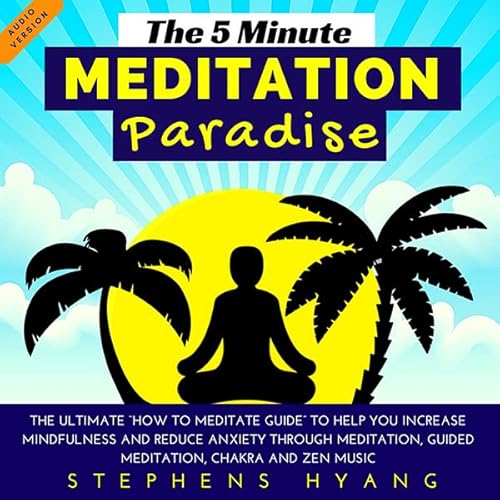
The 5 Minute Meditation Paradise
by Stephens Hyang · narrated by Robert Gazy · 6 hrs and 1 min
The Ultimate "How to Meditate Guide" to Help You Increase Mindfulness and Reduce Anxiety Through Meditation, Guided Meditation, Chakra, and Zen Music
Grounding: The 5-4-3-2-1 Technique
Grounding techniques pull attention out of anxious thoughts and into immediate sensory reality. The 5-4-3-2-1 method is the most widely taught: name five things you can see, four you can hear, three you can touch, two you can smell, and one you can taste. Move slowly, really finding each item. The exercise works because anxious thought lives in the imagined future, while the senses only exist in the present — you cannot spiral and sense at the same time.
A meditation-based variation deepens the effect: after the sensory inventory, rest attention on one neutral anchor, such as the feeling of your feet on the floor or your back against the chair, for ten slow breaths. This converts a one-off coping trick into genuine attention training. Grounding is especially useful for anxiety that arrives suddenly in public, since it requires nothing visible and can be done eyes open in a meeting, on a train, or in a queue.
Body Scan for Anxious Tension
Anxiety is not only mental — it lives in clenched jaws, raised shoulders, shallow breathing, and knotted stomachs. The body scan systematically visits each region, noticing sensation without trying to fix it. Paradoxically, simply observing tension with curiosity often releases it, because the clenching is partly maintained by inattention. Start at the feet and move upward, spending twenty to thirty seconds per region, breathing into areas of tightness as if the breath could reach them directly.
For anxiety specifically, practice the scan lying down in a safe, comfortable place, and keep sessions short at first — ten minutes rather than forty-five. A small number of people with high anxiety find that turning attention toward the body initially amplifies discomfort; if this happens to you, open the eyes, anchor attention externally on sounds instead, and return to shorter scans gradually. Working with a recorded guided scan, such as the sessions in The 5 Minute Meditation Paradise, keeps the pace gentle and the structure safe while you learn.
Breath Counting and Anchor Meditation
Breath counting is the workhorse of anxiety-focused meditation. Sit comfortably and count each exhale from one to ten, then return to one. When you notice you have drifted to eleven, twelve, or lost count entirely in a worry loop, simply begin again at one. The counting occupies just enough of the mind's verbal channel to make spiraling harder, while the repeated return-to-one trains exactly the skill anxious people need most: disengaging from a thought stream without fighting it.
Research on attention training shows that this gentle disengagement, practiced daily, weakens the grip of rumination over time. Sessions can be short — five to ten minutes produces measurable calming — and the technique scales to crisis moments, where even ten counted breaths lower physiological arousal. If counting becomes mechanical, add a soft mental note on each exhale, such as the word calm or release, giving the mind a soothing instruction to ride along with the number.
Loving-Kindness for Anxious Self-Talk
Anxiety and self-criticism travel together: the anxious mind not only worries, it berates itself for worrying. Loving-kindness meditation directly targets this layer. Sitting comfortably, repeat phrases of goodwill toward yourself — may I be safe, may I be at ease, may I be kind to myself in this moment. The phrases can feel artificial at first, especially under anxiety; that is normal. The practice works through repetition of intention, not through forcing warm feelings that are not there.
Studies show loving-kindness practice reduces social anxiety, self-criticism, and the shame spiral that often follows anxious episodes. A useful in-the-moment version is the self-compassion break: when anxiety strikes, place a hand on your chest and silently say, this is a moment of difficulty, difficulty is part of being human, may I be gentle with myself right now. It takes thirty seconds and meaningfully interrupts the second arrow of self-judgment that makes anxiety hurt twice.
Guided Visualization for Anxiety Relief
Guided visualization uses the imagination — anxiety's favorite tool — against anxiety itself. Instead of catastrophic futures, you build a vivid safe place: a quiet beach, a forest clearing, a childhood kitchen. A narrator walks you through the sensory details while calming music plays underneath, and the nervous system responds to imagined safety almost as it would to real safety, lowering heart rate and muscle tension.
This is the easiest entry point for anxious beginners because the voice removes the silence in which worry breeds. Audio programs designed for anxiety, including the guided mindfulness and zen music sessions in The 5 Minute Meditation Paradise narrated by Robert Gazy, offer five-minute immersions that fit into a lunch break or a difficult evening. Many users describe the combination of calm narration and zen music as an off-ramp from spiraling thoughts — a structured place for the mind to rest while the body settles.
Techniques to Approach with Caution
Not every meditation technique suits an anxious nervous system, at least not initially. Long silent retreats, intensive open-monitoring practice, and forceful breathwork such as rapid holotropic breathing can temporarily intensify anxiety by removing distractions that normally keep difficult material at bay. This does not make these practices bad — they are powerful — but power requires pacing. Build a foundation of several months with gentle, anchored techniques before exploring intensive formats, ideally with guidance from an experienced teacher.
Also beware of perfectionism sneaking into the practice itself. Anxious meditators often turn meditation into another performance to fail at: I am doing it wrong, my mind will not stop, everyone else finds this calming. Treat these thoughts as more weather to observe rather than verdicts. Sessions that feel agitated are not failed sessions — they are often the most productive training, because practicing with a difficult mind builds exactly the muscle anxiety requires.
| Situation | Best technique | Duration | How it helps |
|---|---|---|---|
| Sudden spike or panic | Slow breathing, long exhale | 2-5 minutes | Activates the vagus nerve, slows heart rate |
| Spiraling thoughts | 5-4-3-2-1 grounding | 3-5 minutes | Interrupts rumination with present-moment senses |
| Chronic background anxiety | Breath counting | 10 minutes daily | Retrains disengagement from worry loops |
| Physical tension | Body scan | 10-20 minutes | Releases clenched muscles through awareness |
| Harsh self-criticism | Loving-kindness phrases | 5-10 minutes | Softens the second arrow of self-judgment |
| Evening wind-down | Guided visualization with music | 5-15 minutes | Gives the mind a safe scene to rest in |
Match the Anchor to the Anxiety You Are Experiencing
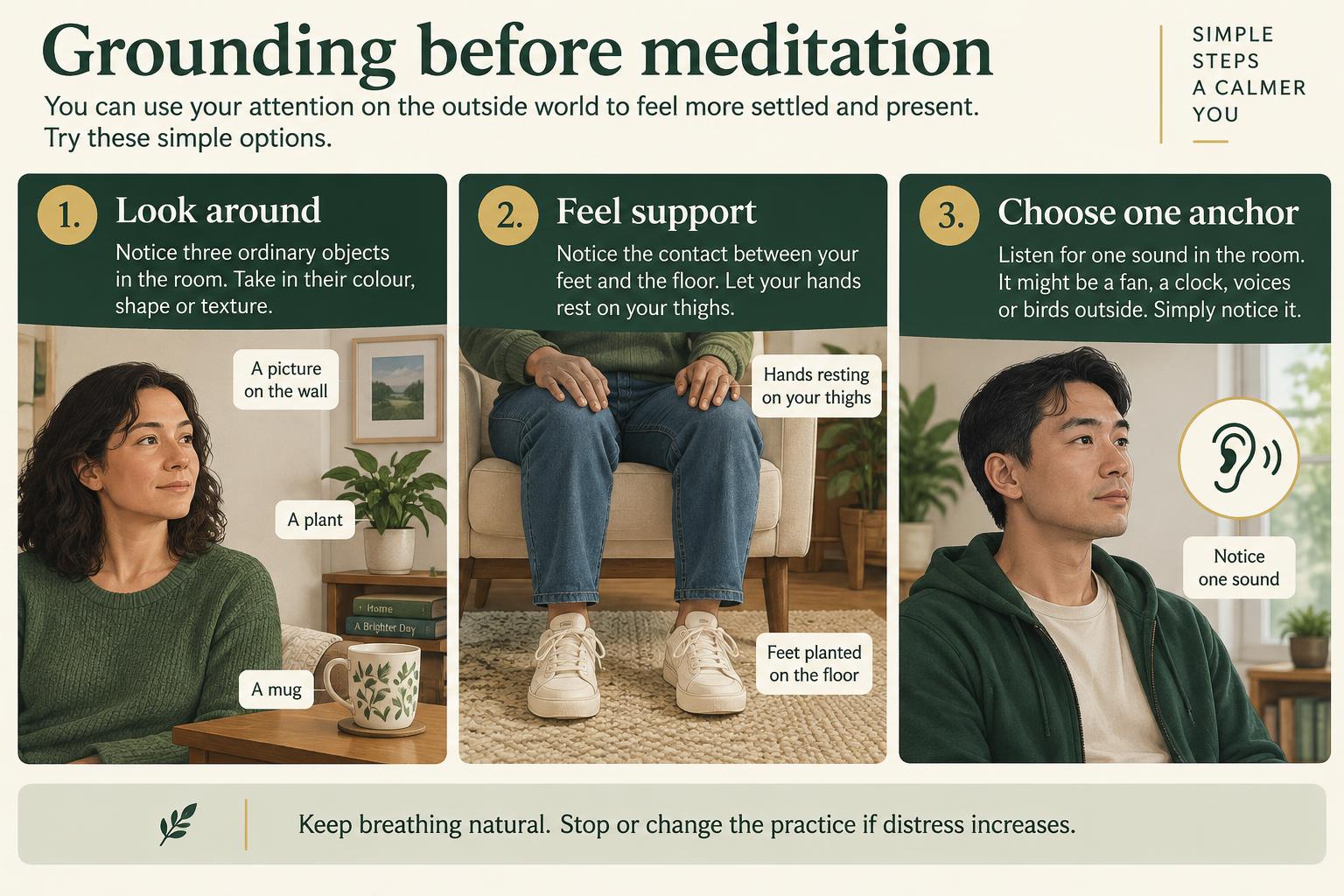
Anxiety is not one uniform state, so a technique that feels helpful on one day may feel uncomfortable on another. If worry is mainly verbal, with repeated what-if stories, a simple sound anchor can interrupt the habit of following every sentence. Listen to an ordinary background sound and return whenever you notice mental rehearsal. If anxiety is strongly physical, focusing closely on the heartbeat or breath may increase vigilance rather than reduce it. In that case, try the pressure of your shoes against the floor, the texture of a cool object, or the visible edges of a nearby picture. An external anchor is a legitimate meditation choice, not a lesser version of the practice.
When restlessness is prominent, a short mindful walk may be more approachable than sitting. Choose a safe place where you can remain aware of traffic and other people. Walk at a comfortable pace and notice the shifting pressure beneath your feet. Do not slow so much that balance becomes difficult, and do not wear isolating headphones near roads. If you feel frozen or detached rather than restless, orient to the room first: name where you are, look at familiar objects, and move your hands. In either case, the goal is not to force yourself into stillness. It is to find a manageable form of attention that leaves you feeling present and able to choose your next action.
For harsh self-criticism, loving-kindness phrases can be adapted so that they do not demand feelings you cannot access. I can take this one step at a time may be more believable than I am completely peaceful. Repeat the phrase slowly and notice whether it reduces pressure or becomes another instruction to perform calmness. You can direct goodwill toward a supportive person before including yourself, or skip the phrases if they feel alienating. The right anchor is one you can return to without escalating distress. Treat these suggestions as options to test gently, not a diagnostic system or a promise that a particular technique will treat a particular anxiety disorder.
Use a Clear Stop Rule Instead of Pushing Through
Before beginning, decide what you will do if the exercise becomes too much. For example, you might stop if breath awareness produces increasing dizziness, if you feel markedly disconnected from your surroundings, or if upsetting memories become difficult to manage. Open your eyes, look around, and return to an ordinary activity such as getting a glass of water or talking with someone you trust. There is no benefit in proving that you can endure distress for the sake of a timer. A stop rule makes the practice safer because it gives you permission to respond early instead of waiting until you feel overwhelmed.
Breathing exercises deserve the same flexibility. A longer exhalation may feel soothing to some people, but fixed ratios, very deep breaths, and breath holding are not necessary for mindfulness. Overbreathing can cause uncomfortable sensations. Allow breathing to remain easy and natural, particularly if you are already monitoring it anxiously. If you have a respiratory or cardiovascular condition, or uncertainty about what is safe, consult an appropriate clinician before adopting a structured breathwork routine. You can train attention through hearing, touch, or movement without changing your breathing at all. The practice is about awareness, not forcing a physiological result.
Seek additional help when anxiety affects sleep, work, relationships, or your ability to leave home. Meditation can complement evidence-based care, but it should not delay assessment or replace prescribed treatment. A trauma-informed teacher or therapist may help you adapt posture, duration, and the degree of inward attention. Guided recordings, including The 5 Minute Meditation Paradise, can offer a predictable voice and a simple routine, yet commercial audio cannot respond to your personal symptoms. Preview the style, choose a brief manageable segment, and stop if it feels unhelpful. If symptoms are severe or you feel unsafe, prioritize appropriate professional or emergency support over continuing the exercise.
A Grounding-to-Meditation Sequence for an Anxious Day
Begin with orientation rather than closing your eyes. Sit with both feet supported and notice three objects in the room. Let your gaze settle on one stable shape, then notice the contact of your hands with your thighs. Stay with those points of contact for a short interval. If that feels manageable, attend to a natural breath without changing its depth. When a worry appears, acknowledge worrying and return to the chosen contact point. Finish by looking around again and naming the next practical task. This is a small, adjustable sequence; it is not an exposure exercise and does not require you to remain with sensations that feel overwhelming.
Afterward, evaluate function rather than demanding total relief. Can you resume a conversation, eat lunch, or begin one part of the task you were avoiding? Anxiety may still be present while you act effectively. If the sequence repeatedly leaves you more distressed, shorten it, choose a fully external focus, or pause and ask for guidance. Keep notes about what helped and what did not so that a clinician or teacher can understand your experience. A useful anxiety practice increases your options. It does not promise that worry disappears, and it does not make you responsible for eliminating every anxious feeling before you are allowed to live your day.
Start listening today
The 5 Minute Meditation Paradise
by Stephens Hyang · narrated by Robert Gazy · 6 hrs and 1 min
The Ultimate "How to Meditate Guide" to Help You Increase Mindfulness and Reduce Anxiety Through Meditation, Guided Meditation, Chakra, and Zen Music
Frequently asked questions
Which meditation technique works fastest for anxiety?
Slow breathing with an extended exhale works fastest — often within two to five minutes — because it directly activates the vagus nerve and shifts the nervous system out of fight-or-flight. Inhale for four counts, exhale for six to eight, and repeat gently until the physical symptoms begin to settle.
Can meditation make anxiety worse?
Occasionally, yes. Long silent sits, intensive retreats, or turning attention inward too quickly can temporarily amplify anxious sensations. If this happens, shorten sessions, keep eyes open, anchor attention externally on sounds, or use guided audio. Gentle, structured practice almost always calms rather than aggravates.
How long before meditation reduces anxiety?
Acute techniques like slow breathing help within minutes. For baseline anxiety, studies typically show meaningful improvement after eight weeks of daily practice, though many people report feeling steadier within two to three weeks of ten-minute daily sessions.
Is guided meditation better than silent meditation for anxiety?
For anxious beginners, guided meditation is usually better. A calm voice occupies the attention that worry would otherwise claim, provides structure, and removes the uncertainty of doing it wrong. Many people start guided and gradually mix in short silent sessions as their tolerance for stillness grows.
Should I use meditation instead of anxiety medication?
Do not change or stop medication based on meditation alone. Research shows mindfulness programs can perform comparably to medication for some people, but the two also work well together. Discuss any changes with your doctor or therapist, and treat meditation as a powerful complement to professional care.
Anxiety lies to you about the future, but the breath only knows the present. Start with two minutes of long, slow exhales today, and add one new technique each week from this guide. For evenings when your mind will not stop, let The 5 Minute Meditation Paradise carry you — five guided minutes with calm narration and zen music can be the difference between a spiraling night and a restful one.


