Key takeaways
- •A guiding voice supplies structure, pacing, and reassurance exactly when beginners need it most.
- •Guided meditation is real meditation — the same attention training, with scaffolding.
- •Short sessions of five to ten minutes are ideal for building a daily habit.
- •Match the session type to your goal: calm, sleep, focus, or emotional balance.
What Is Guided Meditation?
Guided meditation is any meditation in which a teacher leads the practice verbally. Instead of sitting in silence managing your own attention, you follow a calm voice that tells you when to breathe, where to place awareness, what to visualize, and how to return when the mind drifts. Recordings range from simple breath instructions to elaborate journeys through imagined landscapes, usually layered over soft music or nature sounds. Live versions happen in classes, retreats, and increasingly through video sessions.
The format is ancient — monks have guided disciples through practices for millennia — but recording technology turned it into the most popular entry point in the modern world. Apps, audiobooks, and streaming platforms now carry thousands of sessions for every goal and schedule. The core mechanism remains identical to silent meditation: attention is placed, attention wanders, attention returns. The guide simply holds the map while you build the strength to navigate alone.
Why Guided Meditation Works So Well for Beginners
Silent meditation asks three difficult things at once: remember the instructions, execute them, and manage the self-doubt that arises when the mind misbehaves. Beginners typically lose the thread within a minute and spend sessions wondering whether they are doing it right. A guided session eliminates the uncertainty. The voice remembers the instructions for you, paces the timing, and — crucially — normalizes distraction by reminding you that wandering is expected and returning is the practice.
There is also a nervous-system dimension. A warm, unhurried voice is itself regulating; humans are wired to settle in the presence of calm vocal tones, a response rooted in early caregiving. When narration rides over gentle music, as in the zen music sessions of The 5 Minute Meditation Paradise by Stephens Hyang, the auditory environment does part of the calming work before the technique even begins. Beginners consistently report that guided sessions feel shorter, easier, and more rewarding than equivalent silent sits — which is exactly what a fragile new habit needs.
Recommended listening
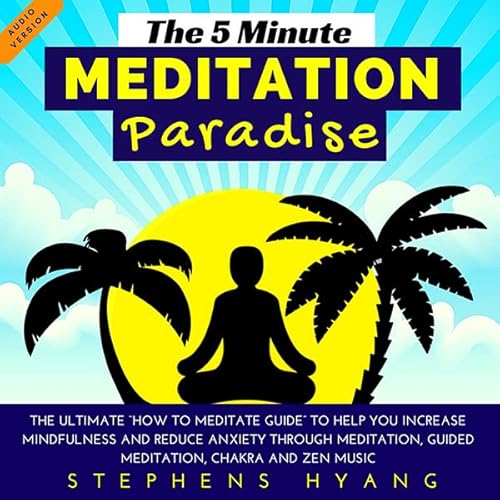
The 5 Minute Meditation Paradise
by Stephens Hyang · narrated by Robert Gazy · 6 hrs and 1 min
The Ultimate "How to Meditate Guide" to Help You Increase Mindfulness and Reduce Anxiety Through Meditation, Guided Meditation, Chakra, and Zen Music
The Main Types of Guided Meditation
Guided breathwork sessions lead you through paced breathing patterns — long exhales for calm, counted breaths for focus — and are the fastest-acting format for stress. Guided body scans move attention slowly through the body, releasing tension region by region; they are the classic choice for insomnia and chronic tightness. Guided visualizations build an imagined scene — a beach, a forest, a safe inner sanctuary — and are the most absorbing format for vivid imaginations and anxious minds that need somewhere pleasant to rest.
Beyond these sit loving-kindness guidances, which lead phrases of goodwill toward yourself and others; mindfulness guidances, which coach open, non-judgmental awareness of the present moment; chakra and energy sessions, which work through the body's traditional energy centers; and sleep meditations, designed to be heard while drifting off, often with progressively quieter narration. Most people gravitate to one or two types quickly. Sample broadly in your first month — variety in these early weeks is research, not inconsistency — then settle into the formats that reliably leave you calmer than they found you.
Guided vs. Silent Meditation: Which Is Better?
Neither is better in absolute terms — they train the same attention muscle with different amounts of scaffolding, and research finds comparable stress and anxiety reductions from both. The real question is which you will actually practice, at this stage of your development. For beginners, guided meditation wins almost every comparison that matters: it is easier to start, easier to sustain, and far less likely to be abandoned in the discouraging second week.
Over time, most practitioners blend the two. Guided sessions remain valuable for variety, for learning new techniques, and for days when the mind is too loud to self-direct. Silent practice develops a self-sufficiency and depth that recordings cannot provide. A sensible progression is guided-only for the first month, guided with occasional silent minutes in months two and three, then a personal mix thereafter. Many experienced meditators still use guided sessions for sleep and body scans decades in. The format is a vehicle; arriving is what counts.
| Factor | Guided meditation | Silent meditation |
|---|---|---|
| Difficulty for beginners | Low — voice provides structure | Higher — self-directed |
| Best for | Learning, busy minds, sleep | Depth, self-sufficiency |
| Structure | Fully paced by the teacher | You set the structure |
| Variety | Thousands of session types | Techniques you already know |
| Equipment needed | Phone or player, headphones | A timer at most |
| Long-term role | Ongoing support and variety | Core independent practice |
How to Get the Most from a Guided Session
Small adjustments dramatically improve results. Use headphones when possible — they deliver the narration intimately and block household noise, which matters more than most people expect. Set the session up before sitting down, so you are not fumbling with a screen mid-practice; better still, download sessions for offline use so notifications cannot ambush you. Sit or lie in the posture the session suggests, and treat the first minute as arrival time: let the voice slow you down rather than demanding instant focus.
During the session, follow instructions lightly rather than perfectly. If the guide says visualize a lake and your mind offers a puddle, take the puddle — approximation is normal, and the nervous system responds to intent as much as vividness. When you notice you have stopped hearing the narration entirely, simply tune back in without criticism; that noticing is the practice working. Finally, give each program a fair trial — three to five sessions — before judging it, because the first listen of any recording is spent learning its style rather than practicing with it.
Choosing a Guided Meditation Program
The guided meditation market is enormous and uneven, so choose by criteria rather than hype. Voice first: you will spend hours with this narrator, and an irritating voice is a deal-breaker no content can overcome — listen to a sample before committing. Length second: sessions should match your real schedule, and for most beginners that means five-to-ten-minute options, not only forty-five-minute epics. Third, look for a structured progression rather than a random pile of tracks, because skill builds through sequence.
Fourth, check the production: background music should support rather than compete with the voice. Audiobook-format programs often excel here because they are produced for sustained listening. The 5 Minute Meditation Paradise, narrated by Robert Gazy, is a strong example of the format done well — over six hours of five-minute guided sessions spanning mindfulness, chakra work, and zen music, so a beginner can progress through techniques without hunting for the next track. Whatever program you choose, commit to it for a month before supplementing; depth with one teacher beats dabbling with ten.
Building a Daily Guided Practice
The habit mechanics are identical to any meditation practice: anchor the session to an existing daily cue, keep it short enough to survive bad days, and track the streak. Guided sessions add two conveniences worth exploiting. Queue tomorrow's session tonight, so morning-you presses one button instead of browsing. And use session length as your flexible floor — on crowded days, a five-minute session counts in full, because the format guarantees those five minutes are complete and well-spent rather than truncated.
Expect the arc most practitioners report: week one is novel and pleasant, weeks two and three are where enthusiasm dips and the habit is truly built, and somewhere around week six the practice begins defending itself — you notice its absence. Rotate session types with your needs: energizing breathwork in the morning, body scans after tense days, sleep meditations at night. A well-chosen library grows with you, meeting a different person each month while the underlying skill quietly compounds.
How to Listen Actively Without Following Every Word
Guided meditation is not simply listening to a soothing voice. The narration offers an action, and you try that action in your own experience. If the narrator asks you to notice your hands, feel their contact rather than imagining what the instruction should look like. If the narrator leaves a pause, continue with the anchor instead of waiting passively for the next sentence. When you miss an instruction because you were thinking, return to what you can hear now. You rarely need to rewind. The purpose is attention practice, not perfect comprehension of a spoken lesson.
You can adapt an instruction while keeping its intention. A narrator may suggest closing your eyes; you can keep them open if that feels safer. A narrator may describe a beach; you can choose a neutral room or simply attend to sound if imagery is uncomfortable. A narrator may ask for deep breathing; you can leave your breathing natural. The recording does not know your physical condition, emotional state, or history. Following with discernment is more important than following literally. A useful guided session leaves you oriented and able to make choices, rather than feeling compelled to endure an experience because the audio has not finished.
Check the distinction between spoken instruction and background content. Music can support the atmosphere, but it is not necessarily the meditation anchor. If you find yourself analyzing the melody, return to the action the guide has suggested. Conversely, a sound-focused session may explicitly invite listening as the main practice. Knowing which you are doing reduces confusion. With The 5 Minute Meditation Paradise, review the description and sample to understand the style before choosing a passage. The title alone does not establish the duration of every track or guarantee that each passage will fit your available time.
A Practical Checklist for Choosing a Guided Recording
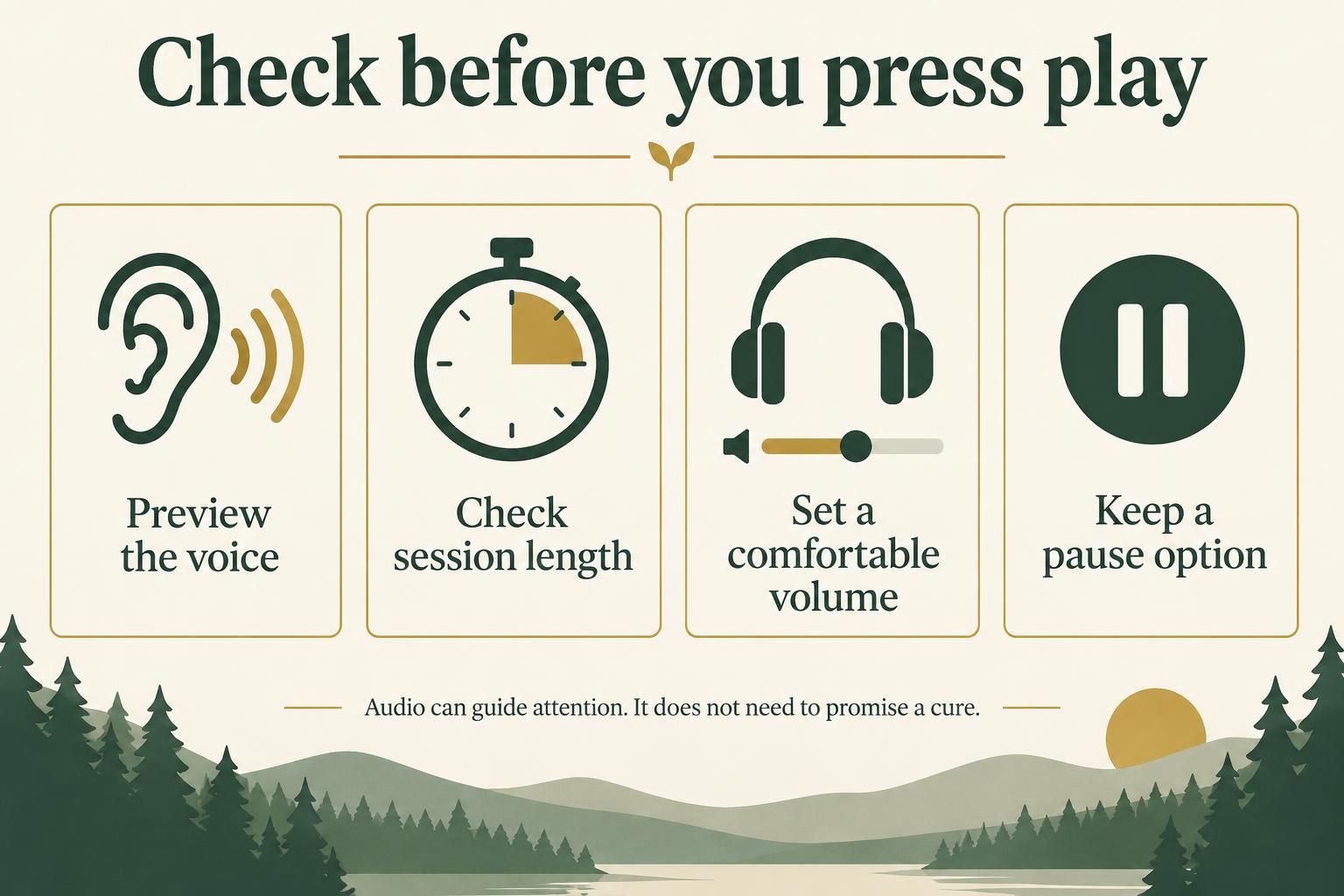
Begin with voice and pacing. A teacher may be well known, but if the tone makes you tense or the instructions arrive too quickly, another recording may suit you better. Preview several minutes when a sample is available. Notice whether the guide explains what to do, leaves workable pauses, and avoids implying that distraction is failure. Check the stated session length and the type of practice. A body scan, visualization, loving-kindness exercise, and sleep story can have different purposes even when they all appear under a meditation label. Choose according to what you want to practice, not only how attractive the cover looks.
Consider practical accessibility. Can you understand the voice clearly at a comfortable volume? Are transcripts or captions available if you need them? Can the passage be downloaded for offline use, and do the current purchase terms permit that? Do not assume that a subscription, audiobook, or free app has identical access conditions. Review the listing where you will actually listen. If you are practicing around other people, decide whether speakers or headphones are more appropriate. Keep enough awareness of your surroundings when safety requires it, and never use a session that encourages closing your eyes while driving or operating equipment.
Be cautious with claims that a recording will cure a disorder, reset hormones, or produce a specific brain state. A pleasant experience is not evidence for those promises. Commercial audio may offer a useful structure, but it is not equivalent to an individualized clinical intervention. If your goal concerns persistent anxiety, trauma symptoms, or severe insomnia, seek appropriate care and discuss whether guided meditation is a suitable complement. The best recording for ordinary practice is often a modest one: clear instructions, a manageable length, and a voice that helps you return without making the session feel like a test.
Move Gradually from Guidance to Your Own Practice
You do not have to stop using guided audio to become an experienced meditator. Still, learning a simple unguided fallback can make practice more flexible. After a familiar recording, sit for another brief interval with the same anchor. Notice what changes when the voice is absent. Perhaps you worry that you are doing it wrong, or perhaps the silence feels easier. Recognize that reaction and continue with one clear instruction: attend, notice wandering, return. The additional interval can be very short. The purpose is to discover that the essential action remains available even when no one is narrating it.
Another approach is to use a recording for the opening and closing while keeping a quiet interval in the middle. Make sure you understand your playback controls before beginning, rather than repeatedly handling the phone during the session. If this feels awkward, use a simple timer on another day. The transition does not need to follow a fixed timetable. Some people prefer ongoing guidance because it supports accessibility or reduces uncertainty. Others enjoy silence. Neither preference establishes superiority. Choose the arrangement that helps you practice consistently without increasing strain or dependence on a perfect set of conditions.
Evaluate your listening routine outside the headphones as well. Are you using audio to begin a practice, or endlessly browsing recordings in place of practicing? Are you choosing sessions that fit your day, or saving an ideal hour that never arrives? A familiar passage from The 5 Minute Meditation Paradise can be a practical default if it suits you, but keep your attention on what you actually do while listening. Afterward, return to ordinary activity deliberately. Guided meditation becomes valuable when the voice helps you understand and repeat a skill, not when it merely fills a quiet period with reassuring sound.
A Practical Detail to Keep in Mind
A transcript, when available, can help you assess a session before listening. Scan for instructions that suit your purpose and for any language that feels uncomfortable. A visualization may contain imagery you do not want to use, while a body scan may ask for inward attention that is not helpful today. Choosing another passage is a sensible adaptation. You can also read a short instruction and practice in silence. This retains the educational value of the guide without requiring continuous audio. Accessibility and comfort matter more than following a particular production from beginning to end. The best listening routine remains one you can adjust with confidence.
Start listening today
The 5 Minute Meditation Paradise
by Stephens Hyang · narrated by Robert Gazy · 6 hrs and 1 min
The Ultimate "How to Meditate Guide" to Help You Increase Mindfulness and Reduce Anxiety Through Meditation, Guided Meditation, Chakra, and Zen Music
Frequently asked questions
Is guided meditation as effective as meditating alone?
Yes. Studies comparing guided and self-directed meditation find comparable reductions in stress and anxiety, since both train the same attention skills. Guided sessions are actually more effective for many beginners because structure and pacing improve consistency — and consistency is what produces results.
How long should a guided meditation be?
For building a daily habit, five to ten minutes is ideal — long enough to settle and practice, short enough to do every day. Longer sessions of twenty to forty-five minutes are valuable once the habit is established. Sleep meditations can run longer because they are designed to be drifted away from.
Can I fall asleep during a guided meditation?
If it is a sleep meditation, that is the point. During daytime practice, occasional drifting off usually means you are tired rather than failing — practice earlier in the day, sit more upright, or keep your eyes slightly open. Frequent sleepiness is useful data about your rest, not a character flaw.
Do I need headphones for guided meditation?
Headphones are not required but strongly recommended. They make the narration feel intimate, block household noise, and deliver music with full depth, which deepens relaxation. Any comfortable pair works — this is one practice where equipment genuinely improves the experience.
How do I know if a guided meditation is good?
Judge after three to five sessions, not one. Signs of quality: a voice you find calming, clear and unhurried instructions, music that supports rather than dominates, and a noticeable difference in how you feel afterward. The best test is simple — do you return to it willingly tomorrow?
Guided meditation is the kindest on-ramp ever built for an ancient skill: press play, follow a calm voice, and let the structure carry you until you can carry yourself. Start tonight with one five-minute session. The 5 Minute Meditation Paradise was made for exactly this first step — short, beautifully paced guided practices with zen music that make tomorrow's session something to look forward to.


