Key takeaways
- •Slow, predictable music near 60 bpm measurably calms heart rate and breathing.
- •Music masks unpredictable household noise — often its most practical benefit.
- •Match sound to purpose: bowls and drones for sitting, nature for calm, soft piano for sleep.
- •Let music support attention rather than replace it; the breath remains the anchor.
How Music Affects the Meditating Brain
Music is one of the few stimuli that acts directly on the autonomic nervous system. Slow tempos entrain physiological rhythms: heart rate and breathing unconsciously drift toward the pace of the sound, which is why pieces around sixty beats per minute — roughly a resting heartbeat — reliably produce relaxation responses in studies. Soft, consonant harmonies reduce cortisol, while the absence of sudden changes keeps the brain's orienting response quiet, so attention is not repeatedly yanked away from the practice.
Music also works on attention itself. Meditation's core challenge is a wandering mind, and gentle sound provides an auxiliary anchor: when the breath feels too subtle to hold, the music offers something easier to rest on. Researchers call this facilitated attention, and it explains why beginners so often report deeper sessions with music than without. The trade-off is that music can become the object rather than the support, a balance the later sections of this guide will help you strike.
Ambient and Drone Music
Ambient meditation music consists of slow-moving textures — sustained synthesizer pads, gentle drones, sparse piano notes with long decays. There is no beat to follow and no melody demanding attention, which is precisely the point: the sound creates an atmosphere, a sonic room in which the mind can settle. Pioneers of the genre designed it to be, in their words, as ignorable as it is interesting, and that balance makes it ideal for meditation.
Drones deserve special mention. A single sustained tone — or a tone with slow-beating harmonics — gives the ear one stable reference point, functioning almost like a mantra made of sound. Indian classical music has used the tanpura drone beneath meditation and practice for centuries. For seated breath work, ambient and drone tracks are the most versatile choice: stimulating enough to hold restless attention, neutral enough not to lead it.
Recommended listening
The 5 Minute Meditation Paradise
by Stephens Hyang · narrated by Robert Gazy · 6 hrs and 1 min
The Ultimate "How to Meditate Guide" to Help You Increase Mindfulness and Reduce Anxiety Through Meditation, Guided Meditation, Chakra, and Zen Music
Singing Bowls, Gongs, and Sound Baths
Tibetan and crystal singing bowls produce rich, slowly evolving tones with complex overtones that seem to shimmer in the air. Struck or rimmed with a mallet, a single bowl can sustain a note for half a minute, and practitioners have used that long decay as a meditation object for generations: attention rides the tone from bloom to silence, training sustained focus in a way the breath rarely matches for sheer beauty.
Sound baths — sessions where participants lie down while a facilitator plays bowls, gongs, and chimes — have become one of the most popular entry points into meditative states. The experience requires no technique at all: you simply receive the sound, and the sound does the settling. Research on sound meditation is young but promising, with studies showing reduced tension, anger, and fatigue after single sessions. For home practice, recorded bowl sessions offer much of the benefit, especially through headphones that reproduce the low frequencies.
Nature Sounds and Why They Work
Rainfall, ocean waves, forest birdsong, and wind through leaves are the oldest meditation music on earth, and modern research confirms what monks in forest monasteries always knew: natural soundscapes lower stress markers and improve mood more reliably than urban noise or silence for many people. Evolutionary researchers argue our nervous systems read gentle nature sounds as safety signals — an environment calm enough for birdsong is an environment without threats.
Nature tracks are particularly effective for masking. Their broad, irregular frequency content covers the unpredictable sounds that sabotage home practice — traffic, neighbors, plumbing — without demanding attention themselves. Ocean waves even provide a built-in breathing metronome, their slow rhythm encouraging the long exhales that activate calm. If ambient synth textures feel artificial to you, nature recordings offer an organic alternative with essentially the same function.
Binaural Beats and Brainwave Music: Hype vs. Evidence
Binaural beats are created by playing slightly different frequencies into each ear — say 200 Hz in the left and 210 Hz in the right — producing a perceived pulsing at the 10 Hz difference. Sellers claim these pulses entrain brainwaves into states of relaxation, focus, or deep meditation. The honest scientific verdict is mixed: some studies show modest improvements in anxiety and attention, others show no effect beyond placebo, and the entrainment mechanism remains unproven at the strengths recordings produce.
The practical takeaway is that binaural tracks are neither magic nor useless. Many are embedded in genuinely pleasant ambient music that calms by the well-established mechanisms described above, and the placebo effect is a real effect when the goal is subjective relaxation. If you enjoy them and they help you sit, use them freely — just do not expect frequencies to do the practice for you. No recording has yet been invented that notices your wandering mind and brings it back; that part remains gloriously manual.
| Sound type | Character | Best for | Cautions |
|---|---|---|---|
| Ambient and drones | Slow textures, no beat | Seated breath work | Can feel cold to some listeners |
| Singing bowls | Long shimmering tones | Deep focus, sound baths | Quality varies; use headphones |
| Nature sounds | Rain, waves, birdsong | Masking noise, relaxation | Avoid tracks with sudden loud events |
| Soft piano or flute | Gentle melody, sparse | Evening wind-down, sleep | Melodies can pull attention |
| Binaural beats | Pulsed tones under ambient | Experimenters, placebo-friendly | Evidence is mixed; manage expectations |
| Guided music sessions | Narration over music | Beginners, anxious minds | Choose calm, unhurried narrators |
Using Music in Your Sessions Without Becoming Dependent
The healthiest relationship with meditation music treats it as scenery rather than vehicle. Begin sessions by resting attention on the breath, letting the music play in the background of awareness. When the mind wanders, return to the breath; when the breath is elusive, borrow the music for a few cycles, then return. This keeps the trainable skill — self-directed attention — in the lead while still harvesting music's calming and masking benefits.
Watch for the dependency sign: an inability or strong reluctance to sit in silence. If it appears, alternate days — music one day, silence the next — so neither becomes mandatory. Many practitioners also vary volume with purpose: barely audible for morning alertness practice, richer for evening relaxation. And for days when even choosing feels like effort, pre-built sessions that blend narration with music, such as the zen music practices in The 5 Minute Meditation Paradise, remove every decision except pressing play.
Building Your Meditation Sound Environment
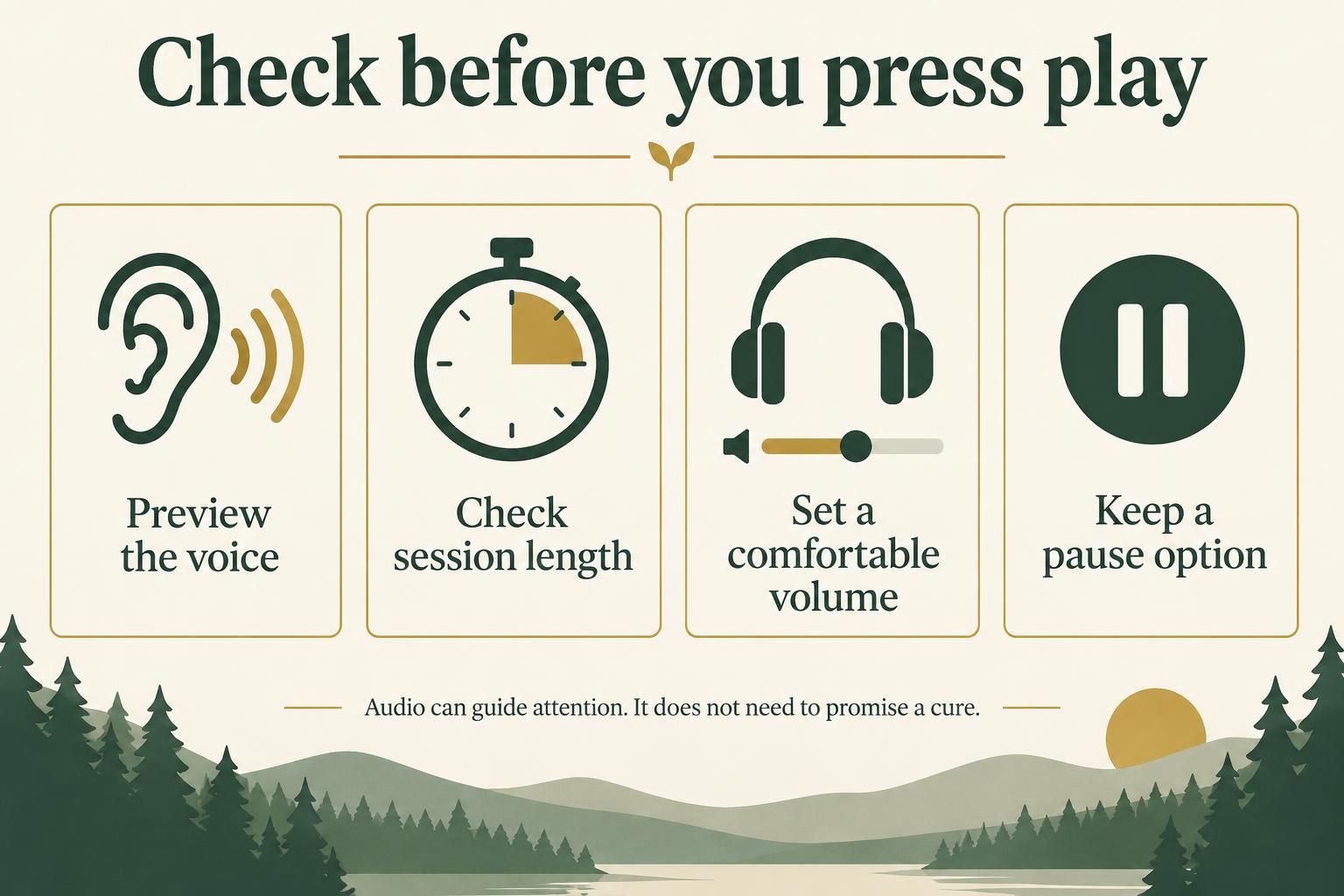
A few practical choices dramatically improve the sound side of practice. Headphones matter more than any other equipment: closed-back designs block household noise and reproduce the low frequencies of bowls and drones that phone speakers cannot touch. Volume should sit lower than feels natural at first — music that is just audible draws attention gently, while louder music performs at you. Create two or three playlists by purpose rather than hundreds of tracks: one for morning practice, one for evening wind-down, one for sleep.
Test every track before trusting it in practice. Many supposedly calm playlists hide mid-song surprises — a drum entrance, a vocal, an advertisement — that detonate a quiet mind. Ad-free sources are worth paying for; a single interruption costs more calm than a month of subscription fees. Finally, remember that the environment includes the room: soft furnishings, closed doors, and a fan's white noise all contribute. The best meditation music is the one you stop noticing within three breaths.
Make Music an Anchor, a Background, or Neither
Before choosing a playlist, decide what role the music will play. In a listening meditation, sound is the main object of attention. You notice a tone beginning, changing, and ending, then return when your mind moves into a story. In a breath-focused session, music may simply sit in the background while breathing remains the anchor. In a guided session, the narrator's instructions may take priority over both. These arrangements are all possible, but mixing them without intention can create confusion. If you keep switching between following the melody, counting breaths, and waiting for a voice, simplify the session to one clear purpose.
For music as an anchor, choose a passage that does not demand constant prediction or analysis. A familiar instrumental piece may be easier than a favorite song whose lyrics bring back vivid memories. Notice the sound as vibration, rhythm, and silence rather than grading the composition. When you recognize that you are mentally preparing the next note, return to what is audible now. You do not need to listen with unusual intensity. A comfortable, receptive attention is enough. If the music becomes emotionally overwhelming, lower the volume, switch to an ordinary room sound, or stop. An anchor should be workable, not something you must endure.
For background music, keep it quiet enough that it does not compete with the chosen practice. If you notice that every new chord captures attention, use a simpler track or try silence. Some people prefer natural environmental sounds precisely because they are not organized into an emotional narrative. Others find silence distracting and appreciate a steady backdrop. Treat these as preferences rather than evidence that one style is universally better. Meditation music can support a routine, but the attention practice still involves noticing where the mind has gone and returning. A playlist alone does not guarantee that you are practicing that skill.
Volume, Headphones, and a Safe Listening Environment
Start at a low, comfortable volume and adjust only enough to hear clearly. There is no need for music to fill every corner of awareness. Prolonged loud listening can harm hearing, and discomfort is a reason to turn the volume down or stop. If you already have tinnitus, sound sensitivity, or another hearing concern, ask an appropriate professional what listening arrangements suit you. A calming label on a recording does not make any volume safe. Speakers can be preferable when headphones feel enclosing or when you need to remain aware of a child, a doorbell, or other important activity nearby.
Avoid using isolating headphones in settings where outside sound is necessary for safety. Walking beside traffic, cycling, driving, and operating equipment are not occasions for a session that asks you to close your eyes or disengage from your surroundings. At home, choose a position where you will not trip over a cable when standing. Set up playback before you begin so that repeated adjustments do not become the main activity. A little preparation makes the listening experience more practical, but it need not become elaborate. One familiar recording and a simple pause option are often enough.
If you use music at bedtime, distinguish winding down from formal attention training. It is fine to fall asleep to suitable audio if that is your intention and the setup is safe. You do not need to interpret sleep as a failed meditation session. Conversely, if your aim is alert awareness, sitting upright earlier in the day may be more useful than listening while exhausted in bed. Review any automatic playback or sleep timer settings so that a quiet passage is not followed by an unexpected louder track. Practical listening choices matter more than whether the recording is marketed with an especially spiritual or scientific description.
Evaluate Frequency Claims and Build a Simple Listening Trial
A track may advertise a particular frequency, binaural beat, or brainwave effect. Those descriptions can sound precise while the claimed personal benefit remains uncertain. A specified audio frequency is not proof that the recording heals tissue, balances energy, or reliably creates a desired mental state. Research on particular sound-based interventions cannot automatically validate every commercial playlist using similar language. If a recording feels pleasant, you can enjoy it without adopting its strongest claims. Choose based on comfort, clarity, and how the sound supports your practice. Avoid paying more solely because a listing suggests a guaranteed therapeutic effect.
Try a modest comparison over several ordinary sessions. On one day, practice with a quiet instrumental passage. On another, use natural room sound. On a third, use a short guided recording. Keep the approximate time and session length similar where practical. Afterward, note whether the sound supported attention, created distraction, or made you sleepy. This is a personal preference experiment, not a controlled clinical test. Sleep, workload, and expectations will influence the result. The aim is to select an arrangement you want to repeat, not to prove that one soundtrack has permanently changed your nervous system.
The 5 Minute Meditation Paradise is an audiobook option if you want to explore guided content alongside meditation-themed listening. Check the current description and sample to identify what is actually included and which passage fits your purpose. Do not infer specific track durations, frequencies, or treatment benefits from the title. Once you choose something suitable, keep it readily available rather than browsing endlessly. Music adds value when it helps you enter and sustain a clear practice. It becomes less useful when selecting the perfect sound replaces the simple act of sitting, listening, noticing distraction, and returning.
A Practical Detail to Keep in Mind
If you create a playlist, keep the first version simple. Choose one or two tracks with similar volume and avoid abrupt advertisements or transitions where possible. Check the actual playback behavior before the session. A track that is calm in isolation may be followed automatically by something very different. Save the arrangement so that selecting music does not consume the practice window. When you want to compare silence, do so on another day rather than repeatedly switching during the same session. This makes your preference easier to understand. Notice whether the music helps you attend or merely becomes another object to optimize. Either way, the observation can guide a practical change. There is no need to build a permanent soundtrack for every mood. A small dependable collection, a comfortable volume, and a reliable pause option often provide all the support required. If sound sensitivity changes from day to day, leave room for that variation rather than insisting that yesterday's playlist must feel soothing again.
Start listening today
The 5 Minute Meditation Paradise
by Stephens Hyang · narrated by Robert Gazy · 6 hrs and 1 min
The Ultimate "How to Meditate Guide" to Help You Increase Mindfulness and Reduce Anxiety Through Meditation, Guided Meditation, Chakra, and Zen Music
Frequently asked questions
Is it better to meditate with music or in silence?
Neither is universally better. Silence develops self-directed attention most directly, while music helps beginners settle, masks environmental noise, and makes sessions more enjoyable — which improves consistency. A practical approach is alternating: music when you need support, silence when you want depth.
What kind of music is best for meditation?
Slow, steady, minimally structured music works best: ambient textures, drones, singing bowls, nature sounds, or sparse instrumental pieces around sixty beats per minute. Avoid songs with lyrics, strong beats, or dramatic dynamics, all of which pull attention away from practice.
Do binaural beats really work for meditation?
The evidence is mixed. Some studies show modest anxiety reduction, others find no effect beyond placebo. The underlying ambient music in most binaural tracks is genuinely relaxing, so if you enjoy them, use them — just do not expect the frequencies alone to produce meditative states.
Can I use my favorite calm songs for meditation?
You can, but familiar songs carry memories and emotional associations that capture attention — the opposite of what practice needs. Instrumental music you do not know well works better. Save beloved songs for relaxation and choose neutral soundscapes for training attention.
How loud should meditation music be?
Just barely audible — quieter than feels natural at first. Low volume lets the music support attention without becoming its object, and it preserves your ability to hear the breath. If you notice the music more than your breathing for long stretches, turn it down.
Meditation music is not a shortcut around practice, but it is a beautiful road into it — calming the body, masking the world, and giving a restless mind something gentle to hold. Build your playlists, lower the volume, and sit. For sessions where music and guidance arrive perfectly blended, The 5 Minute Meditation Paradise offers hours of zen music meditation designed to carry you straight to stillness.


