Key takeaways
- •Meditation is attention training: focus, wander, notice, return — that is the whole practice.
- •It is not emptying the mind; a busy mind is the material it works with.
- •Major types include mindfulness, concentration, loving-kindness, and movement practices.
- •Five to ten daily minutes produce research-backed benefits within weeks.
A Precise Definition
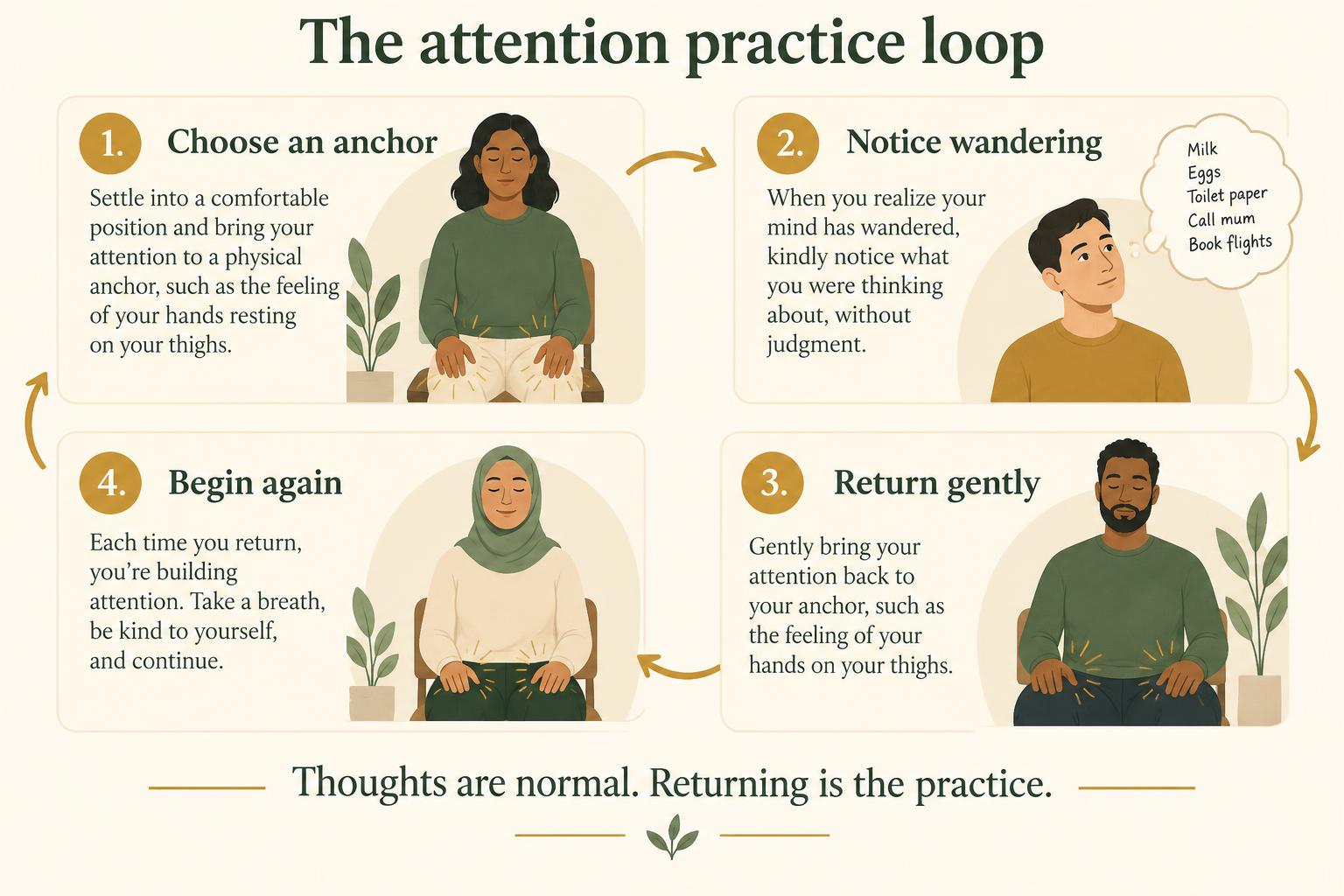
Meditation is the deliberate practice of training attention and awareness. In every authentic form, the same basic loop appears: you choose an object of attention — the breath, a phrase, a flame, a sound, physical sensation. You rest attention on it. The mind wanders, because minds wander. You notice the wandering and return. Repeat. That loop, practiced regularly, is meditation. Everything else — posture, tradition, duration, setting — is elaboration.
Two clarifications complete the definition. First, meditation is training, not a state: the calm, clarity, and insight associated with it are results of the training, not the activity itself. Second, it is active, not passive. Meditation looks like doing nothing, but the repeated act of noticing and returning is genuine mental work — the reason a ten-minute sit can leave you feeling like you exercised, because neurologically, you did.
What Meditation Is Not
The misconceptions deserve equal time, because they stop more beginners than any difficulty. Meditation is not emptying the mind — no tradition teaches stopping thought, which is as impossible as stopping the heartbeat; the goal is changing your relationship with thoughts, not eliminating them. It is not a trance or escape from reality: meditation is training in contact with reality, staying present with experience exactly as it is rather than drifting from it.
It is not necessarily religious. Although the great traditions developed it, modern meditation is widely practiced as secular mental training in hospitals, schools, and corporations, requiring no beliefs whatsoever. It is not reserved for the naturally calm: restless, anxious, skeptical people are precisely who benefits most, since they have the most attention to train. And it is not time-consuming — the research dose that produces measurable benefits starts at ten minutes a day, and beginners see real changes from five.
Recommended listening
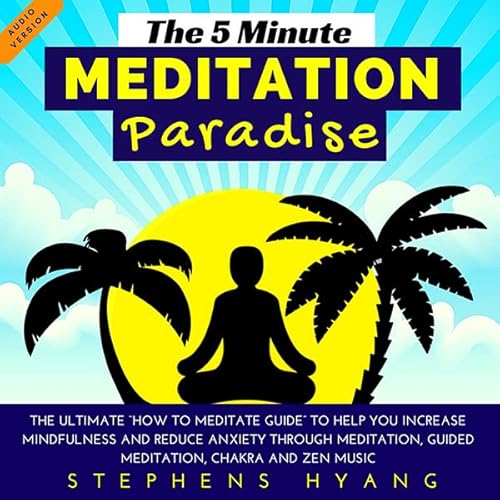
The 5 Minute Meditation Paradise
by Stephens Hyang · narrated by Robert Gazy · 6 hrs and 1 min
The Ultimate "How to Meditate Guide" to Help You Increase Mindfulness and Reduce Anxiety Through Meditation, Guided Meditation, Chakra, and Zen Music
The Main Types of Meditation
Hundreds of named techniques cluster into a few great families. Concentration meditation narrows attention onto one object — breath, mantra, candle flame — building stability and calm; it is the oldest and most beginner-friendly family. Mindfulness meditation opens attention to observe whatever arises in the present moment, without judgment; it is the most scientifically studied family and the basis of modern clinical programs.
Loving-kindness meditation cultivates goodwill through repeated phrases directed at yourself and others, softening self-criticism and strengthening connection. Movement-based practices — walking meditation, yoga, qigong — anchor attention in physical motion for people who cannot sit still. And guided meditation, technically a format rather than a family, leads you through any of the above with a teacher's voice, making it the gentlest entry point for beginners. Programs like The 5 Minute Meditation Paradise blend several families into short guided sessions, letting new practitioners sample the landscape before settling into a favorite.
What Happens in Your Brain When You Meditate
Decades of imaging research have turned meditation from mystery into measurable physiology. During practice, attention networks in the prefrontal cortex engage while the default mode network — the circuitry of mind-wandering, rumination, and anxious self-referencing — quiets down. Slow breathing activates the vagus nerve, shifting the autonomic nervous system from fight-or-flight toward rest-and-digest within minutes: heart rate slows, blood pressure drops, stress hormones fall.
With regular practice, the changes become structural. Studies of eight-week programs show increased gray-matter density in the hippocampus, supporting memory and emotional regulation, and decreased density in the amygdala, the brain's threat detector. Connectivity between rational and emotional regions strengthens, which practitioners experience as a longer pause between trigger and reaction. These are not subtle laboratory curiosities — they map directly onto the reported effects: less stress, steadier mood, sharper focus, better sleep. Meditation is attention exercise, and like all exercise, it remodels the organ it trains.
Why People Meditate
People come to meditation through many doors. The largest is stress: meditation is among the best-evidenced self-directed tools for downshifting an overactive stress response. Close behind are anxiety and low mood, where mindfulness-based programs show benefits comparable to first-line treatments in some trials. Others arrive seeking better sleep, sharper focus for demanding work, relief from chronic pain, or support through illness and grief.
Then there are the quieter reasons. Some people meditate to know themselves — to watch their own minds with the curiosity they would bring to a fascinating stranger. Some come for spiritual growth, following a path thousands of years old. And many simply report that practice makes them kinder: more patient with children, less reactive in conflict, more present with the people they love. Whatever the entry point, the mechanism is the same trained attention — the benefits simply bloom in whichever part of life needs them most.
Try It: Meditation in Five Minutes
Definitions clarify, but only experience answers the question fully — and five minutes is enough for a first taste. Sit in a chair with your spine tall and feet flat. Set a timer for five minutes. Close your eyes, take three slow breaths, then let your breathing find its natural rhythm. Rest your attention on the physical sensation of breathing — the cool air at your nostrils, or the rise and fall of your belly. Feel one whole breath, then the next.
Within seconds your mind will wander into thought. When you notice — and noticing may take a while — that is not failure; that noticing is the practice itself. Say quietly to yourself, thinking, and return to the breath. Do this for five minutes: breathing, wandering, noticing, returning. When the timer sounds, sit for one more breath before opening your eyes, and register how you feel. You have now done the thing this article defines. Every meditator on earth, from Himalayan hermits to hospital patients, practices some version of exactly what you just did.
Where Meditation Fits in Modern Life
Meditation's modern journey is remarkable: a practice refined in monasteries now appears in hospitals, where mindfulness programs treat pain and prevent depression relapse; in schools, where brief practices improve student attention; in corporations, where it buffers burnout; and in therapy, where it partners with counseling for anxiety and trauma. The World Health Organization and national health services acknowledge its benefits, and tens of millions practice daily.
For the individual, meditation fits modern life precisely because it asks so little. No equipment, no gym, no cost — five minutes and a chair. It scales from a three-breath pause before a difficult conversation to hour-long retreats, and travels anywhere attention travels. In an economy engineered to capture and sell your attention, the quiet decision to train and keep it is almost radical. Meditation is, at bottom, the practice of owning your own mind — and there has never been a moment in history when that ownership mattered more.
| Question | Short answer |
|---|---|
| What is meditation? | Deliberate training of attention and awareness |
| What do you do? | Focus on an anchor, notice wandering, return |
| How long per day? | Five to ten minutes for beginners |
| Do you need beliefs or equipment? | No — only attention and a place to sit |
| When does it work? | Measurable benefits within about eight weeks |
| What does it help? | Stress, anxiety, focus, sleep, emotional balance |
A Definition Broad Enough for Different Traditions
Meditation is best understood as a family of intentional practices rather than one identical activity. Many methods train attention through an anchor such as breathing, sound, a phrase, or bodily sensation. Others emphasize receptive awareness, compassion, contemplation, or a particular spiritual aim. These practices can share features while differing in purpose and instruction. A secular exercise for managing everyday stress is not necessarily the same as a religious discipline aimed at liberation or communion with the divine. Defining meditation broadly helps avoid the assumption that one modern technique explains every tradition that uses stillness, repetition, or reflective attention.
A practical definition for a beginner is an intentional period in which you practice a chosen way of attending. That definition distinguishes meditation from simply being quiet. You might sit silently while rehearsing an argument without recognizing that you are doing so. You might also sit in a noisy room and repeatedly return to an ordinary sound with awareness. The second activity can be a meditation practice despite the imperfect setting. The defining feature is not the appearance of the room or the absence of thought. It is the deliberate method and your awareness of participating in it.
This does not mean that every moment of concentration should automatically be called meditation. Reading, playing music, solving a problem, and watching a film can involve focused attention, but their immediate purpose is usually the activity itself. Meditation sets aside a period to work with attention or awareness as the practice. The boundary can be flexible, especially in movement-based and contemplative traditions, yet the intention remains useful. Ask what you are practicing, what you attend to, and what you do when attention moves. Clear answers make the term more informative than a general label for anything that feels peaceful.
Why Thoughts Do Not Disqualify a Session
The idea that meditation requires a blank mind is one of the most persistent misunderstandings. Thoughts are ordinary mental events. During an attention practice, you may plan, remember, evaluate, or imagine before realizing that the anchor has been lost. Recognizing this shift gives you an opportunity to return. If you interpret every thought as failure, the session becomes a struggle against normal experience. If you understand wandering as part of the process, you can practice without demanding an impossible standard. This is not permission to drift indefinitely; it is a clearer understanding of what the return is for.
A useful analogy is learning to listen in a conversation. You may briefly think about your reply, notice that you have stopped hearing the other person, and turn attention back. The noticing does not erase the lapse, but it changes what happens next. Meditation gives you a more deliberate setting for practicing a related action. Choose one clear anchor, recognize when attention has moved, and return. You can use a short label such as thinking if it helps, but detailed analysis is unnecessary. The next ordinary sensation is enough to restart the process.
A quiet mind may occur sometimes, but it is not a reliable test of correct practice. Sleepiness, fatigue, pleasant drifting, and genuine stability can all feel quiet in different ways. Similarly, a busy session can include many useful moments of recognition. Evaluate the method rather than only the mood. Are you reasonably alert? Do you know the intended anchor? Can you return without excessive force? Can you stop or adapt when needed? These questions keep the definition grounded in observable actions rather than an idealized state that every person is expected to produce on demand.
Meditation, Relaxation, and Clinical Care Are Different Things
Relaxation aims to reduce tension or create a pleasant sense of ease. Meditation may be relaxing, but some methods are primarily concerned with awareness, insight, compassion, or concentration. A session can therefore be valid without feeling soothing. At the same time, discomfort should not automatically be celebrated as progress. Increasing anxiety, upsetting memories, or disconnection can be reasons to pause and seek guidance. The distinction is practical: ordinary wandering may be part of attention training, while escalating distress deserves an appropriate response. A definition of meditation should not erase the need to remain safe and responsive to your experience.
Clinical care involves assessment and treatment tailored to a person's needs. Some structured mindfulness programs are studied in healthcare settings, but a general meditation exercise is not equivalent to that care. Research findings depend on the intervention, population, comparison group, and outcome measured. They cannot justify a promise that any short recording will treat a disorder or produce a specific brain change. If you have persistent symptoms, keep appropriate treatment in place and discuss meditation as a possible complement. It should not become a reason to stop medication, delay help, or interpret lack of improvement as insufficient effort.
Commercial resources can still be useful within those limits. The 5 Minute Meditation Paradise offers an audiobook format to explore through its current listing and sample. If the narration suits you, a chosen passage may help organize a practice. Check what the passage actually asks you to do and adapt it when necessary. A recording provides general instruction, not an individualized judgment. The most useful outcome is understanding a repeatable activity: you can begin, attend, notice wandering, return, and finish deliberately. Meditation becomes less mysterious when it is understood as a practice you can learn rather than a universal promise of calm.
A Practical Detail to Keep in Mind
One reason definitions become confusing is that people use meditation to describe both a method and an experience. A teacher may say practice this meditation, meaning a sequence of actions. A practitioner may say I was in meditation, meaning a particular subjective state. Those statements are related but not identical. A beginner can perform a method without having the experience another person describes. Keeping the distinction visible reduces pressure to manufacture something unusual. Ask which meaning is intended when a claim seems unclear. The method can usually be described through instructions, while the experience may be personal and difficult to compare. Neither should automatically validate every claim made about the other. This distinction is especially important in promotional language, where a recording may imply that following a sequence guarantees a profound state. It is more honest to offer the sequence as a practice to explore. Readers can then evaluate comfort, clarity, and practical usefulness without believing that a session has failed because their experience remained ordinary. An understandable definition leaves room for variation rather than making one report the standard for everyone.
Start listening today
The 5 Minute Meditation Paradise
by Stephens Hyang · narrated by Robert Gazy · 6 hrs and 1 min
The Ultimate "How to Meditate Guide" to Help You Increase Mindfulness and Reduce Anxiety Through Meditation, Guided Meditation, Chakra, and Zen Music
Frequently asked questions
What is meditation in one sentence?
Meditation is the practice of deliberately training your attention — focusing on an anchor like the breath, noticing when the mind wanders, and gently returning — which over time builds calm, focus, and emotional balance.
Is meditation about emptying your mind?
No. No authentic tradition teaches stopping thoughts, which is impossible. Meditation changes your relationship with thoughts — you learn to notice them without being carried away — rather than eliminating them. A busy mind during practice is normal and expected.
Is meditation religious or spiritual?
It can be either. Meditation developed within Buddhist, Hindu, and other contemplative traditions, but modern practice is largely secular — attention training taught in hospitals and schools with no beliefs required. You choose the frame; the technique works the same.
Who can meditate?
Anyone. Meditation requires no flexibility, fitness, beliefs, equipment, or experience, and it adapts to any body and schedule — seated, lying, walking, three minutes or sixty. Restless and anxious people often benefit most, since they have the most attention to train.
How is meditation different from just relaxing?
Relaxation is a state; meditation is a training that sometimes produces it. Relaxation fades within hours, while meditation builds lasting capacities — earlier awareness of stress, longer pauses before reacting, steadier focus — that persist between sessions and compound over months.
Meditation, in the end, is the practice of showing up for your own mind — five minutes at a time, with patience. You have the definition; the five-minute session above gives you the experience. If you would like company for the next one, The 5 Minute Meditation Paradise will guide you gently from here.


