Key takeaways
- •Meditation's systematic roots lie in ancient India, with the Buddha's teachings around 500 BCE as a landmark.
- •Trade routes carried practice across Asia, diversifying into Zen, Vajrayana, and many local traditions.
- •Contemplative practice arose independently in Christian, Islamic, and Jewish mysticism.
- •The 1970s science boom transformed meditation from spiritual practice into studied mental training.
Ancient Origins: India Before the Buddha
The earliest written evidence of meditation appears in the Vedas, India's oldest scriptures, composed between roughly 1500 and 500 BCE, where hymns describe sages in deep contemplative states. Archaeological hints run older still — seals from the Indus Valley civilization, over four thousand years old, depict figures in what look like meditative postures, though interpretation is debated. By the time of the Upanishads, around 700 to 500 BCE, Indian thought had developed sophisticated frameworks for inner practice: breath control, withdrawal of the senses, concentration, and absorption, later codified in Patanjali's Yoga Sutras as the eight limbs of yoga.
What made early Indian meditation distinctive was its systematic ambition. These were not vague mystical moods but technologies of mind, with graded stages, named states of absorption, and fierce debates about method. Practitioners renounced ordinary life to pursue them, forming communities of wandering ascetics whose experiments in attention remain astonishingly relevant — the breath awareness taught in a modern hospital mindfulness course descends in a traceable line from techniques refined in Indian forests over two millennia ago.
The Buddha and the Birth of Mindfulness
Around 500 BCE, a former prince named Siddhartha Gautama — later known as the Buddha, the awakened one — tested the extreme practices of his era, from starvation to breath suspension, and rejected them in favor of what he called the middle way. His innovation was not meditation itself, which he learned from existing teachers, but a rebalanced method: ethics as foundation, concentration as tool, and insight into the nature of experience as the goal. The Satipatthana Sutta, his discourse on the foundations of mindfulness, remains the single most influential meditation manual ever written — and the direct ancestor of modern mindfulness-based stress reduction.
The Buddha taught for forty-five years, and his followers memorized and transmitted his teachings orally for centuries before writing them down. Two great vehicles eventually emerged: Theravada, emphasizing individual liberation through insight meditation, dominant in Sri Lanka and Southeast Asia; and Mahayana, emphasizing compassion and the liberation of all beings, which traveled north into China, Korea, Japan, and Vietnam. Nearly every meditation practiced today, secular or religious, carries something of this 2,500-year-old rebalancing in its DNA.
Recommended listening
The 5 Minute Meditation Paradise
by Stephens Hyang · narrated by Robert Gazy · 6 hrs and 1 min
The Ultimate "How to Meditate Guide" to Help You Increase Mindfulness and Reduce Anxiety Through Meditation, Guided Meditation, Chakra, and Zen Music
East Along the Silk Road: China, Tibet, and Japan
Meditation traveled with traders and monks along the Silk Road, reaching China by the first century CE. There it met Daoism's own contemplative traditions, and the collision produced something new: Chan Buddhism, which emphasized direct, wordless insight over scripture and ritual. Chan's legendary founder Bodhidharma reportedly meditated facing a wall for nine years. The tradition valued paradox, spontaneity, and the famous teaching that enlightenment is found in ordinary activities — chopping wood, carrying water — done with total presence.
In Japan, Chan became Zen, refined into practices still taught today: zazen, seated meditation in precise posture; koans, paradoxical questions designed to exhaust rational thought; and kinhin, walking meditation between sits. Meanwhile Tibet developed Vajrayana, the most elaborate meditation system on earth, with visualization, mantra, and intricate mind-training methods preserved in near-isolation for over a thousand years. When China's invasion scattered Tibetan teachers across the world after 1959, this preserved tradition suddenly became accessible to the West — one of history's great unintended cultural transfers.
Contemplative Practice Beyond Asia
Meditation was never exclusively Asian. Christian desert fathers and mothers of the third and fourth centuries practiced hesychasm — repetitive prayer of the heart, strikingly parallel to mantra meditation — which survives in Eastern Orthodox monasteries and was revived in the twentieth century as centering prayer. Jewish Kabbalah developed meditative contemplations on divine names. Islamic Sufism built entire orders around dhikr, rhythmic remembrance of God, sometimes with breath coordination and movement, as in the whirling of the Mevlevi dervishes.
Indigenous traditions worldwide — from Aboriginal Australian dadirri, deep listening, to contemplative practices of the Americas — developed their own attention disciplines, often woven into ritual and relationship with land. This global pattern suggests something profound: the human mind's capacity for trained stillness was discovered independently wherever people paid close attention to their own experience. Meditation is less an invention than a universal human technology, refined in different accents on every continent.
Meditation Comes West: The Twentieth Century
Western encounters with Asian meditation began in the nineteenth century through translations and traveling teachers, but the dam broke in the 1960s. Maharishi Mahesh Yogi brought Transcendental Meditation to America and Europe, teaching a simple mantra technique in a standardized, secular package — and when the Beatles studied with him in 1968, meditation became front-page news. Zen centers opened in San Francisco. Tibetan lamas founded institutions across Europe and North America. Thai and Burmese insight teachers began training Western students, who brought vipassana home.
Crucially, the early Western adopters included scientists. In 1967, Harvard cardiologist Herbert Benson began studying Transcendental Meditation practitioners and documented what he called the relaxation response — measurable drops in heart rate, blood pressure, and metabolism. It was the first crack in the wall between meditation and mainstream medicine, and it reframed an ancient spiritual practice as a trainable physiological skill. Everything that followed, from hospital programs to smartphone apps, passes through that door.
| Era | Development | Where | Legacy today |
|---|---|---|---|
| c. 1500-500 BCE | Vedic and Upanishadic contemplation | India | Breath work, yogic concentration |
| c. 500 BCE | The Buddha systematizes mindfulness | Northern India | Vipassana, modern mindfulness |
| 1st-6th c. CE | Chan forms from Buddhism plus Daoism | China | Zen, everyday presence |
| 7th-12th c. | Vajrayana flourishes; Zen reaches Japan | Tibet, Japan | Visualization, zazen, koans |
| 3rd c. onward | Christian, Sufi, Jewish contemplatives | Middle East, Europe | Centering prayer, dhikr |
| 1960s | Transcendental Meditation goes global | United States, Europe | Secular packaged technique |
| 1979 | Mindfulness-based stress reduction founded | United States | Clinical meditation worldwide |
The Science Era: Meditation Enters the Laboratory
The decisive turn came in 1979, when molecular biologist Jon Kabat-Zinn, a longtime Zen student, founded the Stress Reduction Clinic at the University of Massachusetts Medical School. His eight-week program, mindfulness-based stress reduction, stripped Buddhist meditation of religious framing while preserving its training methods, offering it to chronic pain patients whom conventional medicine had exhausted. The results — reduced pain, anxiety, and medical visits — launched thousands of studies and a new field: contemplative science.
The decades since have produced brain images of meditating monks, trials comparing mindfulness to antidepressants, and evidence that eight weeks of practice alters gray matter in regions governing attention and emotional regulation. Meditation moved from monastery to hospital to school to corporation. Critics rightly note the losses in translation — depth traded for accessibility, context for convenience — but the trajectory is undeniable: a practice once guarded in remote temples is now prescribed by physicians, with modern guided programs like The 5 Minute Meditation Paradise carrying techniques refined over twenty-five centuries into ordinary living rooms.
Why the History Matters for Your Practice
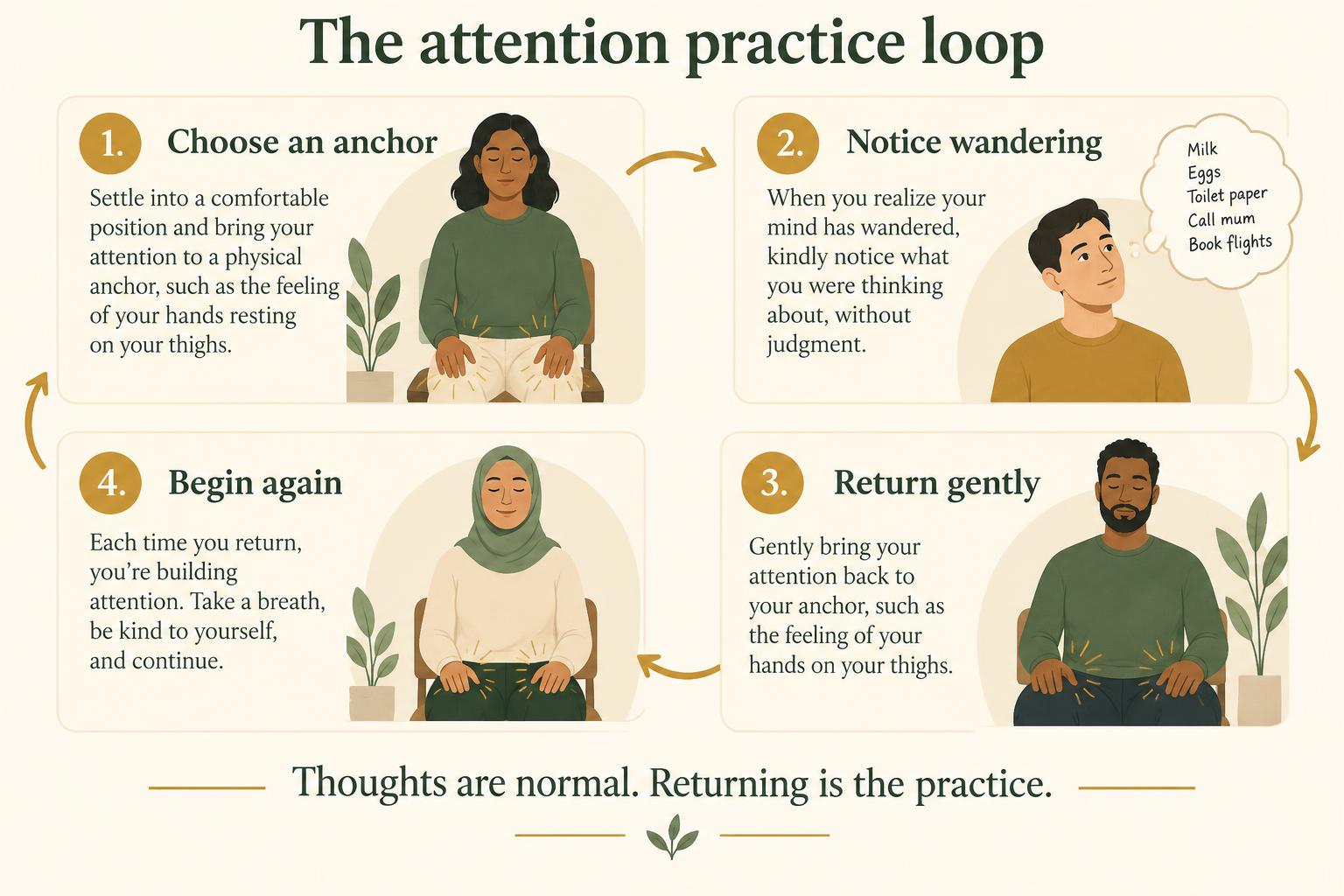
Knowing this history changes how you sit. When your mind wanders for the hundredth time and you return patiently to the breath, you are repeating a gesture performed by millions of practitioners across five thousand years — Indian ascetics, Chinese mountain monks, desert hermits, and hospital patients in Cleveland. The frustration you feel was felt by all of them; the instructions that help you were refined through their collective experience. You are not attempting a wellness fad. You are joining the longest-running experiment in human attention.
The history also grants permission. Every era adapted meditation to its needs: the Buddha rebalanced the extremes of his time, Chan married Buddhism to Daoism, Kabat-Zinn secularized mindfulness for medicine. Your five-minute daily practice, fitted around commutes and children, is not a watered-down betrayal of the tradition — it is the tradition doing what it has always done, surviving by adapting. Sit tomorrow morning with that knowledge, and five thousand years sit with you.
Why Meditation Does Not Have One Simple Origin Story
The word meditation groups together practices that developed in different languages, communities, and religious settings. Historical texts may describe concentration, contemplation, prayer, recollection, or disciplined awareness without using a single equivalent term. Translating all of them as meditation makes comparison possible, but it can hide important differences. One tradition may emphasize liberation from a cycle of suffering, another communion with the divine, and another ethical self-cultivation. Modern readers often approach the same broad category for stress relief or better focus. Those purposes can overlap, but they should not be treated as identical simply because the practices share stillness or attention.
Dating an origin is difficult because written evidence is not the same as the beginning of a practice. An early surviving text tells us that a teaching existed by that point; it does not reveal exactly when people first developed or transmitted it. Oral traditions can precede manuscripts, and manuscripts can be copied or interpreted long after their initial composition. Archaeological images are also open to interpretation. A seated figure may resemble a modern meditative posture without proving which mental practice, if any, the figure represents. Responsible history distinguishes evidence from inference instead of assigning a precise ancient date to every familiar technique.
It is therefore more useful to speak of several historical lineages than of one uninterrupted invention. Practices changed as communities moved, teachers interpreted texts, institutions formed, and local traditions interacted. Some methods retained recognizable features; others acquired new language, rituals, or purposes. A modern breath-awareness exercise may draw from a long tradition while also reflecting recent educational or clinical design. Recognizing this mixture does not diminish the exercise. It helps you understand that what appears timeless in a current recording may be a particular adaptation, selected and presented for the needs of a contemporary audience.
Separate Religious Context, Technique, and Modern Adaptation
A technique does not always carry its original context intact. In some Buddhist settings, attention practice is linked with ethical conduct, community life, and teachings about suffering and liberation. In Hindu traditions, practices may connect with devotion, philosophy, or understandings of self and reality. Christian contemplative practices can center on prayer and relationship with God. These are broad descriptions, not exhaustive accounts of diverse traditions. When a modern course extracts a breathing exercise, it may preserve a useful action while leaving much of the surrounding worldview aside. That adaptation should be described honestly rather than presented as the complete tradition in miniature.
Secular presentation can improve accessibility for people who do not want religious instruction. It can also create confusion if historical roots are erased or if a commercial program claims to represent every tradition equally. You can appreciate a practical exercise while acknowledging where its language or method comes from. If you want to study a lineage in depth, seek teachers, texts, and communities that explain their own context. A general wellness article is a starting point, not a substitute for that learning. Respectful curiosity includes recognizing the limits of a brief overview and avoiding the assumption that familiar vocabulary captures an entire spiritual system.
The same care applies to scientific language. Modern research investigates defined interventions and measurable outcomes, not every historical claim associated with contemplative practice. A traditional teaching about enlightenment is not validated merely because a related attention exercise is associated with a change in a laboratory measure. Conversely, a study that finds limited effects does not settle every philosophical question a tradition raises. History, spiritual interpretation, and clinical evidence answer different kinds of questions. Keeping them distinct allows you to read more accurately and to choose a practice without requiring either ancient authority or modern neuroscience to prove more than it actually can.
Reading Historical Claims in Today's Meditation Media
When an app or audiobook describes a technique as ancient, ask what the claim means. Is it naming a documented lineage, borrowing a general style, or simply using antiquity as a selling point? A method can be old without being suitable for every person, and a method can be recent without being worthless. Watch for claims that compress diverse traditions into one universal secret or imply that a recording gives you the same experience as extensive instruction within a community. Such claims are often too broad to evaluate. Look instead for a clear account of the practice, its intended purpose, and the limits of what the resource offers.
The 5 Minute Meditation Paradise belongs to the modern audio landscape, where listeners can explore meditation-themed material outside a formal retreat or classroom. Its current listing and sample are the appropriate sources for what that particular audiobook includes. Listening may help you establish a routine, but it does not by itself provide a complete historical education or confer training in every tradition named in a description. Pair practical listening with reliable background reading if history interests you. You can use the audio as an accessible companion while remaining careful about the difference between a contemporary presentation and the full lineage from which some of its vocabulary may draw.
A useful way to study is to keep three questions separate: what did people in this tradition aim to do, what action did they practice, and how is that action being presented now? The answers may differ. An exercise once taught within a religious framework may now appear in a workplace wellbeing session. A term once used in a philosophical discussion may now label a playlist. Rather than dismissing or romanticizing the change, examine it. Meditation history becomes valuable when it helps you understand these transformations, giving both ancient communities and modern adaptations more specificity than a single story of timeless calm.
A Practical Detail to Keep in Mind
A helpful reading habit is to distinguish primary material from later interpretation. A translated historical text gives access to a source, but the translator's choices and the text's context still matter. A modern overview may explain that context while also simplifying it. Read more than one reliable account when a claim seems unusually sweeping. Avoid assuming that a familiar contemporary meaning of mindfulness, yoga, or contemplation was used identically in every period. Historical vocabulary changes with communities and purposes. This careful reading does not prevent practical learning; it gives the practice a more specific background and helps you recognize when a modern resource is adapting rather than reproducing an older teaching.
Start listening today
The 5 Minute Meditation Paradise
by Stephens Hyang · narrated by Robert Gazy · 6 hrs and 1 min
The Ultimate "How to Meditate Guide" to Help You Increase Mindfulness and Reduce Anxiety Through Meditation, Guided Meditation, Chakra, and Zen Music
Frequently asked questions
How old is meditation?
Systematic meditation is documented in Indian texts from around 1500 to 500 BCE, making the written record at least 2,500 years old. Possible depictions in Indus Valley artifacts suggest contemplative postures over 4,000 years ago, and informal practices likely predate all records.
Did meditation begin with Buddhism?
No. Meditation predates Buddhism in the earlier Vedic and Upanishadic traditions of India. The Buddha learned meditation from existing teachers and rebalanced it, adding the emphasis on mindfulness and insight that shapes most practice today.
When did meditation become popular in the West?
The decisive decade was the 1960s, when Transcendental Meditation spread through America and Europe, amplified by celebrity interest. Scientific study began in 1967 with Herbert Benson's relaxation response research, and the 1979 founding of mindfulness-based stress reduction brought meditation into mainstream medicine.
Do all meditation traditions come from India?
No. While many famous techniques descend from India, contemplative practices arose independently in Christian hesychasm, Islamic Sufism, Jewish Kabbalah, and indigenous traditions worldwide. Trained stillness appears to be a universal human discovery, refined differently across cultures.
What is the oldest meditation text?
The Vedas, composed between roughly 1500 and 500 BCE, contain the earliest surviving written descriptions of contemplative practice. The Upanishads deepened the theory, and Patanjali's Yoga Sutras later codified meditation systematically. The Buddhist Satipatthana Sutta remains the most influential practical manual.
Five thousand years of practitioners refined this practice so that you could begin it in five minutes, in your living room, tomorrow morning. Honor the lineage lightly: sit, breathe, and return. For a modern doorway into these ancient waters, The 5 Minute Meditation Paradise carries the tradition's essentials — breath, mindfulness, and sound — in sessions sized for contemporary life.


