Key takeaways
- •Attach meditation to an existing daily cue — habit stacking is the most reliable trigger.
- •Five minutes daily beats thirty minutes occasionally; consistency drives the benefits.
- •Prepare the night before: cushion out, session queued, decision already made.
- •Never miss twice — one skipped day is an accident, two is the start of a new habit.
Why Daily Practice Beats Long Occasional Sessions
The brain learns meditation the way it learns a language: through regular, repeated exposure rather than heroic cramming. Neuroplasticity research shows that attention networks strengthen in proportion to total sessions completed, and spacing those sessions across days produces deeper consolidation than bunching them into weekend marathons. A daily five-minute sit delivers thirty-five training opportunities per week of noticing and returning, while a single long Sunday session delivers only a handful.
There is also a psychological reason daily works better. Habits form around frequency, not duration — every repetition strengthens the cue-routine-reward loop until the behavior becomes automatic. A weekly meditator must re-decide to practice every single time, burning willpower each Sunday. A daily meditator stops negotiating entirely, the way you stopped negotiating about brushing your teeth decades ago. Removing the daily decision is the real prize, and only daily repetition can deliver it.
Choose Your Anchor Habit
Habit stacking, a technique popularized by behavioral researchers, attaches a new behavior to one that already runs on autopilot. The formula is simple: after I do X, I will meditate for five minutes. Strong anchors include pouring morning coffee, sitting down at your desk, finishing lunch, changing into evening clothes, or getting into bed. The anchor must happen every day at roughly the same time, which is why waking and sleeping routines make the sturdiest hooks.
Choose one anchor and resist the urge to stack meditation everywhere at once. Morning anchors have the highest success rates in habit studies because willpower and quiet are both more available early, and because the practice's calm then colors the entire day. Evening anchors work well for people whose goal is better sleep. If your schedule is chaotic, anchor to an event rather than a clock time — after I close my laptop for lunch, I will sit for five minutes — so the practice survives shifting hours.
Recommended listening
The 5 Minute Meditation Paradise
by Stephens Hyang · narrated by Robert Gazy · 6 hrs and 1 min
The Ultimate "How to Meditate Guide" to Help You Increase Mindfulness and Reduce Anxiety Through Meditation, Guided Meditation, Chakra, and Zen Music
Start Smaller Than You Think You Should
The most common reason daily meditation dies within a month is overambition. Twenty minutes sounds virtuous on day one, but by day nine a busy morning makes twenty minutes impossible, the session gets skipped, and the streak — your real asset — breaks. Five minutes is small enough to survive deadlines, sick kids, travel, and bad moods. Once the habit is automatic, extending to ten or fifteen minutes happens almost without effort.
Adopt a two-tier rule: a standard session and a floor session. Your standard might be ten minutes; your floor is two. On normal days you sit the standard; on catastrophic days you sit the floor and count it as a full win. This preserves the streak, which preserves the identity — I am someone who meditates daily — and identity, research shows, is the strongest predictor of long-term behavior. Guided programs with short sessions make this easy: The 5 Minute Meditation Paradise by Stephens Hyang is built entirely around five-minute guided blocks, so even your floor session feels complete rather than truncated.
Design Your Environment for Success
Willpower is a terrible strategy; environment is a great one. Lay out your cushion, chair, or blanket the night before, somewhere you will physically trip over it in the morning. Queue your guided session or set your timer app to the right length in advance. Silence notifications, or better, leave the phone across the room with only the timer running. Every point of friction you remove in advance is a future skipped session prevented.
Environment also means people. Tell your household what your five or ten minutes mean — a closed door, headphones on, not to be interrupted except for emergencies. If you share tight space, claim a specific chair and a consistent time so others learn the pattern. Some meditators keep a small visual marker, like a candle they light only during practice; the ritual object becomes a cue that settles the mind before the session even begins.
A Simple Daily Session Structure
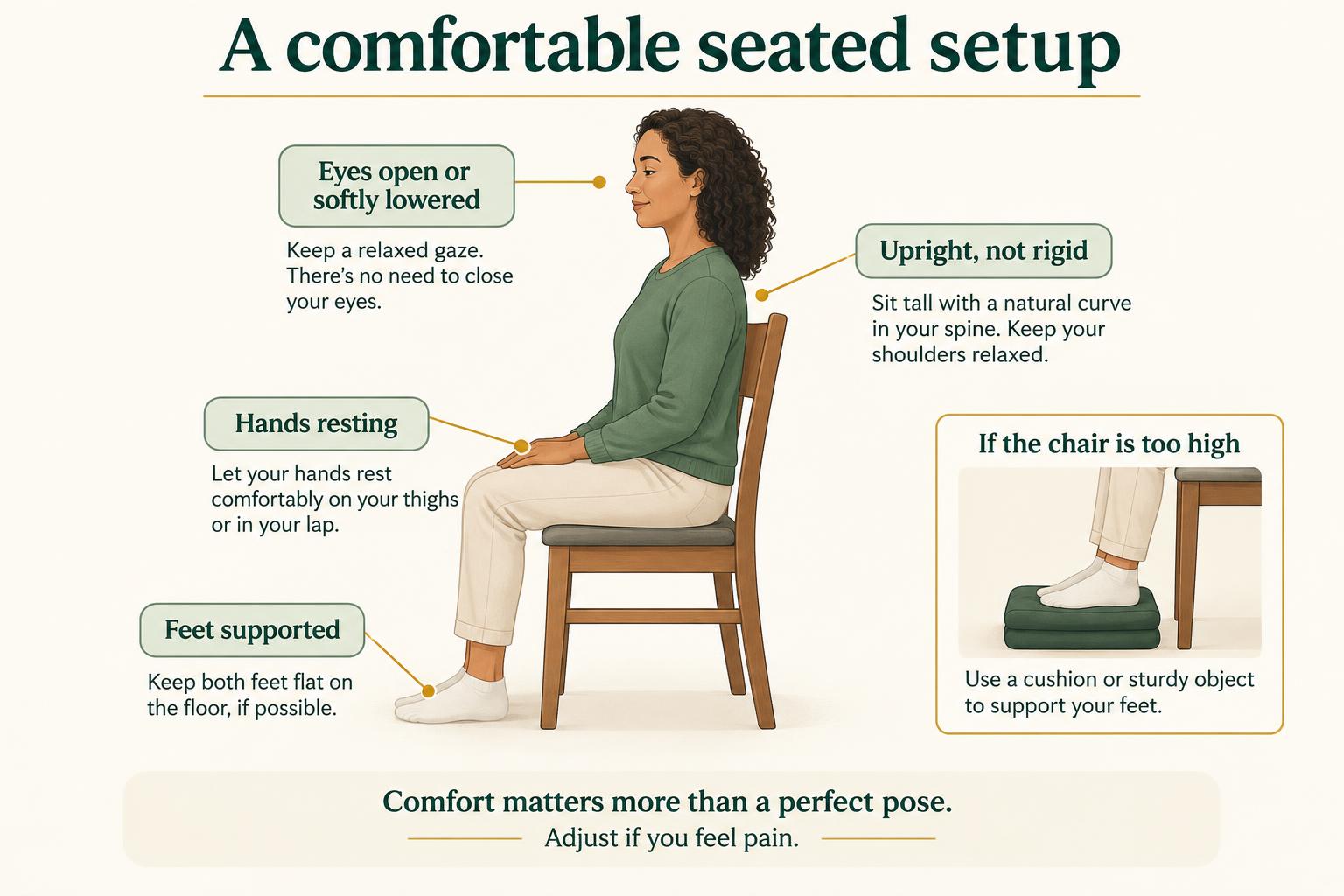
A daily session needs no complexity, but a loose structure keeps it from feeling aimless. A reliable five-to-ten-minute arc looks like this: arrive, settle, practice, close. Arrive by taking three slow breaths and feeling the points of contact between body and seat. Settle by scanning once from head to toe, releasing obvious tension in the jaw, shoulders, and hands. Practice by resting attention on the breath, counting exhale cycles from one to ten and starting over whenever you lose count.
Close deliberately. Rather than jumping up at the timer, take one final full breath, notice how the body feels compared to when you sat down, and set a small intention for the next hour — patience in a meeting, presence at breakfast. This thirty-second ritual carries the session's calm into action and gives the brain a clear reward signal, which strengthens the habit loop. Over weeks, you can rotate the middle practice: breath on weekdays, a body scan or loving-kindness on weekends.
| Phase | Duration | What you do | Why it matters |
|---|---|---|---|
| Arrive | 30 seconds | Three slow breaths, feel the seat | Signals the nervous system to downshift |
| Settle | 1 minute | Quick head-to-toe tension release | Removes physical distractions |
| Practice | 3-8 minutes | Breath awareness with counting | Trains the notice-and-return skill |
| Close | 30 seconds | One deep breath, set an intention | Carries calm into the next activity |
What to Do When Motivation Disappears
Motivation follows a predictable arc: enthusiasm in week one, negotiation in weeks two and three, and either automaticity or abandonment by week eight. The dip is not a sign that meditation is failing; it is the normal death of novelty. Expect it, and pre-commit to a rule for that period: the session happens at the scheduled time regardless of how you feel about it. Feelings are allowed to come along, but they do not get a vote.
Two tactics help through the trough. First, track the streak visibly — a paper calendar with daily X marks exploits our deep reluctance to break a chain. Second, reconnect with evidence: keep a one-line journal noting sleep quality, stress reactions, and focus each day, then read it back when practice feels pointless. Most people are surprised by how much has quietly shifted. If boredom is the issue, change the content rather than quitting the habit — swap silent sitting for a guided session, or try walking meditation for a week.
Handling Travel, Illness, and Chaotic Weeks
Rigid routines shatter; flexible routines bend. Build travel and chaos versions of your practice in advance. The travel version might be three minutes of breath counting on the plane or in a parked car before walking into the hotel. The illness version might be a single minute of feeling the breath while lying in bed — it counts. The chaotic-week version is your floor session at whatever time a gap appears, with the morning anchor suspended and resumed next week.
The guiding principle is the never-miss-twice rule. One missed day is noise; two consecutive misses is the beginning of a new pattern. Treat the second day as an emergency and sit for even sixty seconds to protect the chain. Long-term meditators report that this single rule, more than any technique or teacher, is why they still practice decades later. Perfection is not the goal — unbroken return is.
Signs Your Daily Practice Is Working
Progress in meditation rarely announces itself during the session; it shows up in the rest of your life. Early signs include catching yourself before snapping at someone, noticing anxiety as it starts rather than after it peaks, falling asleep faster, and recovering from stressful moments in minutes instead of hours. You may also notice the sessions themselves shortening subjectively — ten minutes begins to feel like three.
Around the eight-week mark, many practitioners report a quiet identity shift: meditation stops being something they do and becomes something they are. The practice starts protecting itself — you feel its absence the way you would feel skipping a meal. That is the moment the habit has fully installed. Until then, trust the process, keep the sessions small, and let the accumulated minutes do their slow, reliable work.
Build Three Versions of Your Daily Routine
A durable daily routine has more than one size. Create a standard version for an ordinary day, a small version for a crowded day, and an optional longer version for a day with genuine space. Your standard might be five minutes after washing your face. Your small version might be one minute seated at the edge of the bed. Your longer version could include ten minutes of sitting followed by a slow walk. These are planning examples, not clinical doses. Writing them down in advance prevents a busy morning from turning into a debate about whether a shortened practice counts. The aim is continuity without rigidity.
Make the cue an event you actually encounter, rather than an idealized time. After the kettle starts is often more dependable than at precisely six thirty, particularly for parents, shift workers, and people with changing schedules. Be specific about the next movement: after starting the kettle, I will sit in the nearby chair and notice three natural breaths before setting a timer. If the cue regularly fails, change the cue instead of blaming yourself. A routine anchored to a peaceful morning will not survive if your mornings are consistently rushed. Daily practice needs to fit the day you have, not the one you wish you had.
Choose one default resource and remove unnecessary decisions. You might use a quiet timer, a written instruction, or a familiar passage from The 5 Minute Meditation Paradise. If audio is your choice, check the passage length and prepare it before the practice window. Do not spend the entire window browsing for the perfect voice. Keep a silent fallback for days when headphones are missing or the internet is unavailable. A useful default is to sit comfortably, feel contact with the chair, and return to one natural breath at a time. Familiarity makes beginning easier, while the fallback keeps equipment from becoming a condition for practice.
A Weekly Review That Does Not Become Another Chore
At the end of a week, review logistics before judging benefits. Which cue worked? What interrupted you? Did the chosen session length fit? Suppose you practiced on four mornings and missed three because the household became noisy. That is useful information, not a verdict about discipline. You might move the session earlier, use an eyes-open sound practice, or try a lunchtime chair instead. Change one variable for the following week so that the result is easy to interpret. A short handwritten note is enough. Detailed tracking can be motivating for some people, but it can also create a second task that crowds out the first.
Review your relationship with the routine as well. Are you approaching it with curiosity, or using it to prove that you are a productive person? Are you staying seated through pain because a timer has not finished? Are you chasing yesterday's calm? These questions help prevent consistency from becoming coercion. A daily practice can be gentle and still dependable. Some days the healthiest choice is a shorter, externally focused session or a deliberate pause. If practice repeatedly causes distress, seek guidance rather than treating more effort as the automatic answer. A habit should support your life, not become a private rule you are afraid to break.
Look for changes outside the session using concrete examples. Perhaps you noticed an urge to interrupt and let the other person finish. Perhaps you recognized exhaustion before agreeing to another task. Such observations are more useful than a claim that you are now universally calmer. They also protect against overinterpreting a good week, since sleep, workload, exercise, and relationships all influence mood. Keep meditation in perspective as one part of your routine. If nothing seems useful after a reasonable trial, adjust the format or consider an alternative rather than indefinitely expanding the time in hope of a dramatic breakthrough.
Restarting After a Break: A Practical Example
Imagine that travel interrupts your practice for ten days. On returning home, resist the temptation to compensate with an unusually long session. Restore the old cue and start with the smallest version for several days. Put the chair or cushion back where it belongs, remove a predictable distraction, and choose the same simple anchor you used before the trip. You are rebuilding a pathway into the routine, not paying off a debt. If the original schedule no longer suits you, use the interruption as an opportunity to redesign it. Daily meditation becomes more resilient when returning is ordinary rather than a ceremony of self-reproach.
The same approach works after illness, an intense work period, or a caregiving emergency. A calendar streak may have ended, but previous practice has not been erased. Let your current energy determine what is realistic. If you are tired, try an upright chair and a short eyes-open session instead of lying down and struggling against sleep. If the house is crowded, notice your feet while waiting quietly for a moment of privacy. These small adaptations preserve the central action: you intentionally notice what is happening and redirect attention. Tomorrow's session can be longer, but today's does not need to carry the burden of the entire habit.
Start listening today
The 5 Minute Meditation Paradise
by Stephens Hyang · narrated by Robert Gazy · 6 hrs and 1 min
The Ultimate "How to Meditate Guide" to Help You Increase Mindfulness and Reduce Anxiety Through Meditation, Guided Meditation, Chakra, and Zen Music
Frequently asked questions
What is the best time of day to meditate daily?
Morning works best for most people because willpower is highest, interruptions are rare, and the calm carries into the day. Evening practice is better if your main goal is sleep. The truly best time is the one you can protect every single day — consistency of timing builds the habit faster than any ideal schedule.
How many minutes a day should I meditate?
Start with five minutes daily for the first two weeks, then move to ten. Research shows measurable stress reduction from ten-minute daily sessions, and structural brain changes from twenty to thirty minutes over eight weeks. A consistent five minutes always beats an ambitious twenty that gets skipped.
Is it okay to meditate twice a day?
Yes. Many practitioners sit briefly in the morning and again in the evening, bookending the day with calm. Two short sessions are often easier to sustain than one long one. Just make sure the second session supports rather than replaces your primary anchor habit.
What if I miss a day of meditation?
Simply sit the next day without guilt or compensation sessions. Follow the never-miss-twice rule: one miss is an accident, but never allow two in a row, even if the second session is only sixty seconds. Self-compassion after a miss predicts long-term consistency far better than self-criticism.
How long until daily meditation becomes automatic?
Habit studies suggest an average of sixty-six days for a behavior to feel automatic, with a range of about three weeks to eight months depending on the person and the complexity of the habit. Keeping sessions short and the cue consistent moves you toward the faster end of that range.
A daily meditation practice is built the night before: cushion out, session queued, decision made. Start tomorrow with five minutes after your morning coffee, and let the streak carry you. If you want structure without commitment to long sits, press play on The 5 Minute Meditation Paradise — its short guided sessions were designed for exactly this kind of daily rhythm. One small sit at a time, you are building a calmer life.


