Key takeaways
- •Five minutes daily is the correct starting dose — small enough to never skip.
- •Guided sessions make the first weeks dramatically easier than silence.
- •Expect awkwardness in weeks one and two; it is the feeling of learning, not failing.
- •Anchor practice to a daily habit and track your streak visibly.
Before You Begin: Three Things to Know
First: you cannot do this wrong. Meditation is not a performance with a passing grade — it is attention training where the only requirement is showing up. A session with a racing mind trains you exactly as well as a peaceful one, because the skill being built is noticing and returning, and busy sessions offer more chances to practice it. Beginners who grasp this in week one persist at dramatically higher rates than those who spend months waiting to get good.
Second: benefits are real but gradual. You will not levitate, and you may not feel different after session one. The research-backed changes — calmer stress response, better focus, easier sleep — accumulate over weeks of daily practice, like interest in a savings account. Third: five minutes counts. The beginner who sits five minutes daily for a year will be transformed; the one who attempts forty-five minutes and quits by Friday will not. Small and daily beats grand and abandoned, every single time.
Days 1 to 7: Just Show Up
Week one has a single goal: make sitting down a habit. Each day, at the same time, sit for three to five minutes. Morning works best for most beginners — before the day's demands start negotiating — but any consistent time beats the perfect time you keep postponing. Sit anywhere comfortable with your spine reasonably tall, set a gentle timer, close your eyes, and follow your breathing. When your mind wanders, which will happen within seconds, come back. That is the entire assignment.
Two rules will carry you through the week. Rule one: never skip two days in a row. One miss is an accident; two is the beginning of quitting, so sit for even one minute on day-after-miss days. Rule two: no grading. Banish the question was that a good session for the entire week. You sat; it counted. By day seven you will have completed more meditation sessions than most people manage in a year, and the foundation — the habit loop itself — will already be forming.
Recommended listening
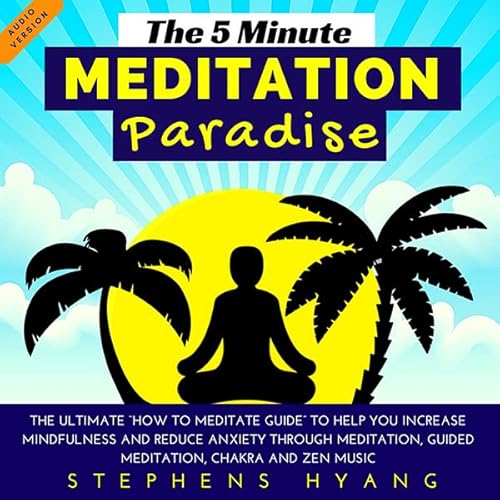
The 5 Minute Meditation Paradise
by Stephens Hyang · narrated by Robert Gazy · 6 hrs and 1 min
The Ultimate "How to Meditate Guide" to Help You Increase Mindfulness and Reduce Anxiety Through Meditation, Guided Meditation, Chakra, and Zen Music
Days 8 to 14: Learn to Welcome the Wandering
Week two is when novelty fades and the real learning begins. Sessions start to feel repetitive, the mind seems busier than ever, and a suspicious thought appears: I must be bad at this. Understand that nothing has gone wrong — you are simply now alert enough to notice how busy your mind always was. The noise was there on day one; awareness of it is the first sign of progress, not its opposite.
This week, add one refinement: the soft label. When you catch yourself thinking, silently name the distraction — planning, remembering, worrying — and return to the breath. Labeling creates a half-step of distance between you and the thought, and in that distance the thought loses its grip. Also begin noticing the moment of return itself. That instant, when you realize you drifted, is the actual exercise. You are not failing at meditation when you notice wandering; you are doing meditation, perfectly, once per return.
Days 15 to 21: Deepen with Guidance
By week three, five minutes should feel familiar — the resistance to sitting has likely faded, and attention returns a little faster. Now extend to seven or eight minutes and introduce variety to keep the practice alive: alternate breath days with body scan days, where you move attention slowly from feet to face, releasing tension as you go. Variety is not a distraction from the path; for beginners it is protection against the boredom that ends more practices than difficulty ever has.
This is also the ideal week to bring in guided support. A narrator's voice paces the session, reminds you to return, and models the unhurried patience you are trying to build. Programs designed for beginners, like The 5 Minute Meditation Paradise by Stephens Hyang, offer short guided sessions with calm narration and zen music — an easy way to extend your sit without white-knuckling it. Many beginners find that alternating guided and silent days gives them the best of both: structure when needed, independence as it grows.
Days 22 to 30: Make It Yours
In the final stretch, settle into ten minutes and begin personalizing. Test a second daily anchor — three breaths before lunch, a minute of stillness in the parked car — so the practice starts bleeding usefully into the rest of your day. Experiment with time of day if mornings have been strained. Try one session with gentle music and one outdoors. The goal is ownership: discovering which version of practice fits your life so well that it stops requiring willpower.
End the month with a review. Look back over your streak, and write one sentence about anything that has shifted — sleep, patience, the speed of recovering from a bad moment. Research says the changes are there by day thirty for most consistent beginners, but they are easy to miss without looking. Whatever you find, you have now done the hardest part of meditation: the beginning. Day thirty-one requires nothing you have not already done thirty times.
| Phase | Days | Session | Focus | Watch out for |
|---|---|---|---|---|
| Arrive | 1-7 | 3-5 minutes | Building the daily habit | Grading sessions, missing twice |
| Notice | 8-14 | 5 minutes | Labeling thoughts, gentle returns | I am bad at this doubt |
| Deepen | 15-21 | 7-8 minutes | Body scans, guided variety | Boredom, overreaching |
| Own it | 22-30 | 10 minutes | Personalizing time and style | Letting the streak slide post-milestone |
The Beginner Questions Nobody Asks Out Loud
Is it okay that my leg falls asleep? Yes — shift position without ceremony; monks adjust too. Is it okay to scratch an itch? Yes; either feel it fully as sensation or scratch mindfully and return. What if I fall asleep? You were tired — practice earlier or sit more upright, and take the nap data as useful information about your rest. What if I feel nothing special? Nothing special is the correct and normal experience; the practice works underground long before it flowers.
What if I miss a week entirely? Begin again at five minutes the next day without compensation sessions or self-punishment — the habit forgives instantly, and self-compassion predicts long-term practice far better than discipline does. Every experienced meditator has restarted dozens of times. The ones who seem serene are simply the ones who restarted most recently and kept going. You are allowed to be a beginner for as long as you need — which, honestly, is forever, and is the tradition's favorite kind of student.
After Day 30: The Road Ahead
A month of daily practice earns you the right to call meditation yours, and the path forward is refreshingly simple: continue. Keep the ten-minute daily session as your baseline for the next two months while the habit hardens into identity. Then explore — a weekend body scan, a loving-kindness practice, a walking meditation in the park — letting curiosity rather than ambition choose the direction.
The benefits keep compounding quietly: research shows attention, stress resilience, and emotional balance all improving across the first year of regular practice. Many beginners also find their interests expanding outward into the tradition itself — the history, the teachings, the wider world of techniques — which is a healthy sign of a practice taking root. For now, though, the assignment stays exactly as small as it was on day one: sit, breathe, notice, return. It was enough to start. It is enough to continue.
Your First Session: What the Instructions Feel Like in Practice
A beginner may understand the phrase focus on your breath without knowing what to look for. You are noticing a physical sensation, not creating a picture of breathing or thinking about the lungs. Perhaps you feel a small movement at the abdomen, a change at the nostrils, or contact between clothing and the chest. Pick the clearest ordinary sensation and let breathing remain natural. If none feels comfortable, use the weight of your hands on your legs. An anchor does not need to be subtle or spiritual. It needs to be something you can recognize when you return after distraction.
Within a short time, a thought will appear. You may remember an errand, imagine how long the session has left, or wonder whether you are doing it correctly. Often you will not notice immediately. You will discover the wandering after several thoughts have already developed. That discovery is normal. Say thinking silently if a label helps, then return to the chosen sensation. There is no need to identify every thought or force it to disappear. The next breath or point of contact provides a fresh place to begin. You can repeat the same modest action many times without making it more elaborate.
At the end, broaden attention to the room and move gently before standing. Notice whether you feel alert enough to resume your day. A first session may feel quiet, busy, sleepy, or ordinary. Do not use that one experience to decide whether you are capable of meditation. It gives you information about the setup and a first encounter with the sequence. If you felt uncomfortable, adjust the posture, length, or anchor next time. If you felt significantly distressed, pause and seek guidance. Beginning well means understanding the action and preserving choice, not achieving a memorable inner state on the first attempt.
Beginner-Friendly Adjustments for Common Situations
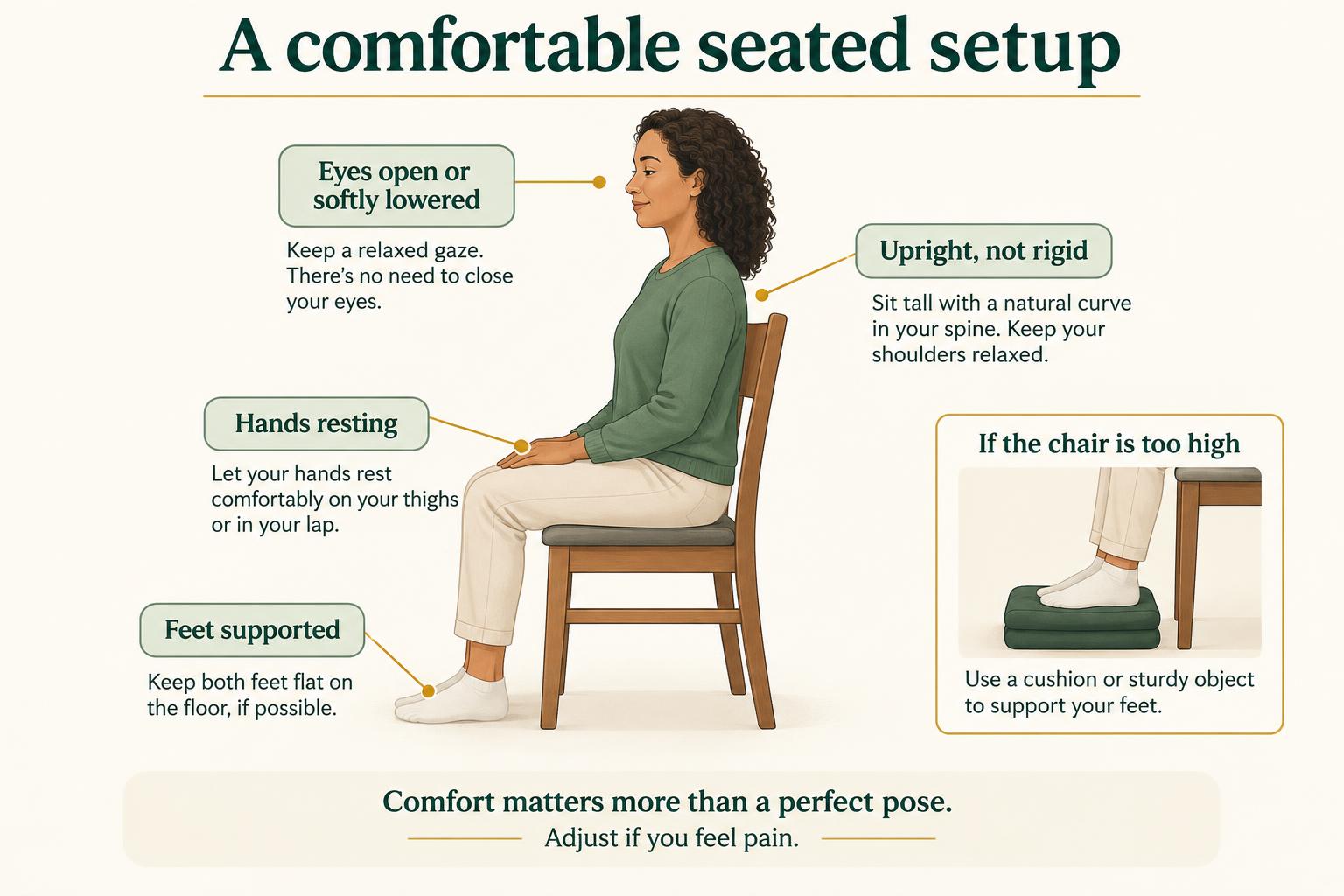
If floor sitting hurts, use a stable chair with feet supported. If a chair is too high, a suitable support beneath the feet may help. Rest the hands comfortably and avoid holding the spine rigidly. If closing the eyes makes you uneasy, keep them open with a neutral gaze. If you become sleepy, practice earlier or use a brighter room rather than struggling in bed at the end of an exhausting day. These adjustments are part of learning. There is no special posture that makes a painful session more legitimate than a comfortable one, and no rule that every beginner must start with closed eyes.
If breathing becomes a source of anxiety, switch to an external anchor. Listen to ordinary room sound, look at a stable shape, or feel your feet against the floor. You can practice awareness without changing breathing at all. If you are very restless, try a short safe walk and notice contact with the ground. Keep your eyes open and remain aware of obstacles and other people. If pain, dizziness, or distress increases, stop or adapt. The purpose of a beginner exercise is to make the basic skill approachable, not to test how much discomfort you can tolerate while a timer continues running.
If silence leaves you uncertain, use guidance selectively. Preview a sample from The 5 Minute Meditation Paradise or another suitable resource and notice whether the narration is clear and comfortably paced. Check the actual passage length rather than assuming that the title describes every chapter. During playback, follow the intention of the instruction while adapting any part that does not suit you. You can pause or stop. Audio is a support for learning the sequence, not a requirement for a valid practice. Keep a simple fallback so that you can begin even when the recording is not available.
Set Expectations That Help You Continue
Many beginners measure progress by the number of thoughts in a session. That measure is unreliable because greater awareness can make ordinary thinking more noticeable. Instead, observe the process: are you recognizing wandering, returning without as much argument, and finding a setup you can repeat? Outside the session, look for small examples such as noticing an impulse to interrupt or recognizing tension before taking a break. These observations do not establish a clinical effect, but they can show how the skill relates to your life. Keep expectations modest enough that a normal distracted session does not become evidence of failure.
Do not expand the session simply because a longer duration sounds more serious. Add time only when the current version feels manageable and you genuinely want more space. A short routine can remain short. Studies of structured mindfulness programs often involve instruction and substantial practice, so their results cannot be promised from any particular beginner schedule. Your goal at first is learning a repeatable activity. If you are practicing for a persistent health concern, keep appropriate care in place and discuss the plan with a qualified professional. Meditation is not a substitute for diagnosis, treatment, sleep, or other basic supports.
Expect interruptions. A noisy room, a missed day, or a difficult week does not erase the skill. Resume with a small session and the same clear anchor rather than compensating with extra time. You can also change the cue if the old one no longer fits. After brushing your teeth may work better than an exact morning time. Prepare the chair or recording in advance if that removes a predictable obstacle. Beginner progress often looks less like a transformation and more like a simpler return: you know what to do, you can start without extensive preparation, and you do not need a perfect mood to practice.
A Practical Detail to Keep in Mind
Give yourself permission to learn the vocabulary gradually. You do not need to understand every term used by a teacher before trying a simple attention exercise. Ask what the instruction means in an observable action: feel contact, listen to sound, repeat a phrase, or notice a natural breath. If a term remains unclear, seek clarification rather than inventing an elaborate experience to match it. Beginner learning is often most effective when the method can be described in ordinary language. This does not reduce the depth of a tradition; it identifies the next practical step. A clear small step is more useful than a mysterious instruction that leaves you unsure whether you are doing anything at all.
Start listening today
The 5 Minute Meditation Paradise
by Stephens Hyang · narrated by Robert Gazy · 6 hrs and 1 min
The Ultimate "How to Meditate Guide" to Help You Increase Mindfulness and Reduce Anxiety Through Meditation, Guided Meditation, Chakra, and Zen Music
Frequently asked questions
How should a complete beginner start meditating?
Start with three to five minutes of breath awareness at the same time each day. Sit comfortably, feel your breathing, and return gently whenever the mind wanders. Attach the session to an existing habit like morning coffee, and use guided audio if silence feels overwhelming.
How long should beginners meditate each day?
Three to five minutes for the first two weeks, building to ten minutes by the end of the first month. Short daily sessions build the habit and the skill far more reliably than long occasional ones. You can extend naturally once sitting feels like something you look forward to.
What is the easiest meditation technique for beginners?
Breath counting: inhale naturally, and count each exhale from one to ten, then start over. The counting gives a busy mind a simple job while the breath anchors attention. Guided meditation is equally beginner-friendly because a narrator carries the structure for you.
Is it normal for beginners to feel like meditation is not working?
Completely normal, especially in weeks two and three. The feeling usually means you are now aware of how busy your mind always was — which is progress. Benefits arrive gradually over weeks; judge the practice monthly by your sleep, patience, and reactions, not by single sessions.
Do beginners need a meditation app or teacher?
Neither is required, but guidance helps. A good app or audiobook program provides structure, pacing, and reassurance that dramatically improve a beginner's consistency. Think of guidance as training wheels: valuable early, optional later, and nothing to be embarrassed about at any stage.
Your first thirty days of meditation ask only one thing: five honest minutes, repeated. Everything else — calm, clarity, the steadier mind — arrives as a side effect of that repetition. Begin tomorrow morning, and if you want a gentle companion for the journey, The 5 Minute Meditation Paradise was built for beginners exactly like you.


