Key takeaways
- •Meditation is one loop: focus, wander, notice, return. That loop is the entire practice.
- •Start with five minutes daily; duration matters far less than consistency.
- •An upright but comfortable posture beats a perfect lotus position every time.
- •Wandering thoughts are not mistakes — noticing them is the exercise itself.
Step 1: Choose Your Time and Place
Before technique comes logistics, because most meditation attempts die from friction rather than difficulty. Choose a time attached to something you already do daily — after waking, after morning coffee, before lunch, or before bed — and a spot where you can sit undisturbed for the length of your session. It does not need to be silent or special; a corner of your bedroom or a parked car works perfectly. Consistency of time and place teaches the brain to enter practice mode on cue, the same way a regular bedtime teaches it to feel sleepy.
Keep the barrier to starting absurdly low. Your cushion or chair should be reachable in under a minute, your phone silenced or left outside the room, and your family or housemates aware that these minutes are yours. Preparing the night before — cushion out, timer set, decision made — removes the morning negotiation that kills most young habits. Meditation fails at the planning stage far more often than at the sitting stage.
Step 2: Find Your Posture
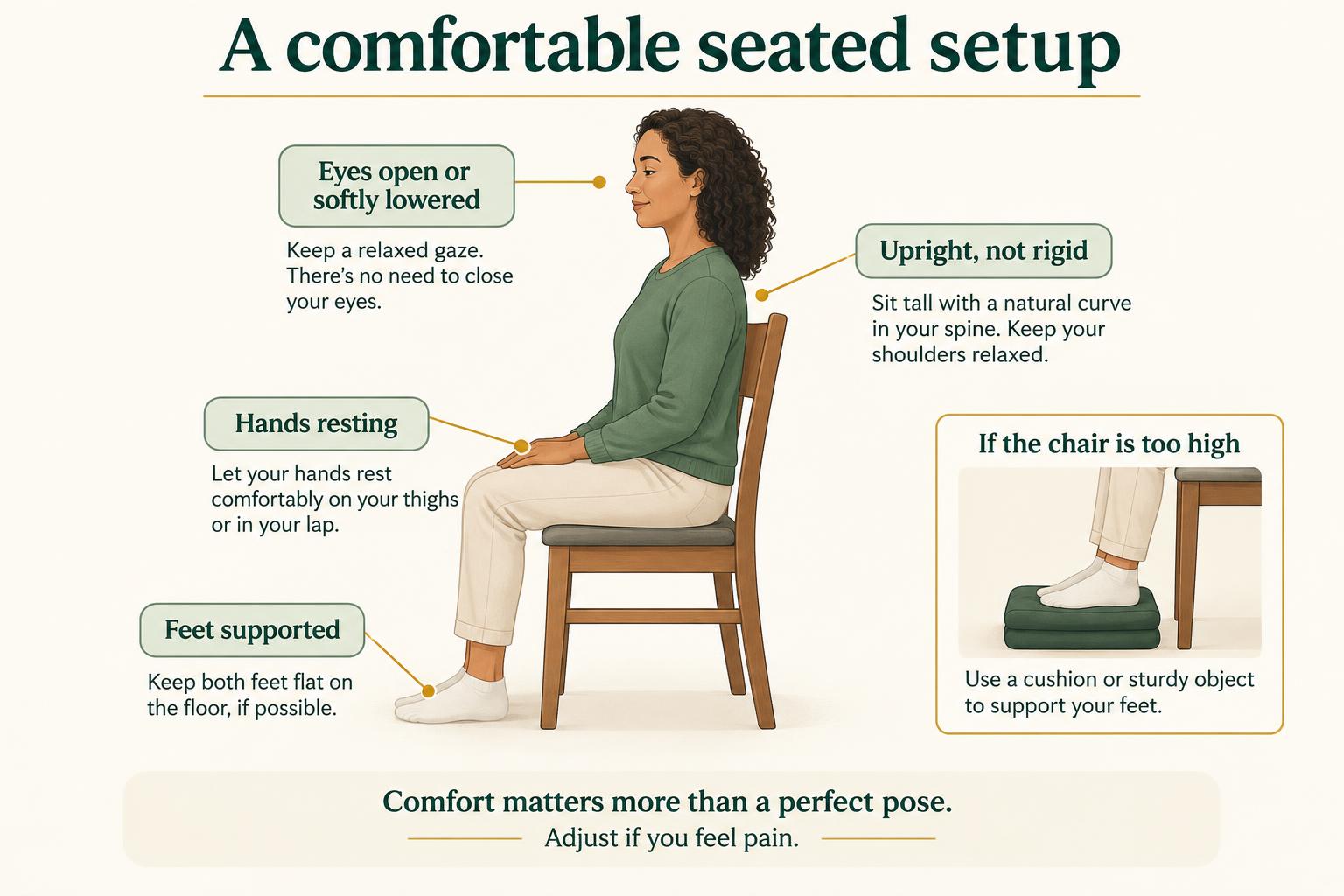
Posture has one job: keeping you alert and comfortable at the same time. Sit on a chair with feet flat on the floor, or cross-legged on a firm cushion that tilts the pelvis slightly forward. Let the spine rise naturally tall, as if a string lifts the crown of the head, and rest your hands on your thighs or folded in your lap. Soften the shoulders, unclench the jaw, and let the chin tuck slightly. The result should feel dignified but relaxed — a posture you could hold for ten minutes without strain.
Avoid two extremes. Slumping invites drowsiness and fog; military rigidity creates tension that hijacks attention. If floor sitting hurts your hips or back, use a chair without a shred of guilt — meditation traditions have used benches and stools for centuries. Lying down is legitimate for body scans but invites sleep for most people. Whatever you choose, give it one honest week before adjusting; the body adapts faster than you expect, and early discomfort often reflects novelty rather than wrongness.
Recommended listening
The 5 Minute Meditation Paradise
by Stephens Hyang · narrated by Robert Gazy · 6 hrs and 1 min
The Ultimate "How to Meditate Guide" to Help You Increase Mindfulness and Reduce Anxiety Through Meditation, Guided Meditation, Chakra, and Zen Music
Step 3: Settle In with Three Deep Breaths
Begin every session with a deliberate arrival. Close your eyes or lower your gaze to the floor a few feet ahead. Take three slow, full breaths — in through the nose, out through the mouth — letting each exhale release the shoulders a little further. Then allow the breath to return to its natural rhythm through the nose. This thirty-second ritual signals the nervous system that the day's doing is paused and being has begun.
Next, feel the points of contact: feet on the floor, seat on the chair, hands on thighs. Spend a few seconds with each. This grounding step matters because attention cannot rest on the breath while it is still sprinting from the morning. Arriving is not a warm-up to meditation — it is the first act of meditation itself, and learning to arrive fully is a skill that will serve you in every meeting, conversation, and crisis outside the session.
Step 4: Rest Attention on the Breath
Now the core practice begins. Without changing the breath, simply feel it. Choose the spot where the sensation is clearest — the cool air at the nostrils, the rise and fall of the chest, or the expansion of the belly — and rest your attention there the way a leaf rests on still water. Follow each full breath from beginning to end, curious about its texture: long or short, rough or smooth, deep or shallow. You are not breathing in any special way; you are finally noticing the breathing that has happened on its own all your life.
If raw sensation feels too subtle, add counting: silently count each exhale from one to ten, then begin again at one. Counting gives the verbal mind a small job, which makes it less likely to hijack the session. Some people prefer a soft mental note — in on the inhale, out on the exhale. Experiment across your first week and keep whichever scaffold makes the breath easiest to stay with. The scaffold is training wheels, not cheating.
Step 5: Handle Wandering Thoughts the Right Way
Here is the moment every beginner thinks they have failed: somewhere around the fourth breath, you realize you have been planning dinner, replaying a conversation, or composing an email for the last two minutes. Understand this clearly — that realization is not the failure of meditation. It is the success of it. The entire practice lives in that instant of noticing. Silently acknowledge what happened with a soft label like thinking or wandering, without commentary or criticism, and guide attention back to the breath as gently as you would guide a child back to bed.
You will repeat this loop dozens of times in a five-minute session, and that is exactly right. Each return is one repetition of the mental muscle you came to build: the ability to notice where your attention is and choose where it goes. Research shows this skill transfers directly off the cushion into better focus at work and earlier awareness of emotional reactions. A stormy session with fifty returns is a harder, more valuable workout than a placid session with five. When you stop grading your sessions by how calm they felt and start counting returns, meditation becomes un-failable.
Step 6: Close the Session Deliberately
When your timer sounds, resist the urge to leap up. Let your eyes stay closed for one more full breath. Notice how your body feels compared to when you sat down — the shoulders, the jaw, the speed of the mental chatter. Whatever you find, calm or restless, simply acknowledge it. Then set a small intention for the next part of your day: patience in the next meeting, presence at breakfast, kindness toward yourself in the afternoon slump.
This thirty-second closing ritual does two things. It carries the session's quality into action, which is where meditation's benefits actually cash out. And it gives the brain a clear completion signal with a small reward, strengthening the habit loop that makes tomorrow's session more likely. Many experienced meditators consider the closing minute as important as the practice itself, because it trains the transition from cushion to world — the place meditation is ultimately for.
Step 7: Repeat Daily and Build Gradually
One session teaches you almost nothing; thirty sessions begin to change you. Commit to five minutes daily for the next fourteen days — short enough to survive any schedule, long enough to practice the full loop. Mark each completed day on a calendar, and adopt the never-miss-twice rule: one skipped day is an accident you forgive instantly, but never let a second day pass without sitting, even for sixty seconds.
After two weeks, extend to ten minutes if the habit feels stable; after a month or two, consider fifteen or twenty. Growth should feel earned, not forced. If a day arrives when silence feels impossible, use a guided session instead — the five-minute practices in The 5 Minute Meditation Paradise by Stephens Hyang, narrated by Robert Gazy, are designed exactly for beginners who want structure while the skill develops. The method is simple: sit, breathe, notice, return, repeat tomorrow. Everything else in the world of meditation is commentary on those five verbs.
| Step | Action | Duration | Common mistake |
|---|---|---|---|
| 1. Time and place | Anchor to a daily habit, prepare the spot | Setup only | Waiting for perfect conditions |
| 2. Posture | Sit tall and relaxed, hands resting | 10 seconds | Forcing an uncomfortable lotus |
| 3. Arrive | Three deep breaths, feel contact points | 30 seconds | Skipping straight to technique |
| 4. Breathe | Rest attention on breath sensations | 3-8 minutes | Controlling the breath |
| 5. Return | Notice wandering, gently come back | Throughout | Criticizing yourself for thinking |
| 6. Close | One breath, set an intention | 30 seconds | Leaping up at the timer |
| 7. Repeat | Same time tomorrow, track the streak | Daily | Judging single sessions |
A Complete First Session You Can Follow Without a Recording
Start by checking that you are in a place where pausing is safe. Sit on a stable chair with your feet supported, or choose another position that does not cause pain. Put your hands somewhere comfortable and let your gaze remain open or softly lowered. Notice the room before turning attention inward. You might register the light, the nearest sound, and the contact of your body with the seat. There is no need to take unusually deep breaths. Let breathing happen at its own pace while you settle. If a timer helps, choose a short interval with a gentle ending sound, then put the device out of reach.
Next, choose one clear anchor. The movement of the abdomen may be easy to feel, but the contact of your hands with your legs or a steady room sound can work just as well. Stay with that experience without trying to intensify it. After a while, you will discover that you have been planning, remembering, or judging the session. Acknowledge this discovery briefly and return to the anchor. Do not rewind the thought to work out exactly when distraction began. Noticing now is enough. The return can be light, like turning your face toward someone who has started speaking, rather than a forceful attempt to pin the mind in place.
When the timer ends, do not treat the final seconds as a race to achieve calm. Broaden attention to your body and the room. Move your fingers, shift your feet, and stand when ready. Ask what you need to do next and begin that activity deliberately. You may feel quieter, unchanged, sleepy, or a little restless. None of those reactions alone determines whether you meditated correctly. The central actions were choosing an anchor, recognizing wandering, and returning. Repeating those actions is the practice. A first session can be ordinary and still establish the sequence you will use again tomorrow.
Adjust the Instructions to Fit Your Body and Attention
Meditation instructions should be adaptable. If a floor cushion makes your knees ache, use a chair. If an upright position becomes tiring, add support rather than holding a rigid pose. If closing your eyes feels unsafe or increases vivid imagery, keep them open and look at a neutral area of the room. If noticing breathing encourages anxious monitoring, select touch or hearing instead. These adaptations preserve the purpose of the exercise while changing its form. A teacher's preferred posture is not a requirement to ignore your body. Pain, discomfort, and distress provide information that can justify an adjustment or the decision to stop.
Restlessness can be met with a smaller session or a movement practice. Try walking at a comfortable pace along a safe route, noticing contact with the ground. Stay aware of other people and obstacles. Sleepiness may call for a brighter room, an earlier time, or standing briefly before sitting again. Neither challenge necessarily means you lack the ability to meditate. Your state changes with sleep, food, workload, and health. A flexible practice acknowledges those conditions. Instead of asking how to force yourself through the same exercise every day, ask which version allows you to stay reasonably alert and comfortable today.
Guidance can help when the instructions remain unclear. Preview an audio sample and listen for a voice that leaves enough silence to practice rather than continuously explaining. The 5 Minute Meditation Paradise is one audiobook option to explore, but use its available description and sample to decide whether the content matches your needs. You can pause, shorten a session, or choose another resource. No recording needs to become an authority over your experience. A useful guide helps you understand the action of attending and returning so that, over time, you can practice with or without the narrator.
What to Do When the Session Does Not Feel Peaceful
A quiet setting can make you more aware of how busy the mind already is. This sometimes creates the impression that meditation caused the thoughts. In other cases, inward attention really can intensify discomfort. Avoid deciding too quickly which explanation applies. Begin with a modest session and notice whether you remain oriented and able to choose what happens next. Ordinary distraction can be met with a gentle return. Increasing panic, distressing memories, or a sense of disconnection may call for stopping, opening your eyes, moving, and seeking guidance. The instruction to accept experience should never be used to override a clear need for safety.
Do not chase a previous peaceful session. Yesterday's experience occurred with a particular amount of sleep, a particular workload, and a particular mood. Trying to reproduce it can create more tension than the original distraction. Notice the wish for a result as another thought, then return to the current anchor. A useful question is whether you can meet this session with less argument, not whether you can manufacture the same feeling again. Over time, meditation may help some people respond more thoughtfully to stress, but no individual session owes you a specific emotional outcome.
If you want to assess usefulness, look at ordinary behavior as well as the seated minutes. Did you notice yourself rushing? Did you pause before sending an irritated message? Were you able to return to a task after a distraction? These are practical observations, not proof of a medical benefit. Keep other supports in view, including sleep, movement, social connection, and appropriate care. Meditation is one skill among many. Learning how to meditate means learning a repeatable way of attending, not discovering a universal solution that makes every difficult day disappear.
A Practical Detail to Keep in Mind
Before beginning a second session, repeat the same basic setup rather than changing everything at once. Use the chair, anchor, and short interval that were most comfortable. If you change posture, music, timing, and technique together, it becomes difficult to know which adjustment helped. A modest experiment gives clearer information. Perhaps eyes-open practice is easier, or perhaps an earlier time reduces sleepiness. Keep what works and change one obstacle. Learning how to meditate is not a search for a flawless configuration; it is a process of making a simple action more understandable and repeatable in the conditions of your actual life.
Start listening today
The 5 Minute Meditation Paradise
by Stephens Hyang · narrated by Robert Gazy · 6 hrs and 1 min
The Ultimate "How to Meditate Guide" to Help You Increase Mindfulness and Reduce Anxiety Through Meditation, Guided Meditation, Chakra, and Zen Music
Frequently asked questions
How do I meditate for the first time?
Sit in a chair with your spine tall, set a timer for five minutes, and close your eyes. Take three deep breaths, then breathe naturally while resting attention on the physical sensation of breathing. When your mind wanders, notice it kindly and return to the breath. Repeat until the timer sounds — that is a complete first meditation.
What should I think about when meditating?
Nothing in particular. Meditation is not about thinking the right thoughts but about resting attention on a neutral anchor like the breath. Thoughts will arise constantly; the practice is noticing them and returning to the anchor, not preventing them from appearing.
Is it normal to feel like I am bad at meditating?
Completely normal — nearly everyone feels this in the first weeks. The feeling comes from misunderstanding the goal: a wandering mind is not failure but the raw material of practice. Each time you notice wandering and return, you have succeeded at the only thing meditation asks.
Should I meditate with eyes open or closed?
Either works. Closed eyes reduce visual distraction and suit most beginners. A soft, lowered gaze toward the floor helps if you get drowsy or feel uneasy with eyes closed. Experiment for a week each way and keep whichever leaves you alert and settled.
How long until meditation gets easier?
Most people notice the settling-in phase shortening within two to three weeks of daily practice — attention comes back faster, and the inner critic quiets. The practice never becomes effort-free, but it reliably shifts from awkward to familiar, and eventually to something you genuinely look forward to.
You now know everything meditation requires: sit tall, breathe, notice, return, repeat tomorrow. The only step left is tomorrow morning's five minutes. If you would like a calm voice guiding your first sessions, press play on The 5 Minute Meditation Paradise and let the practice build itself, one gentle sit at a time.


