Key takeaways
- •Proper meditation is about how you return from distraction, not how still your mind stays.
- •Upright and comfortable beats perfectly cross-legged and miserable.
- •Never fight thoughts; noticing and releasing them is the correct technique.
- •Judge your practice weekly by life off the cushion, never session by session.
What Proper Meditation Actually Means
Ask ten teachers what proper meditation is and you will hear ten answers with one shared core: deliberate attention, applied gently, to present experience. Everything else — posture, duration, technique, tradition — is scaffolding around that core. This is liberating news. It means proper meditation is available to anyone willing to sit down and practice the loop of placing attention, noticing it has wandered, and bringing it back.
It also means that most of what people worry about is irrelevant to correctness. Whether your legs are crossed, whether your mind is busy, whether you feel peaceful — none of these determine whether you are meditating properly. The session where you sat, noticed distraction fifty times, and returned fifty times was proper meditation, arguably more valuable training than a blissful session where attention never strayed. Proper is a description of your relationship with experience, not of the experience itself.
Proper Posture: Upright, Relaxed, Sustainable
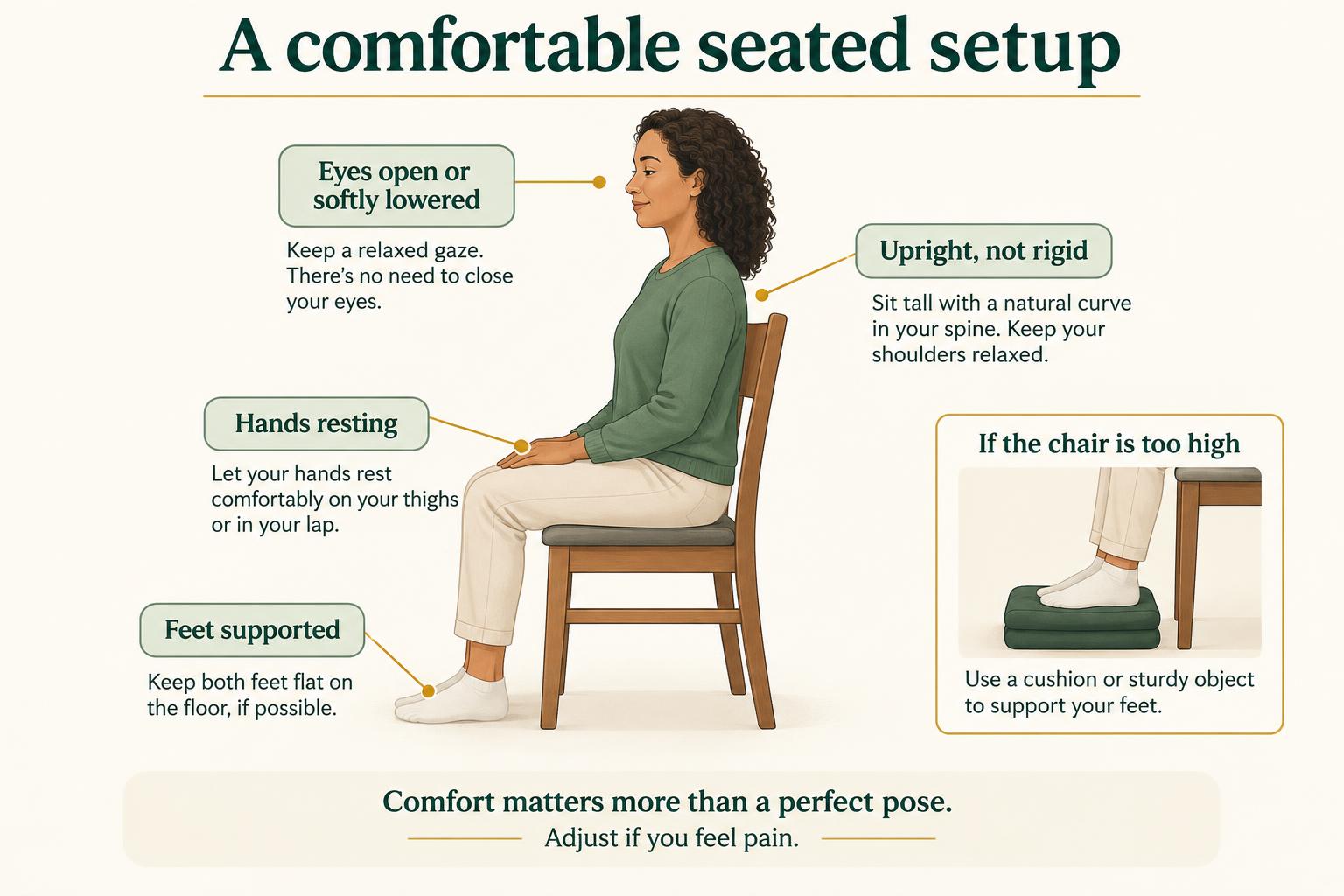
Posture in meditation serves one purpose: supporting alert relaxation. Sit with the spine naturally tall — imagine a string gently lifting the crown of your head — while the rest of the body softens. Shoulders drop back and down, hands rest on thighs or fold in the lap, chin tucks slightly so the neck lengthens. The chest stays open enough for the breath to move freely. Whether this happens cross-legged on a cushion, kneeling on a bench, or sitting in a chair with feet flat is entirely secondary.
Test your posture with two questions. Could I stay here for my full session without escalating pain? And does this position keep me awake and bright rather than foggy? If yes to both, your posture is proper. Discomfort that builds into genuine pain is not noble — adjust without guilt, because pain hijacks the attention you came to train. The monks who sit motionless for hours built that capacity over years; your only job is a posture you can sustain tomorrow and the day after.
Recommended listening
The 5 Minute Meditation Paradise
by Stephens Hyang · narrated by Robert Gazy · 6 hrs and 1 min
The Ultimate "How to Meditate Guide" to Help You Increase Mindfulness and Reduce Anxiety Through Meditation, Guided Meditation, Chakra, and Zen Music
Proper Breathing: Do Nothing, Notice Everything
The most common technical error in meditation is controlling the breath. Beginners sit down and immediately start breathing deeply, slowly, deliberately — and then wonder why they feel light-headed and strained after five minutes. In breath meditation proper, the breath is the observed, not the operator. Your task is to feel breathing exactly as it happens: shallow or deep, fast or slow, smooth or rough. The body has breathed without your management your entire life; meditation is where you finally watch it work.
What typically happens is subtler and more interesting than control: as attention settles, the breath naturally slows and deepens on its own, a physiological signature of the relaxation response. Let that happen by itself. If you catch yourself steering — and you will, constantly — simply release the steering and return to observing. One legitimate exception: a deliberate, slow exhale at the very start of a session, or during acute anxiety, where conscious breathing is used as a tool. Once calm arrives, return the breath to its own management.
Proper Relationship with Thoughts
Here is the skill that separates proper meditation from a frustrating sit: thoughts are not the enemy. The mind produces thought the way the heart produces beats, and a practice built on suppressing thoughts is a war you will lose every session for the rest of your life. The proper move is recognition without engagement. A thought arises, you notice it — ah, planning; ah, memory; ah, worry — and you let it continue its trajectory without you, returning attention to the breath the way you would gently set down a heavy bag.
The labeling technique makes this concrete. Give each distraction a soft, one-word mental tag — thinking, hearing, feeling — and note how the label creates a sliver of space between you and the mental event. In that space, thoughts lose their authority: you stop being inside the worry and start observing it. This shift, from identification to observation, is the single most valuable skill meditation develops, and it transfers directly into daily life, where the space between provocation and response is where your freedom lives.
The Seven Mistakes That Undermine Proper Practice
Most improper meditation is actually improper expectation. The seven mistakes below account for nearly every stalled practice, and each has a simple correction.
Read the corrections as permissions rather than rules. Meditation traditions agree on remarkably little except this: the practitioners who continue are the ones who treat themselves kindly while doing it. Every mistake on this list, committed daily, still constitutes a practice that will mature — the errors dissolve through experience far more reliably than through effort.
| Mistake | Why it hurts | Proper correction |
|---|---|---|
| Forcing the breath | Creates strain and light-headedness | Observe breathing without controlling it |
| Fighting thoughts | Guarantees frustration and failure | Label thoughts and return gently |
| Chasing calm states | Turns practice into craving | Welcome whatever arises equally |
| Grading every session | Kills motivation on hard days | Evaluate monthly, by life off the cushion |
| Practicing only when inspired | Prevents habit formation | Fixed daily time, small sessions |
| Enduring real pain | Attention collapses into suffering | Adjust posture without guilt |
| Comparing to others | Breeds discouragement | Your wandering mind is the normal curriculum |
How to Know Your Practice Is Working
Proper meditation rarely announces itself during the session. The reliable signs appear elsewhere: you catch yourself mid-irritation before speaking; a stressful email arrives and you take one breath before answering; you notice the first stirrings of anxiety rather than waking up inside a full spiral; sleep comes a little faster; Sunday evenings feel slightly less heavy. These are the metrics that matter, and they are measured in your life, not on your cushion.
During sessions, the trustworthy sign is subtler: the returns quicken. Where a distraction once kidnapped attention for three minutes before you noticed, it now holds you for thirty seconds, then ten. The mind still wanders — it always will — but your noticing sharpens. If you want objective encouragement, keep a one-line daily journal: session done or not, and one observation about the day. Reviewed monthly, it will show a trajectory that no single session ever reveals.
Refining Form with Guidance
Self-taught meditation works, but guidance accelerates proper form by correcting the subtle errors you cannot see in yourself. A teacher — live or recorded — catches the forced breath you did not notice, normalizes the distraction you were ashamed of, and paces sessions so you practice at the edge of your ability rather than beyond it. This is why structured programs have always been the traditional way to learn: the monasteries were, among other things, form-correction machines.
Modern guided audio serves the same function for home practitioners. A well-produced program such as The 5 Minute Meditation Paradise, narrated by Robert Gazy, models proper practice session after session — unhurried pacing, gentle returns, no strain — until the form becomes yours. After a few weeks of practicing alongside good guidance, silent sits inherit the same quality. Proper meditation, in the end, is simply what remains when good habits replace self-criticism: upright, relaxed, patient, and willing to begin again every single breath.
Check the Process Instead of Judging the Feeling
If you want to know whether you are meditating properly, review what you are doing rather than how calm you feel. Did you choose a clear anchor? Did you recognize at least one moment when attention moved? Did you return without deliberately making the exercise harsher? These questions describe a process you can observe. A feeling of peace may accompany that process, but it is not required. A session can be restless and still contain many moments of awareness. Conversely, pleasant drifting can feel relaxing while involving little intentional recognition of where attention has gone. Neither experience needs condemnation; they simply describe different activities.
Consider a common example. You begin watching natural breathing, then spend a minute planning dinner. When you notice, you think that you have ruined the session. That second thought is another mental event, not an objective assessment. Acknowledge planning and judging, then return to the next clear sensation. Do not punish yourself by tightening the body, breathing harder, or adding time. The discovery that you were distracted is the very moment in which awareness becomes available again. Proper practice is not uninterrupted control. It includes the capacity to recognize a lapse and begin again without turning the lapse into an argument about your worth.
The same principle applies when you use a guided recording. You may miss a sentence or adapt a suggested posture. That does not automatically make the practice incorrect. What matters is whether you understand the intended action and can approach it safely. If an instruction is unclear, listen again outside the session or consult a teacher. If it is uncomfortable, change it or stop. A recording supplies general guidance, not an individualized assessment. The 5 Minute Meditation Paradise can be a listening resource to preview, but no audiobook can decide that your body must remain in a position or your breath must follow a pattern that feels wrong.
Calibrate Effort: Neither Forcing nor Drifting
Beginners often alternate between intense concentration and vague relaxation. In the first mode, they grip the anchor as though any thought is an intruder. In the second, they drift and forget the intention of the session. A more workable middle ground is steady but light attention. Feel one natural breath or point of contact clearly, then allow the next moment to arrive. When distraction appears, return without urgency. You are not trying to freeze attention. You are practicing knowing where it is and redirecting it when useful. This can be easier to understand through experience than through a demand to concentrate harder.
Notice signs that effort has become excessive. You might be holding the breath, pressing the tongue against the roof of the mouth, narrowing the eyes, or bracing the shoulders. Relax what can comfortably soften and return to an ordinary anchor. If attention is too vague, open the eyes, sit more upright with support, or choose a clearer sensation such as contact with the feet. These adjustments are practical, not moral. The right amount of effort changes with fatigue, stress, and the technique. A session after poor sleep may need a shorter length or more external attention than a session on a rested afternoon.
Avoid making breathing into a performance. Unless you are deliberately doing a suitable breathwork exercise, you do not need a fixed ratio, an unusually deep inhalation, or breath holding. Mindfulness of breathing means noticing breathing as it occurs. If observing it causes uncomfortable monitoring, use touch or sound instead. There is no requirement that the breath be the anchor for every person. Proper meditation is better understood as appropriate practice: a clear method, a comfortable setup, and enough flexibility to respond to your actual experience rather than forcing yourself into an imagined model of how a meditator should look.
When Personal Guidance Is More Useful Than Another Tip
A general guide cannot fully answer every question about pain, trauma, anxiety, or unusual experiences during meditation. If practice repeatedly increases distress, pause and speak with an appropriate professional or a teacher qualified to adapt the method. Look for someone who welcomes questions, explains the limits of their role, and does not insist that discomfort proves progress. A teacher should help you understand choices rather than make you dependent on their authority. For significant mental or physical symptoms, a clinician may be more appropriate than a meditation instructor. The distinction matters because skill in teaching a practice is not the same as training to diagnose or treat a condition.
You can prepare for guidance by recording concrete observations. Note the posture, approximate session length, anchor, and what happened. I felt dizzy after deliberately breathing very deeply gives more useful information than meditation does not work. I felt disconnected when I closed my eyes suggests a different adjustment from my knees hurt on the cushion. Keep the account factual and avoid diagnosing yourself from online descriptions. Specific observations make it easier to identify whether the issue concerns setup, instruction, or a need for additional support. They also help prevent you from changing several variables at once without understanding what improved or worsened the experience.
Ultimately, proper practice should remain connected to everyday functioning. After a session, can you orient to the room and choose your next action? Can you respond to your needs without feeling bound by the timer? Are you learning a repeatable process rather than chasing an exceptional state? These questions keep the goal grounded. Meditation may be useful without feeling dramatic, and it may need adaptation without being a personal failure. Keep the central sequence simple: choose, notice, return, and finish deliberately. The best correction is often less force and more clarity, not a stricter rule about how you must breathe, sit, or feel.
A Practical Detail to Keep in Mind
A proper finish is as important as a clear beginning. When the session ends, broaden awareness to the room, notice the support beneath you, and move before standing. If you feel sleepy or unsteady, take a moment rather than rushing directly into another activity. Then identify one ordinary next action. This transition prevents meditation from being treated as an isolated inner performance with no connection to daily life. It also provides a simple opportunity to notice your current state without demanding that it be different. You may feel calm, unchanged, or restless. Respond to what is present. If you repeatedly feel distressed or disconnected, pause the practice and seek appropriate guidance rather than extending it. A method is not made correct by completing a timer regardless of its effects. Clarity, comfort, and agency are better guides than rigid compliance with a general instruction. Keep the process understandable enough that you can explain what you did and flexible enough that you can change it when necessary.
Start listening today
The 5 Minute Meditation Paradise
by Stephens Hyang · narrated by Robert Gazy · 6 hrs and 1 min
The Ultimate "How to Meditate Guide" to Help You Increase Mindfulness and Reduce Anxiety Through Meditation, Guided Meditation, Chakra, and Zen Music
Frequently asked questions
Am I meditating properly if my mind keeps wandering?
Yes. A wandering mind is the universal condition of meditation, not a sign of improper practice. Proper meditation is defined by noticing the wandering and returning gently. If you are returning, you are doing it correctly — regardless of how busy the mind feels.
What is the proper way to breathe during meditation?
For most meditation, the proper way is to let the body breathe on its own while you observe the sensations. Do not deepen, slow, or control the breath. Conscious slow breathing is a separate, legitimate technique used for calming, but breath observation is the core practice.
How long should a proper meditation session be?
Proper length is whatever you will sustain daily: five to fifteen minutes for most beginners, extending gradually over months. Five consistent minutes is far more proper — and more beneficial — than thirty minutes attempted twice and abandoned.
Is it improper to meditate lying down or with music?
Neither is improper. Lying down suits body scans and sleep practice, though it risks drowsiness. Gentle music helps many people settle and masks noise. The only improper element would be falling asleep when you intended to practice, or letting music fully replace attention.
How do I properly end a meditation session?
Close deliberately: one conscious breath, a brief notice of how your body and mind feel, and a small intention for the next part of your day. Avoid leaping up at the timer. The closing moments carry the session's quality into action, which is where the benefits actually live.
Proper meditation is not a performance to perfect but a relationship to practice: upright, unhurried, and endlessly forgiving of your own wandering mind. Sit tomorrow, return kindly, and let form refine itself. For guided sessions that model proper practice from the first breath, The 5 Minute Meditation Paradise is a patient teacher in your pocket.


