Key takeaways
- •Meditation requires nothing but attention — you can practice anywhere, today.
- •Three minutes done daily beats thirty minutes done rarely.
- •The breath is a portable anchor that travels everywhere you go.
- •Awkward beginnings are universal; the skill arrives through repetition, not talent.
The Only Instruction You Really Need
Strip meditation to its skeleton and four words remain: sit, breathe, notice, return. Sit comfortably. Breathe naturally. Notice when attention has wandered into thought. Return to the breath. Repeat until your chosen time ends. Every tradition, app, teacher, and bestselling book is an elaboration on this loop, and you can begin practicing it in the next sixty seconds with nothing you do not already have.
Why, then, does meditation have a reputation for difficulty? Because the instruction is simple but the mind is busy, and beginners mistake the busy mind for failure. In truth, the wandering is the workout. Each return from distraction strengthens attention exactly as each lift strengthens a muscle — the resistance is the point. Once you understand that a noisy session is a productive session, the practice becomes impossible to fail: you either sat and noticed, or you did not sit. Sitting is the whole exam.
Your First Three-Minute Session, Right Now
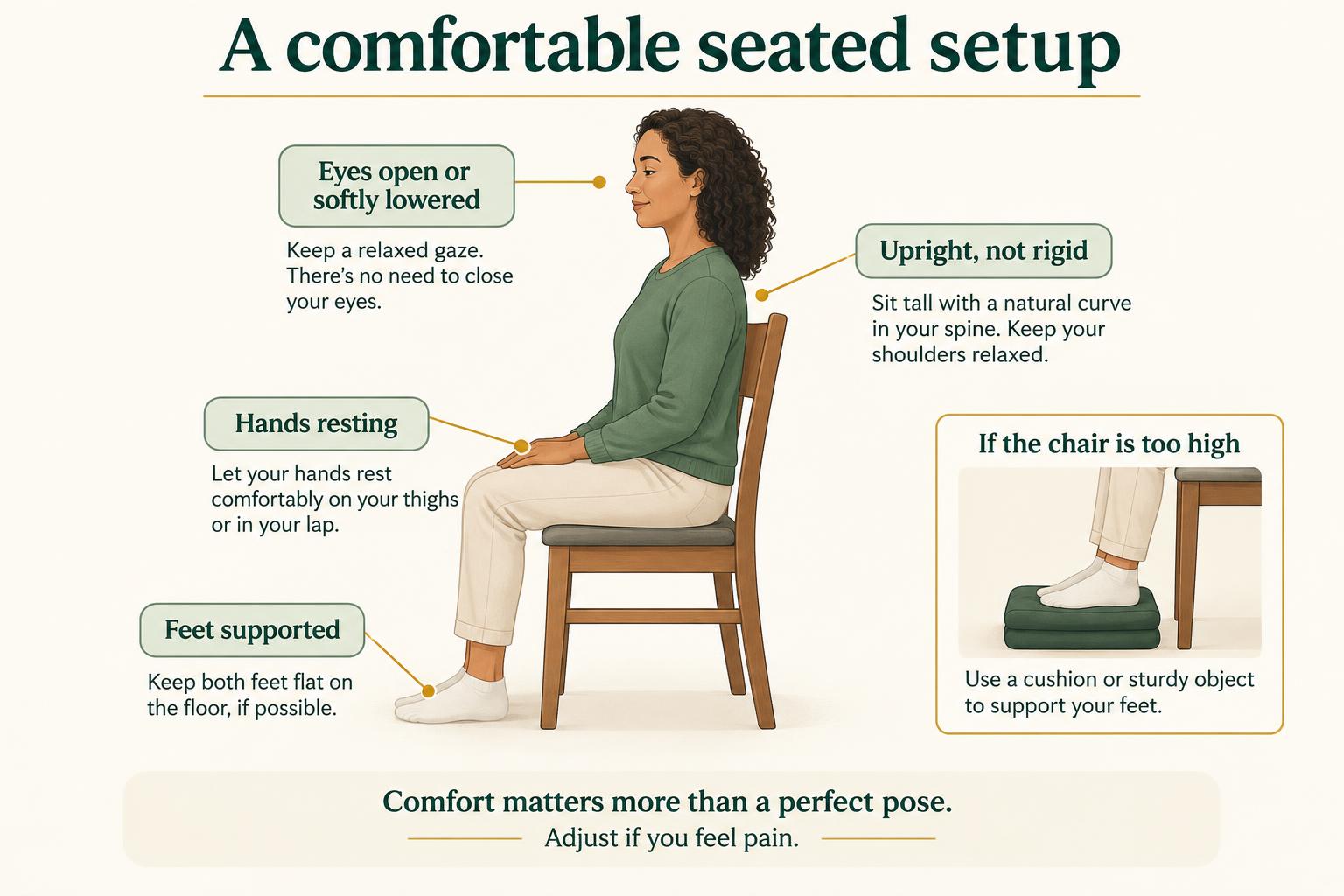
You can meditate before finishing this article, and you should — experience teaches in three minutes what reading cannot in three hours. Put the phone face-down with a quiet timer set for three minutes. Sit wherever you are with your spine reasonably tall. Close your eyes or soften your gaze. Take three slow breaths, then let breathing return to normal and simply feel it — air at the nostrils, movement in the chest or belly. When thoughts come, and they will, acknowledge them and come back to the next breath.
When the timer sounds, take one more deliberate breath and notice how you feel compared to three minutes ago. Most people report some combination of calmer, slower, and was that really only three minutes — occasionally with a side of my mind would not stop, which is also fine and completely normal. Whatever happened, you have now meditated. The distance between a non-meditator and a meditator is one session, and you just crossed it.
Recommended listening
The 5 Minute Meditation Paradise
by Stephens Hyang · narrated by Robert Gazy · 6 hrs and 1 min
The Ultimate "How to Meditate Guide" to Help You Increase Mindfulness and Reduce Anxiety Through Meditation, Guided Meditation, Chakra, and Zen Music
Meditating at Home: The Corner That Calls You
Home is where practice lives or dies, because home is where habit operates. Choose one spot — a chair, a cushion, a corner of the sofa — and meditate there every time. The brain learns places the way it learns times: sit in the same spot daily for two weeks and simply being there begins to settle you, a free head start on every session. Keep the spot ready: cushion in place, headphones nearby, nothing to arrange at 6 a.m.
Manage the two home-specific obstacles: other people and your own devices. Tell housemates what your minutes mean and when they happen; even young children can learn that a closed door and headphones mean later. As for the phone — meditation's greatest modern rival — leave it outside the room with a plain timer running, or use it for a guided session with every notification silenced. The household does not need to be silent; it needs to be slightly less available than usual.
Meditating at Work and in Public
Workplace meditation sounds awkward until you realize the best techniques are invisible. Three breaths with attention fully on the exhale before opening email. A minute of feeling your feet on the floor during a meeting that should have been an email. A slow walk to lunch where you actually feel each step. A five-minute sit in a parked car before walking into the building — for many commuters, the car becomes the most reliable meditation room they own.
Public practice follows the same principle: eyes open, posture ordinary, attention inward. On a train, rest attention on the rhythm of the carriage or the sensations of breathing while appearing to gaze out the window. In a queue, feel your feet and the weight of your body instead of reaching for the phone. These micro-sessions are not watered-down meditation — they are its most advanced application, carrying calm into exactly the environments that need it most.
Short Routines for Every Situation
Different moments call for different lengths, and having a routine for each removes the daily negotiation about when to practice. The routines below cover a full day; adopt one or two rather than all five, and add others only when the first feels automatic.
Notice what all five share: an existing cue, a tiny time cost, and no equipment. Morning coffee, transitions, lunch, arrivals, bedtime — the day is already full of hinges, and each routine simply hangs a moment of attention on one. Practitioners who build even two of these habits report a disproportionate effect, because they punctuate the day with recovery instead of running it as one long sprint.
| Routine | When | Length | How |
|---|---|---|---|
| Morning settle | After waking, before phone | 3-5 min | Sit on the bed's edge, follow the breath |
| Transition breaths | Before each new task | 3 breaths | Full attention on each exhale |
| Lunch reset | Before eating | 2 min | Feel feet, breathe, then eat first bites mindfully |
| Car decompression | Parked, before going inside | 5 min | Eyes soft, breath counting, one to ten |
| Night wind-down | In bed, lights off | 5-10 min | Slow body scan from feet to face |
What to Do About a Loud Mind
Every meditator's first complaint is the same: my mind is too busy for this. Understand that a busy mind is not a disqualification — it is the exact condition meditation treats, and claiming you are too distracted to meditate is like claiming you are too dirty to shower. The practice was designed for you. Still, a loud mind benefits from certain adjustments: shorter sessions, since three focused minutes beat ten minutes of wrestling; counting the breaths, which gives the verbal mind a job; and guided audio, where a calm voice supplies the structure your attention cannot yet supply itself.
The last option deserves emphasis because it rescues more beginners than any other. When silence amplifies the noise, narration replaces it: a voice reminds you where to look and reassures you that wandering is normal. Programs built for exactly this situation — the five-minute guided sessions in The 5 Minute Meditation Paradise, for instance, with mindfulness instruction carried on soft zen music — let a loud mind practice successfully on day one. Many people who failed at silent meditation for years find that guided sessions finally make the habit possible.
From First Sit to Lasting Practice
The gap between meditating once and meditating for years is crossed by boring, reliable mechanics. Same time daily, attached to something you already do. Small enough to survive your worst week — a floor of two minutes that always counts. A visible streak you hate to break. And the never-miss-twice rule: one missed day is forgiven instantly, but never let a second pass without sitting, even briefly.
Expect the arc: enthusiasm, then negotiation around week two, then — if you held the line through the negotiation — automaticity somewhere around week six to eight. The reward is not merely calm sessions but a changed baseline: slightly more patience in traffic, slightly earlier noticing of stress, slightly faster recovery from everything. People meditate for decades not because they are disciplined but because the practice keeps paying. Your first three minutes are above; the rest of the path is just tomorrow, repeated.
Choose a Practice for the Moment You Are Actually In
The instruction to meditate can sound like a demand to become a different kind of person: quieter, more disciplined, or less busy. Start with the situation already present instead. If you have just arrived home, sit for a short interval before opening another screen. Feel the chair and notice the room. If you are waiting safely in a queue, attend to contact with the floor while remaining aware of the people around you. If you are outdoors on a clear route, notice several ordinary steps. These are not replacements for every formal practice, but they demonstrate that intentional attention does not require an ideal room or a special identity.
Match the anchor to what feels accessible. A natural breath sensation may be clear on one day and difficult on another. Contact with your hands, a neutral visual point, or ordinary sound can serve instead. Choose one and stay with it briefly. When a thought pulls you away, acknowledge that shift and return. You do not have to suppress the thought, complete its argument, or count every distraction. The action is simple but may need repeated practice. Let the session be small enough that you can approach it without turning the whole day into a project about becoming perfectly present.
Meditating in public requires ordinary judgment. Keep your eyes open when safety or social context calls for it. Do not block a path, ignore a person who needs your response, or use isolating audio near traffic. A brief attention practice can coexist with awareness of the environment. If you cannot safely pause, choose a later opportunity rather than insisting on practicing now. Portability is useful, but it does not mean every situation is appropriate for inward attention. The ability to adapt is part of making meditation practical rather than forcing life to conform to a fixed image of how a meditator behaves.
Let Restlessness Be Information Rather Than a Verdict
If you sit down and immediately want to get up, notice what is happening before concluding that you cannot meditate. You may be tired, physically uncomfortable, worried about a task, or simply unused to pausing. Adjust the obvious conditions first. Use a chair if the floor hurts. Write down an urgent reminder if the mind keeps rehearsing it. Shorten the session if the planned length feels unrealistic. If movement would be more comfortable, try a safe mindful walk. The fact that a still session is difficult does not establish a personal defect. It may indicate that this version of the practice does not fit the moment.
Some restlessness is ordinary mental activity that you can notice without acting on immediately. Feel the urge to move, recognize it as an urge, and see whether you can remain comfortably for another breath or two. This is an experiment, not a command to stay seated through distress. If agitation increases, move or stop. There is an important difference between allowing a passing impulse and overriding a clear need for safety. Meditation should expand your choices. It should not make you afraid to respond to pain, panic, or a sense that you are becoming disconnected from your surroundings.
When a session feels uneventful, resist adding intensity just to make something happen. The mind may ask for music, a longer timer, or a more elaborate technique because ordinary attention seems insufficiently dramatic. You can acknowledge that wish and continue with the simple anchor. Sometimes a modest session is useful precisely because it interrupts the habit of seeking a new stimulus. Other times a different format genuinely helps. Give each change a reason you can name. I need a more comfortable posture is clearer than I must find the method that finally makes my mind stop.
Use Audio as a Starting Point, Not a Requirement
A guided recording can make beginning easier when you do not want to decide what to do next. Choose a voice and session length that feel manageable, then listen actively to the instruction. If the guide asks you to notice contact with the chair, attend to that contact rather than merely hearing the words. When you miss an instruction, return to the current one without rewinding unless clarification is genuinely needed. The 5 Minute Meditation Paradise is one audiobook to preview for this purpose. Its available sample can help you decide whether the pacing and style support the kind of practice you want.
Keep a simple silent fallback. You might sit comfortably, notice three ordinary sounds, and return to one point of contact for a short interval. This prevents a missing device, unavailable download, or empty battery from ending the routine. It also clarifies that the essential skill belongs to you rather than to the recording. You can keep using audio for as long as it is helpful; independence is not a contest. The fallback simply gives you another option. Practical meditation often grows through these small redundancies, where more than one comfortable route leads into the same basic action of noticing and returning.
After a session, decide on one ordinary next step. Drink water, return to a task, take a needed break, or begin a conversation. Notice whether you can do that action a little more deliberately. Do not demand a complete personality change or a measurable health result from a few quiet minutes. Your experience will vary, and other conditions matter. The word meditate names an activity, not a promise. When you understand it as a repeatable practice of attention, you can begin without waiting to feel ready, while still adjusting or stopping whenever the chosen exercise is not serving you well.
A Practical Detail to Keep in Mind
A brief session can have a clear beginning and end even when it lasts only a minute. Begin by recognizing that you are intentionally pausing. Choose contact with your feet or one ordinary sound. Notice wandering and return. Finish by looking around and deciding what comes next. This small structure distinguishes practice from simply waiting while thoughts run. It also makes the activity portable without making it vague. You do not need to call every pause meditation, and you do not need to turn every pause into a performance. Use the structure when it is helpful and leave it aside when another response is more appropriate. If you are very tired, a needed rest may be better than an effort to remain alert. If you face an urgent task, a plan may be more useful than prolonged sitting. Meditating well includes knowing the limits of the moment. The practice belongs within life, alongside other sensible actions, rather than above them as a requirement that must always come first.
Start listening today
The 5 Minute Meditation Paradise
by Stephens Hyang · narrated by Robert Gazy · 6 hrs and 1 min
The Ultimate "How to Meditate Guide" to Help You Increase Mindfulness and Reduce Anxiety Through Meditation, Guided Meditation, Chakra, and Zen Music
Frequently asked questions
How do I meditate if I have never done it before?
Set a timer for three minutes, sit comfortably with a tall spine, and close your eyes. Breathe naturally while feeling the physical sensations of each breath. When your mind wanders, notice and gently return to the breath. Repeat until the timer sounds — you have now meditated.
Can I meditate lying down or while walking?
Yes. Lying down works well for body scans and sleep preparation, though it invites drowsiness. Walking meditation — moving slowly while feeling each step — is a complete traditional practice and ideal for people who find sitting intolerable. The anchor changes; the training is identical.
How often should I meditate to see results?
Daily practice of even three to ten minutes produces noticeable effects within two to four weeks for most people. Frequency matters more than duration: five minutes every day outperforms an occasional long session, because the brain consolidates attention training through regular repetition.
Is it okay to meditate with background noise?
Absolutely. Silence is a luxury, not a requirement. You can either use sounds as part of practice — noticing them without judgment — or mask them with headphones and gentle music. Many long-term meditators practice successfully in busy households, offices, and public transport.
What is the easiest way to meditate with a very busy mind?
Use short sessions of three to five minutes, count your breaths from one to ten, and try guided audio so a narrator carries the structure. Counting and guidance give a busy mind jobs it can actually do, while the repeated returns from distraction quietly build the focus that currently feels impossible.
You are three minutes away from your next session — no cushion, no silence, no special skills required. Set the timer before you close this page, and let sit, breathe, notice, return do its quiet work. For the days your mind refuses to cooperate, The 5 Minute Meditation Paradise will meet you with a calm voice and five gentle minutes. That is all beginning has ever required.


