Key takeaways
- •Meditation is attention training, not thought elimination — a busy mind is the gym, not the problem.
- •Consistent short sessions of five to ten minutes produce measurable benefits within eight weeks.
- •Breath, body, mantra, and guided styles all work; the best style is the one you practice daily.
- •Pairing meditation with an existing daily habit is the most reliable way to make it stick.
What Is Meditation, Really?
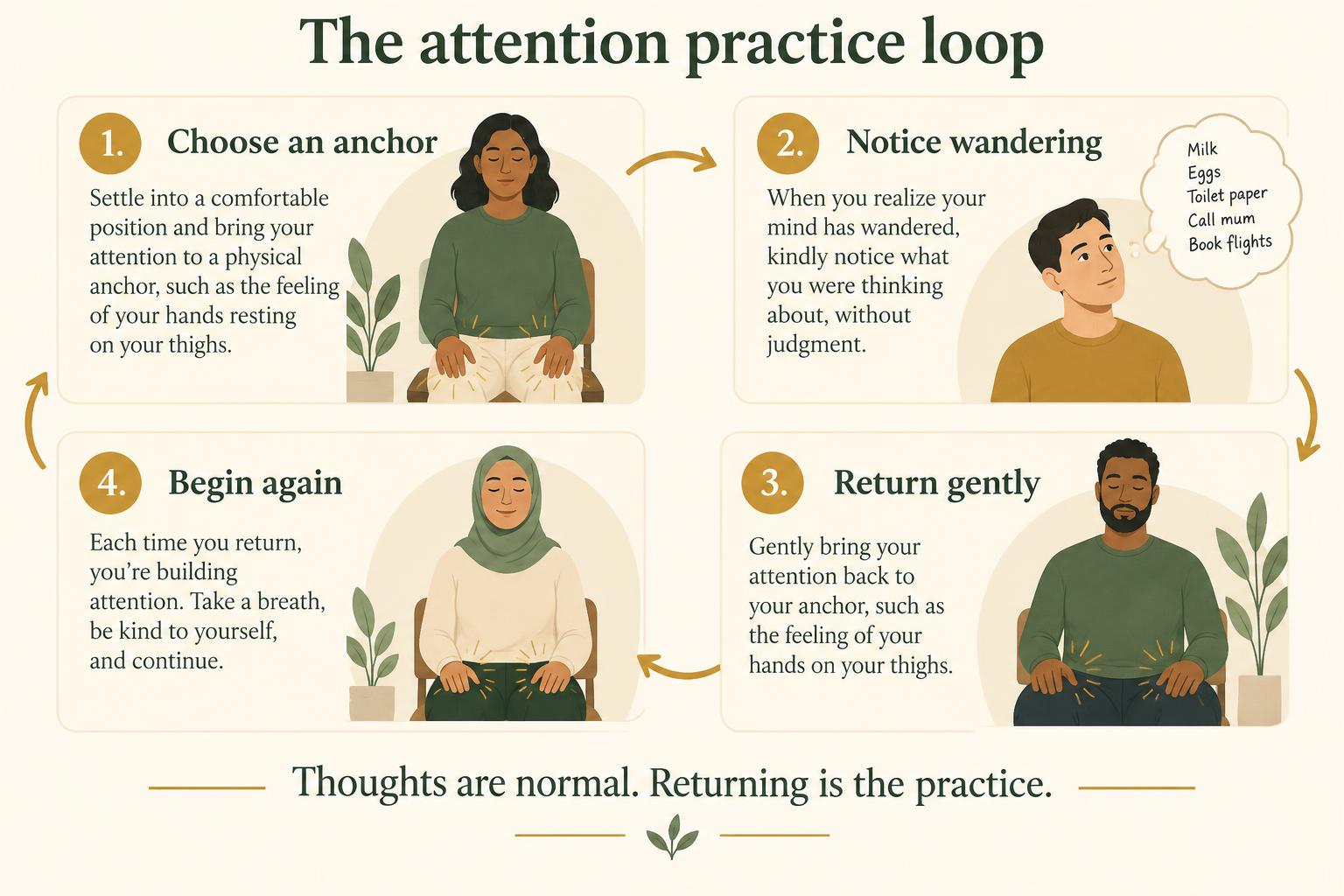
Strip away the incense, the chanting, and the Instagram aesthetics, and meditation is one thing: the intentional training of attention. You choose where to place your mind, you notice when it slips away, and you bring it back. That is the entire engine. Every tradition — Buddhist vipassana, Hindu mantra practice, Christian contemplative prayer, modern clinical mindfulness — is a variation on this loop, dressed in different language and ritual.
This definition matters because it corrects the two myths that stop most beginners. First, meditation is not about stopping thoughts; the mind produces thoughts the way the heart produces beats, and fighting them only adds tension. Second, meditation is not a trance or escape. It is the opposite — a practice of staying present with experience exactly as it is, pleasant or unpleasant, without grasping or pushing away. Once you understand meditation as training rather than transcendence, every session becomes a success simply because you showed up and did the reps.
How Meditation Changes the Brain
The science of meditation has moved from fringe to mainstream over two decades of imaging studies. Regular practice is associated with increased gray-matter density in the hippocampus, a region central to learning and memory, and decreased volume in the amygdala, the brain's alarm center for fear and stress. Functional studies show stronger connectivity in attention networks and reduced activity in the default mode network — the circuitry that powers mind-wandering, rumination, and anxious self-referencing.
Clinically, the results are equally striking. Mindfulness-based stress reduction, an eight-week structured program, produces moderate reductions in anxiety and depression comparable to first-line medications in some trials, without side effects. Meditation lowers cortisol, reduces blood pressure, improves sleep quality, and even appears to slow cellular markers of aging such as telomere shortening. None of this requires hours a day: most studies showing measurable change used daily sessions of ten to thirty minutes across eight weeks. The brain responds to meditation the way muscle responds to exercise — gradually, reliably, and in proportion to consistent effort.
Recommended listening
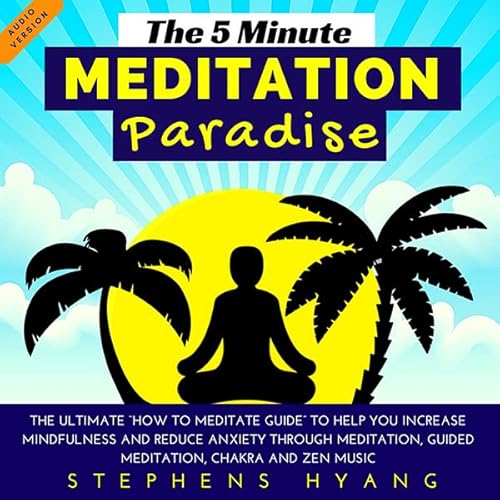
The 5 Minute Meditation Paradise
by Stephens Hyang · narrated by Robert Gazy · 6 hrs and 1 min
The Ultimate "How to Meditate Guide" to Help You Increase Mindfulness and Reduce Anxiety Through Meditation, Guided Meditation, Chakra, and Zen Music
The Major Styles of Meditation
Although hundreds of named techniques exist, nearly all fall into four families. Concentration practices — breath awareness, mantra repetition, candle gazing — train stability by holding one object. Open-monitoring practices, including mindfulness of thoughts and zen, train equanimity by observing whatever arises without preference. Heart-centered practices such as loving-kindness and compassion meditation train warmth toward self and others. And embodied practices — body scans, yoga, qigong, walking meditation — train presence through physical sensation and movement.
Guided meditation deserves special mention because it is a format rather than a family: a teacher's voice leads you through any of the styles above. For beginners it is often the most forgiving entry point, since the narration supplies structure exactly when self-direction is hardest. Programs like The 5 Minute Meditation Paradise by Stephens Hyang package mindfulness, chakra, and zen music sessions into short guided blocks, which is why so many new meditators use it as their first daily practice before graduating to silent sits.
How to Start Meditating Today
Begin absurdly small. Sit in a chair with your feet flat and spine tall but not rigid. Set a timer for five minutes. Close your eyes and feel three full breaths, noticing cool air entering and warm air leaving. Then simply continue breathing naturally, resting attention wherever the breath feels clearest. When you notice you have been thinking — and you will, within seconds — silently note thinking and return to the breath. Repeat until the timer sounds. That is a complete, legitimate meditation session.
For the first month, protect consistency rather than duration. Five minutes every day builds the neural habit faster than thirty minutes twice a week. Choose a trigger that already exists — after pouring morning coffee, before opening email, right after changing out of work clothes — and let that cue carry the practice. If motivation wavers, downshift to two minutes rather than skipping; the streak matters more than the session. Most people find that by week four, the practice begins to feel less like a task and more like a daily appointment with quiet.
Setting Up Your Space and Posture
You do not need a dedicated meditation room, but a consistent corner helps the brain switch into practice mode. A cushion or chair, soft light, and relative quiet are enough. Some people add a candle, a plant, or a blanket to signal that this spot is different from the rest of the house. Keep the setup simple enough that it never becomes an excuse — the goal is a place you can be sitting in within thirty seconds of deciding to practice.
Posture serves one purpose: alert relaxation. Sit tall with the spine naturally erect, chin slightly tucked, hands resting on thighs or in the lap. Lying down invites sleep; slumping invites fog. If cross-legged on the floor is uncomfortable, a chair is completely legitimate — monks have used benches and stools for centuries. Comfort matters because pain hijacks attention, but a small edge of uprightness keeps the mind bright. Experiment for a week and let your body vote.
Common Challenges and How to Meet Them
Every meditator meets the same five obstacles. Sleepiness: practice earlier, open the eyes slightly, or stand. Restlessness: shorten sessions and add mindful walking. Boredom: remember that watching boredom itself is advanced practice — stay curious about its texture. Doubt: track small wins in a journal, because benefits accumulate below the threshold of daily notice. And self-judgment, the harshest obstacle: treat each wandering and return as success, because that return is literally the exercise.
The most dangerous challenge is the belief that you are bad at meditation. There is no such thing. A session where you noticed distraction fifty times gave you fifty repetitions of the core skill — arguably a harder workout than a calm session. Research on habit formation shows that self-compassion, not discipline, predicts who is still practicing a year later. When you miss a day, begin again the next morning without ceremony. The practice forgives instantly; only the inner critic keeps score.
How Long and How Often Should You Meditate?
The honest answer is that dose matters and consistency matters more. Studies detecting structural brain changes typically involved twenty to thirty minutes daily over eight weeks, but studies on stress reduction show benefits from as little as ten minutes a day, and even five-minute sessions measurably lower acute anxiety. A sensible progression is five minutes daily for two weeks, ten minutes for the next month, then fifteen to twenty if the practice has earned a place in your routine.
Frequency beats duration at every stage. The brain consolidates attention training the way it consolidates language learning — through regular exposure, not heroic cramming. Two shorter sessions, morning and evening, often work better than one long sit because they bookend the day with calm. Whatever schedule you choose, tie it to existing routines and review monthly. A practice that flexes with your life survives; a rigid one shatters at the first busy week.
| Experience level | Suggested session | Frequency | Realistic goal |
|---|---|---|---|
| Weeks 1-2 | 5 minutes | Once daily | Build the habit loop |
| Weeks 3-8 | 10 minutes | Once daily | Stabilize attention on breath |
| Months 3-6 | 15-20 minutes | Once or twice daily | Notice calmer reactions off the cushion |
| Months 6+ | 20-30 minutes | Daily, plus weekly long sit | Deepen insight and equanimity |
Meditation vs. Relaxation: What Is the Difference?
Relaxation is a pleasant side effect of meditation, but it is not the point. Relaxation techniques aim to release tension; meditation aims to change your relationship with experience itself. Sometimes a session feels blissful, sometimes restless, sometimes dull — and all three are equally valid training, because the skill being built is presence regardless of conditions. Practitioners who chase only calm often quit when sessions feel difficult, mistaking a hard session for a failed one.
The distinction shows up in daily life. Relaxation fades within hours; meditation's real harvest — pausing before reacting, noticing anxiety early, recovering from setbacks faster — compounds over months. This is why experienced teachers say the goal is not to feel good during practice but to live differently after it. Welcome relaxation when it arrives, but measure your practice by what changes in the other twenty-three and a half hours of the day.
Deepening Your Practice Over Time
Once daily sitting feels natural, depth comes from variety and intention. Explore a second style — add loving-kindness to a breath practice, or a weekly body scan. Try occasional longer sessions on weekends. Read a classic text or listen to teachings from a tradition that intrigues you. Many practitioners also find that guided programs keep evolving with them: a collection like The 5 Minute Meditation Paradise, with its mix of mindfulness instruction, chakra work, and zen music, offers new territory even after months of practice.
Finally, consider the multiplier of community. A local sitting group, an online sangha, or even one friend who also practices dramatically improves long-term consistency. Meditation is an inner journey, but humans are social learners — hearing how others meet the same obstacles normalizes your own experience and keeps the flame lit through dry seasons. Depth is not a destination; it is simply what happens when a modest daily practice refuses to stop.
An Ordinary Session, Described Without the Mystique
Picture a person sitting at the kitchen table before the house becomes busy. They put their phone beyond reach, choose five minutes, and notice the weight of their feet against the floor. For a few breaths, attention rests easily. Then a shopping list appears, followed by a memory of yesterday's conversation. Nothing unusual has happened. The person recognizes that attention has moved, softens the jaw, and returns to the next natural breath. This cycle may happen repeatedly. When the timer rings, they look around, stand up slowly, and continue the morning. The session was meditation even if there was no bliss, profound insight, or uninterrupted concentration.
That everyday description is useful because expectations shape how people interpret the same experience. Someone expecting a blank mind sees distraction as failure. Someone practicing awareness sees distraction as information. You do not need to celebrate every wandering thought, but you also do not need to argue with it. A simple mental acknowledgment, such as remembering or planning, can create enough space to redirect attention. If breathing is not a comfortable focus, the contact of your hands with your thighs or the sound of the room can serve instead. The object matters less than knowing what you are attending to and recognizing when attention has moved.
Closing the session deliberately helps connect formal practice with ordinary behavior. Before reaching for the phone, ask what the next activity requires. Perhaps you need to make breakfast, answer a difficult message, or leave for work. Notice whether there is an impulse to rush, then take one manageable action. Meditation does not remove responsibilities, and it should not become a reason to avoid them. It can provide a small interval in which you choose how to begin. That interval is often a more meaningful indicator of usefulness than how peaceful the seated minutes felt. A restless practice followed by a patient conversation can still be worthwhile.
Reading Meditation Research with Realistic Expectations
Research findings need to be interpreted according to what was actually studied. An eight-week instructor-led program with group meetings, homework, and substantial practice is not interchangeable with an occasional five-minute audio recording. Participants may also benefit from social support, education, and an expectation of improvement. Studies comparing meditation with no intervention can therefore tell a different story from studies comparing it with exercise, relaxation training, or another active treatment. These details do not make meditation worthless; they prevent an interesting result from becoming a promise that every reader will experience the same change on the same schedule.
Brain imaging deserves particular caution. A difference in a scan does not automatically explain how an individual feels or prove that a practice has permanently rewired their mind. Small studies, differences between meditation styles, and the difficulty of measuring prior experience complicate the picture. It is more responsible to say that researchers are investigating attention, stress, and emotional regulation than to treat every proposed brain mechanism as settled. Similarly, meditation should not be described as having no side effects. Some people experience increased anxiety, upsetting memories, or a sense of disconnection, particularly with intense practice. Shorter sessions, eyes-open grounding, and professional guidance may be more appropriate.
If you are considering meditation for a health concern, keep existing care in place and discuss significant symptoms with a qualified professional. Use practice as a supportive skill rather than an experiment in stopping medication or enduring distress. An audiobook such as The 5 Minute Meditation Paradise can help organize a listening routine, but a commercial recording is not a substitute for individualized treatment or a structured clinical program. For everyday learning, a fair question is whether the practice helps you meet ordinary situations more thoughtfully. Look for small, observable changes and remain open to the possibility that a different activity may suit you better.
A Practical Detail to Keep in Mind
One useful boundary is to distinguish practice time from reflection time. During a session, you can notice a thought and return without investigating its entire history. Afterward, if the thought concerns something important, give it a deliberate place in your day. For example, a repeated worry about a conversation may call for writing down what you want to say, not adding another twenty minutes of sitting. This keeps meditation from becoming an indirect way to avoid action. The practice can create a pause, while planning and communication address the circumstances that remain. Neither activity has to replace the other. A clear boundary makes both easier to approach.
Start listening today
The 5 Minute Meditation Paradise
by Stephens Hyang · narrated by Robert Gazy · 6 hrs and 1 min
The Ultimate "How to Meditate Guide" to Help You Increase Mindfulness and Reduce Anxiety Through Meditation, Guided Meditation, Chakra, and Zen Music
Frequently asked questions
What is the simplest definition of meditation?
Meditation is the practice of deliberately training your attention. You focus on an anchor such as the breath, notice when the mind wanders, and gently return. Repeating that loop builds calm, focus, and emotional balance over time, regardless of which style or tradition you follow.
How long does it take for meditation to work?
Most people notice subtle effects — slightly better sleep, faster recovery from stress — within two to four weeks of daily practice. Research studies measuring significant changes in anxiety, attention, and brain structure typically run eight weeks with sessions of ten to thirty minutes per day.
Do I have to sit cross-legged to meditate?
No. Any posture that keeps you alert and comfortable works: a chair with feet flat, a meditation bench, kneeling, lying down for body scans, or even walking. Cross-legged floor postures are traditional but optional. Comfort and an upright spine matter far more than the specific position.
Is meditation a religious practice?
Meditation has roots in Buddhist, Hindu, and contemplative Christian traditions, but modern practice is largely secular. Clinical programs such as mindfulness-based stress reduction teach meditation as attention training with no religious content. You can practice within a faith tradition or entirely outside one — the mechanics of attention are the same.
What if I cannot stop my thoughts during meditation?
You are not supposed to stop thoughts. The goal is to notice thinking and return to your anchor, and each return strengthens attention like a repetition at the gym. A busy mind does not mean failed meditation — it means you have material to train with, which is the entire point of practicing.
Meditation is the rare habit that costs nothing, fits in five minutes, and quietly upgrades every other hour of your life. Start tomorrow morning with one small session — breath by breath, return by return. If you would like a calm voice to guide those first steps, The 5 Minute Meditation Paradise is a gentle place to begin. The cushion is waiting, and so is a steadier version of you.


