Key takeaways
- •Walking meditation anchors attention in the sensations of each step.
- •Start very slowly — half pace or slower — on a short back-and-forth path.
- •It suits restless people and counts as full meditation, not a lesser substitute.
- •Once learned, the skill extends to ordinary walking at normal speed.
What Walking Meditation Is
Walking meditation is formal meditation practice done while walking. Instead of sitting still with attention on the breath, you walk with attention on the body in motion — the lift of the heel, the swing of the leg, the placement of the foot, the shifting of weight. It is a complete, traditional practice with roots as old as seated meditation: the Buddha himself taught walking meditation as one of the postures of practice, and monastics have paced meditation paths for over two thousand years.
It deserves to be taken seriously rather than treated as meditation-lite. The attention training is identical — anchor, wander, notice, return — and for certain minds and certain moments it works better than sitting. Restless bodies settle more easily in motion. Sleepy minds brighten while upright and moving. And practitioners recovering from illness or managing pain often find gentle walking the only comfortable posture. The cushion is tradition; the walking path is equally tradition.
Setting Up Your Walking Space
Formal walking meditation needs surprisingly little: a path of ten to twenty paces where you can walk back and forth without obstacle or audience. Indoors, a hallway, a large room, or even a clear stretch beside your bed works perfectly — privacy helps beginners feel less self-conscious. Outdoors, choose somewhere quiet and level: a garden path, a park trail, an empty stretch of beach. Flat, predictable ground matters because it frees attention from navigation.
Wear comfortable shoes or go barefoot if the surface allows — bare feet offer richer sensation, which gives attention more to hold. Leave the phone behind or silenced in a pocket; a timer across the room or a gentle alarm in your pocket can mark the session's end. Plan for ten to fifteen minutes at first. The back-and-forth format surprises newcomers — won’t this feel pointless? — but the repetition is the point: with nowhere to go, the destination drops away, and only the walking remains.
Recommended listening
The 5 Minute Meditation Paradise
by Stephens Hyang · narrated by Robert Gazy · 6 hrs and 1 min
The Ultimate "How to Meditate Guide" to Help You Increase Mindfulness and Reduce Anxiety Through Meditation, Guided Meditation, Chakra, and Zen Music
The Basic Technique, Step by Step
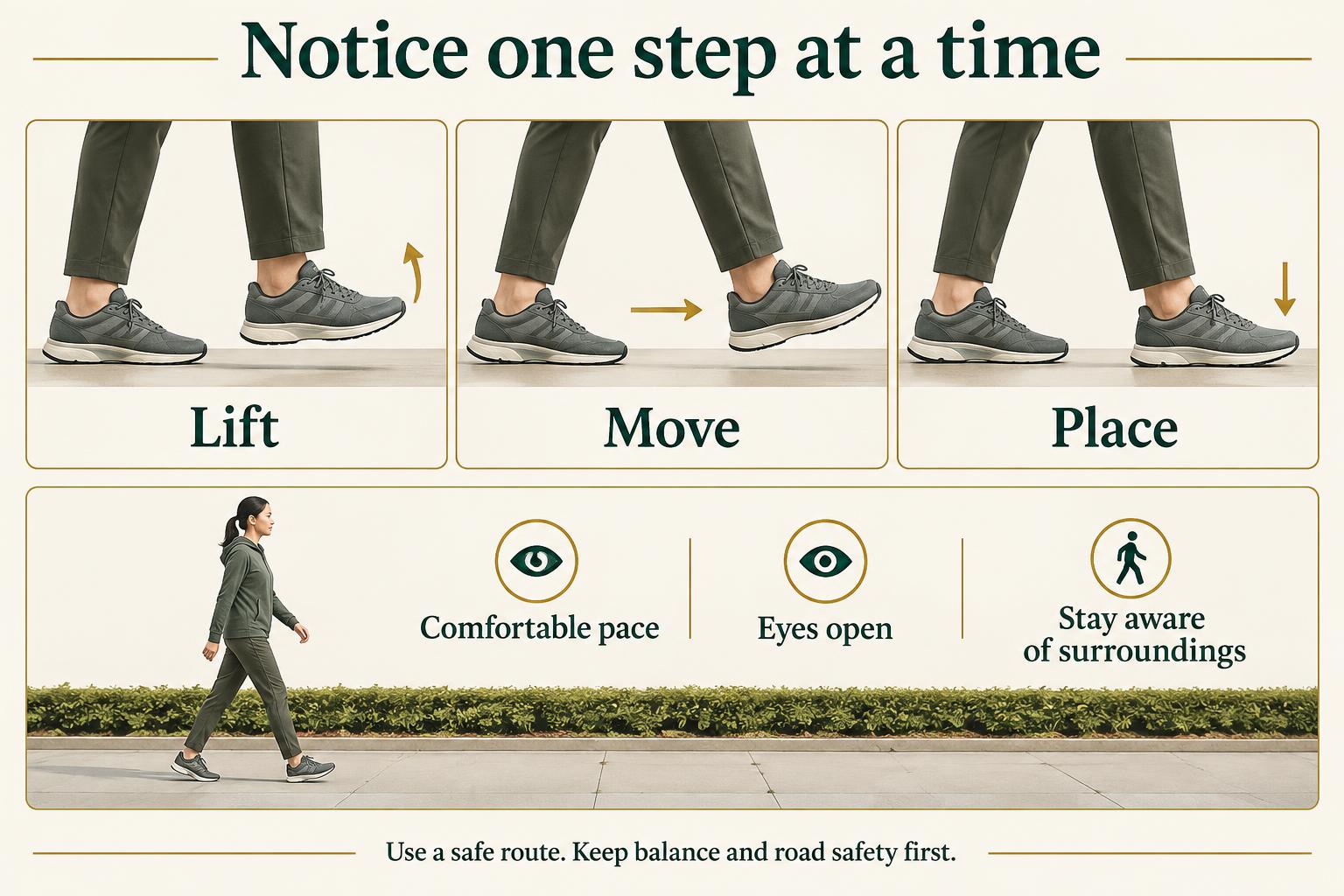
Begin standing still at one end of your path. Feel your weight on both feet, the balance of your body upright, your hands clasped in front or resting at your sides. Take one conscious breath and form a simple intention: for the next ten minutes, just walking. Now begin. Lift one foot slowly — notice the heel rising, the foot leaving the ground. Move it forward through the air — notice the leg swinging, the foot traveling. Place it down — notice heel, then sole, then toes making contact, the weight transferring. Then the other foot. Walk at roughly half your normal pace to the path's end.
At the end, stop. Stand still for a breath, feeling the body at rest. Turn slowly — turning is a notorious gap where attention vanishes, so give the turn itself full awareness: the pivot, the weight shift, the rebalancing. Then walk back. Continue this way for your full session, back and forth, unhurried. When your mind wanders — into planning, into self-consciousness, into boredom — the practice is exactly the same as in sitting: notice, and return to the sensations of the current step. The anchor moves; the meditation does not change.
Refining Attention: The Six Stages of a Step
As the basic practice settles, traditional instruction offers a way to deepen it: break each step into finer stages and attend to each. Beginners start with two stages — lifting, placing. Then three: lifting, moving, placing. With practice, six become discernible: raising the heel, lifting the foot, pushing forward, dropping, touching, and pressing down as weight transfers. Some practitioners add soft mental labels — lifting, moving, placing — the way breath meditators note in and out.
Do not rush to the fine-grained version; it emerges naturally as attention sharpens, and forcing it early produces mechanical tension rather than mindfulness. The purpose of the stages is not choreography but revelation: an action you have performed unconsciously ten thousand times a day since toddlerhood turns out to contain an entire universe of sensation, balance, and micro-adjustment. That discovery — the ordinary made vivid — is the taste of mindfulness itself, and walking serves it more directly than almost any other practice.
Common Challenges and How to Meet Them
The first challenge is self-consciousness, especially outdoors — the fear of looking strange pacing slowly. Solutions: practice indoors first, choose secluded paths, or walk at a pace just slow enough to practice but normal enough to pass unnoticed. The second challenge is impatience: the mind that finds slow walking pointless and boring. This is worth investigating rather than obeying — boredom, observed closely, is a fascinating mind state, and the urge to speed up is the very restlessness the practice trains you to master.
Third is balance wobble at slow speeds, which is normal and fades as the body adapts; widen your stance slightly and slow the turn more than the walk. Fourth is drowsiness in reverse — walking meditation is often prescribed for sleepy meditators, but if you practice tired, even walking can fog; morning light and outdoor air help. Finally, the absent turn: everyone loses awareness at the path's end. Make the turn its own mini-practice, and the most distracted moment becomes the most mindful one.
| Stage of practice | Pace | Attention | Session length |
|---|---|---|---|
| Learning | Half normal pace | Two stages: lifting, placing | 5-10 minutes |
| Settling | Half to quarter pace | Three stages, soft labels | 10-15 minutes |
| Deepening | Very slow | Six stages of each step | 15-30 minutes |
| Integrating | Any pace, incl. normal | Whole-body walking awareness | Any walk, anywhere |
Walking Meditation in Daily Life
The formal practice is the training ground; daily life is the field. Once slow walking has taught you what step-awareness feels like, begin converting ordinary walking into informal practice. Walking to the car: feel three steps fully, then let it go. Climbing the stairs at work: hand on the rail, attention in the feet, one flight in presence. The hundred daily walks between rooms, buildings, and errands stop being dead time and become a string of micro-sessions — attention training smuggled into a schedule with no room for more.
Nature supercharges the practice. A mindful walk in a park or forest adds the sounds of birds, the feeling of breeze, the smell of soil — rich anchors that make presence easy and deliver the documented calming effects of green space alongside meditation's own. Many practitioners eventually prefer a slow mindful walk to any seated session, and on days when the cushion feels impossible, a ten-minute walking meditation keeps the streak and the sanity intact. Some days, practice is simply refusing to rush from one place you are not to another you will not notice.
Combining Walking with Guided Practice
Walking and guidance combine beautifully, especially early on. Headphones and a guided session give the mind structure while the body moves — instructions in your ear pacing your attention as your feet pace the path. This pairing works particularly well for people building a daily habit, because it stacks two healthy behaviors into one time slot: the walk and the sit that is no longer a sit.
Choose guidance suited to movement — unhurried mindfulness instruction or gentle paced sessions rather than deep relaxation tracks designed for lying down. The guided sessions in The 5 Minute Meditation Paradise, with their five-minute formats and calm narration over zen music, adapt naturally to walking: one session out, one session back, and a daily practice has happened almost without noticing. However you structure it, walking meditation proves the tradition's oldest claim: meditation was never about the cushion. It is about attention — and attention walks everywhere you do.
Choose Between Formal Walking and an Everyday Mindful Walk
Formal walking meditation often uses a short, clear route and a deliberately slower pace. You move back and forth, noticing lifting, moving, and placing the foot. An everyday mindful walk uses a more ordinary pace while bringing attention to contact with the ground and the surrounding environment. Both can support intentional awareness, but the instructions are not interchangeable in every setting. Very slow stepping may be suitable in a quiet room or sheltered garden, while a public pavement requires movement that is safe and considerate. Choose the form according to the route rather than forcing a formal pace wherever you happen to be.
For a first formal session, find a level stretch with enough space to turn comfortably. Check for loose rugs, uneven ground, pets, and other obstacles. Stand with a stable base and notice weight through both feet. Begin with ordinary steps, then slow only as much as balance permits. You do not need to exaggerate the movement or hold a foot in the air. Attention can rest on the shifting pressure beneath the soles. At the end of the route, pause, turn carefully, and begin again. The turn is part of the practice, not an interruption to rush through.
For an everyday walk, keep enough attention available for crossings, vehicles, cyclists, and other people. Notice several steps, then include the wider surroundings. Do not look down continuously if that reduces awareness of hazards. Avoid isolating headphones when hearing is important for safety. Walking meditation is not an instruction to disengage from the world. It is a way to become more aware of moving through it. If the environment is too demanding for inward attention, prioritize ordinary safe walking and choose a quieter opportunity later. Practical judgment matters more than preserving a particular meditative form.
Adapt the Practice for Balance, Mobility, and Pain
A movement practice should fit your body. If slow walking makes balance less stable, use a comfortable ordinary pace and simpler attention. If you use a mobility aid, continue using it; the aid is not an obstacle to awareness. Notice contact with the handle, the rhythm of movement, or the pressure of a supported step as appropriate. If walking is painful or unsuitable, a seated movement practice may be a better option. You can notice hands opening and closing or another safe movement recommended for you. The general skill of attending does not depend on walking a prescribed number of steps.
If you are unsure what movement is safe because of a medical condition, recent injury, or fall risk, consult an appropriate professional. A general meditation guide cannot assess your gait or determine whether a particular pace is suitable. Do not treat discomfort as a spiritual challenge or force yourself to complete a route because the timer is running. Stop when needed. Support, rest, and adaptation are compatible with practice. The useful question is whether you can move with enough comfort and awareness to notice the experience, not whether you can reproduce the appearance of a teacher in a demonstration.
Footwear and surface affect what you feel. A thick sole may make contact less detailed, while barefoot walking may be unsafe on certain surfaces. Choose safety and comfort first. You do not need strong sensations to have an anchor. Even a general awareness of weight shifting can be sufficient. If attention becomes absorbed in judging the quality of each step, acknowledge judging and return to the next ordinary contact. The exercise is not a gait examination. It is a bounded practice of noticing movement and recognizing when the mind has gone elsewhere.
A Short Walking Session and a Deliberate Finish
Begin standing still for a brief interval, with eyes open and attention on the support of the ground. Walk a few steps at a comfortable pace. Notice one simple feature, such as pressure beneath the foot, rather than trying to track every joint. When you realize that you are planning or replaying a conversation, return to the next step. At a turn or stopping point, notice the change in movement. Continue for a modest interval, then stop deliberately and look around. This sequence is complete without a special route length or a perfectly quiet mind. The structure gives attention a repeated place to return.
If you want audio support, learn the instructions in a safe seated setting first. The 5 Minute Meditation Paradise may provide meditation-themed listening to explore, but do not assume that a particular passage is designed for walking without checking its description. A recording that asks you to close your eyes or focus deeply on imagery is not suitable for a route where outside awareness is necessary. You can listen before the walk and then practice without playback. This preserves the usefulness of guidance while keeping movement and environmental safety in your own attention.
Afterward, notice the transition into ordinary activity. Are you about to hurry, check your phone, or immediately begin another task? You do not need to prolong the practice, but you can choose the next action consciously. Walking meditation may feel settling, energizing, or ordinary. Those reactions vary with conditions and do not establish a guaranteed health effect. Keep the method flexible enough to fit your route and body. Its value lies in a repeatable way of noticing movement, returning after distraction, and remaining engaged with the world you are moving through.
A Practical Detail to Keep in Mind
Turns deserve the same awareness as forward steps. Slow enough to remain stable, notice the shift in weight, and turn in a way that is comfortable for your body. Do not pivot sharply just to preserve a formal pattern. If your route is public, leave space for others and stop when conditions require your full attention. The practice includes responding appropriately to the environment. You can resume the step anchor once it is safe. This is different from treating interruptions as failures. A person crossing your path is part of the situation you need to recognize, not an obstacle to a perfect session. Awareness should make walking more considerate and safe, not less engaged with the world.
Start listening today
The 5 Minute Meditation Paradise
by Stephens Hyang · narrated by Robert Gazy · 6 hrs and 1 min
The Ultimate "How to Meditate Guide" to Help You Increase Mindfulness and Reduce Anxiety Through Meditation, Guided Meditation, Chakra, and Zen Music
Frequently asked questions
How do you do walking meditation for beginners?
Find a quiet path of ten to twenty paces. Stand still and feel your feet. Then walk at half normal speed, noticing the lifting, moving, and placing of each foot. At the path's end, pause, turn slowly with full attention, and walk back. Continue for five to fifteen minutes, returning to the sensations of stepping whenever your mind wanders.
Is walking meditation as effective as sitting meditation?
Yes — it trains the identical skill of anchoring attention and returning from distraction, and research on mindful movement shows comparable benefits for stress and mood. For restless people, drowsy minds, or those in pain, walking often works better than sitting. Many practitioners use both.
Can I do walking meditation at normal speed?
Yes, once the basic skill develops. Formal practice uses slow walking to make sensations vivid; informal practice applies the same awareness at any pace — commuting, errands, hiking. Normal-speed practice is subtler, so build the foundation slowly first, then integrate it into everyday walking.
Where is the best place to do walking meditation?
Anywhere level and quiet with ten to twenty paces of clear ground: a hallway, garden path, park trail, or beach. Indoors offers privacy for beginners; nature adds calming scenery. The back-and-forth format works everywhere and removes the distraction of navigating.
How long should a walking meditation session be?
Start with five to ten minutes and extend to fifteen or twenty as the practice settles. Because walking is physically gentle and naturally alerting, sessions can comfortably run longer than seated ones — thirty to forty-five minutes is common among experienced practitioners.
Walking meditation turns something you already do ten thousand times a day into a source of calm and clarity. Try ten slow paces today — lifting, moving, placing — and feel the difference one mindful step makes. For company on the path, a five-minute guided session from The 5 Minute Meditation Paradise fits perfectly into the walk you were going to take anyway.


